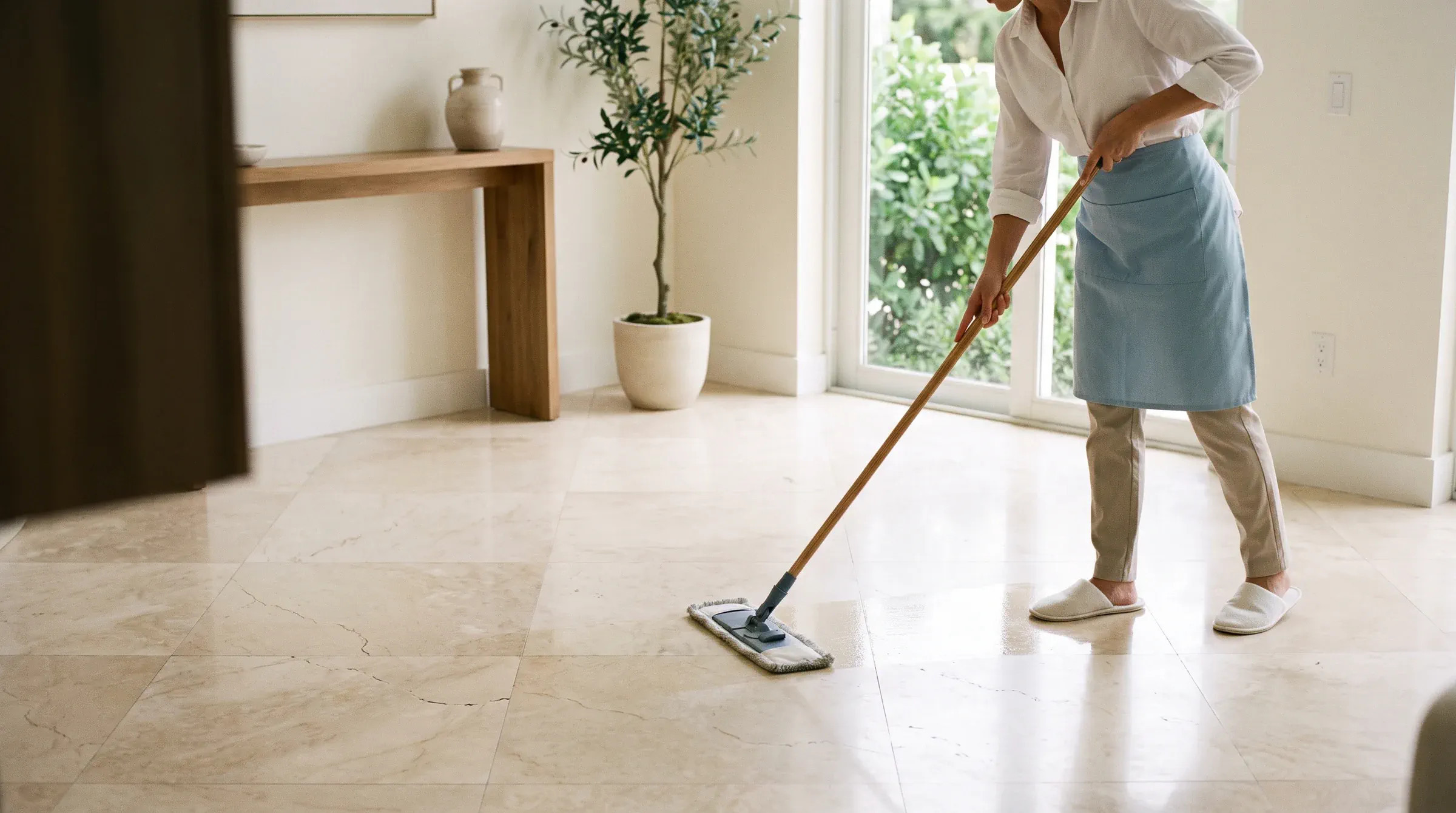
This floor maintenance guide is the starting point for every hard floor in a Tampa Bay home. It covers how to tell what your floor is made of, the habits that protect all of them, the products that quietly destroy them, and how to tell when a floor has stopped being a cleaning job and become a restoration job. When your surface needs care of its own, it sends you to the page that covers it properly.
Important
What is the short version?
Keep grit off the floor, clean with a pH neutral cleaner made for stone, and deal with spills while they're still sitting on the surface. Everything else in this floor maintenance guide is detail for a particular material.
Different floors fail in different ways, so it pays to know what you're standing on before you apply any advice. A single cleaning routine can't serve all of them equally, and most of the damage we repair starts with treating them as if it could. Most cleaning advice is written for surfaces that tolerate acid. Stone doesn't.
What Is Your Floor Actually Made Of?
This guide sorts the hard floors in a Tampa Bay home into five groups: marble and limestone, granite, travertine, Saltillo, and porcelain or ceramic tile. They differ in chemistry, in how much they absorb, and in what a bad cleaner does to them. The last column says where each one is covered in full.
| Floor | Made of | What acid does | Needs sealer | Full guide |
|---|---|---|---|---|
| Marble and limestone | Calcium based | Acid dissolves it on contact and leaves a dull etch mark | Yes | Natural stone maintenance guide |
| Granite | Silica based | Handles acid without etching | Usually, and it depends on the slab | Natural stone maintenance guide |
| Travertine | Calcium based, with natural pores that hold moisture | Etches like marble, and holds moisture longer | Yes | Travertine maintenance guide |
| Saltillo | Fired clay | Acid breaks down the sealer, and the sealer is the whole defense | Yes, the sealer is the finish | Saltillo maintenance guide |
| Porcelain and ceramic tile | Dense fired tile | The tile tolerates it, the cement grout between it does not | Not the tile. Cement grout, yes | Tile and grout cleaning |
Where a floor is tiled, the grout is its own material with its own rules, and the Tile Council of North America is the reference for it. Grout almost always looks dirty before the tile does, so clean it with a soft brush and gently enough that the tile finish doesn't come along for the ride. And if you can't tell what you have, don't guess with a product. Identifying the material first is worth more than any cleaner.
Terrazzo is the one floor the table leaves out, because it isn't a single stone at all. It's chips of stone or glass set into a binder, and Tampa Bay has a lot of it, most of it mid century. The binder decides the care: older cement based terrazzo is porous and needs sealing, while newer epoxy terrazzo isn't porous and doesn't. If the floor went in with a mid century house, assume cement. The full care sits with the natural stone guide, and stripping old coatings sits with terrazzo restoration.
What Does Routine Floor Care Look Like in Tampa Bay?
Routine care is three habits: sweep daily, mop weekly with a pH neutral cleaner, and deep clean monthly or quarterly. Sweeping matters most. Sand is an abrasive, and every day it stays on the floor it's being walked into the finish.
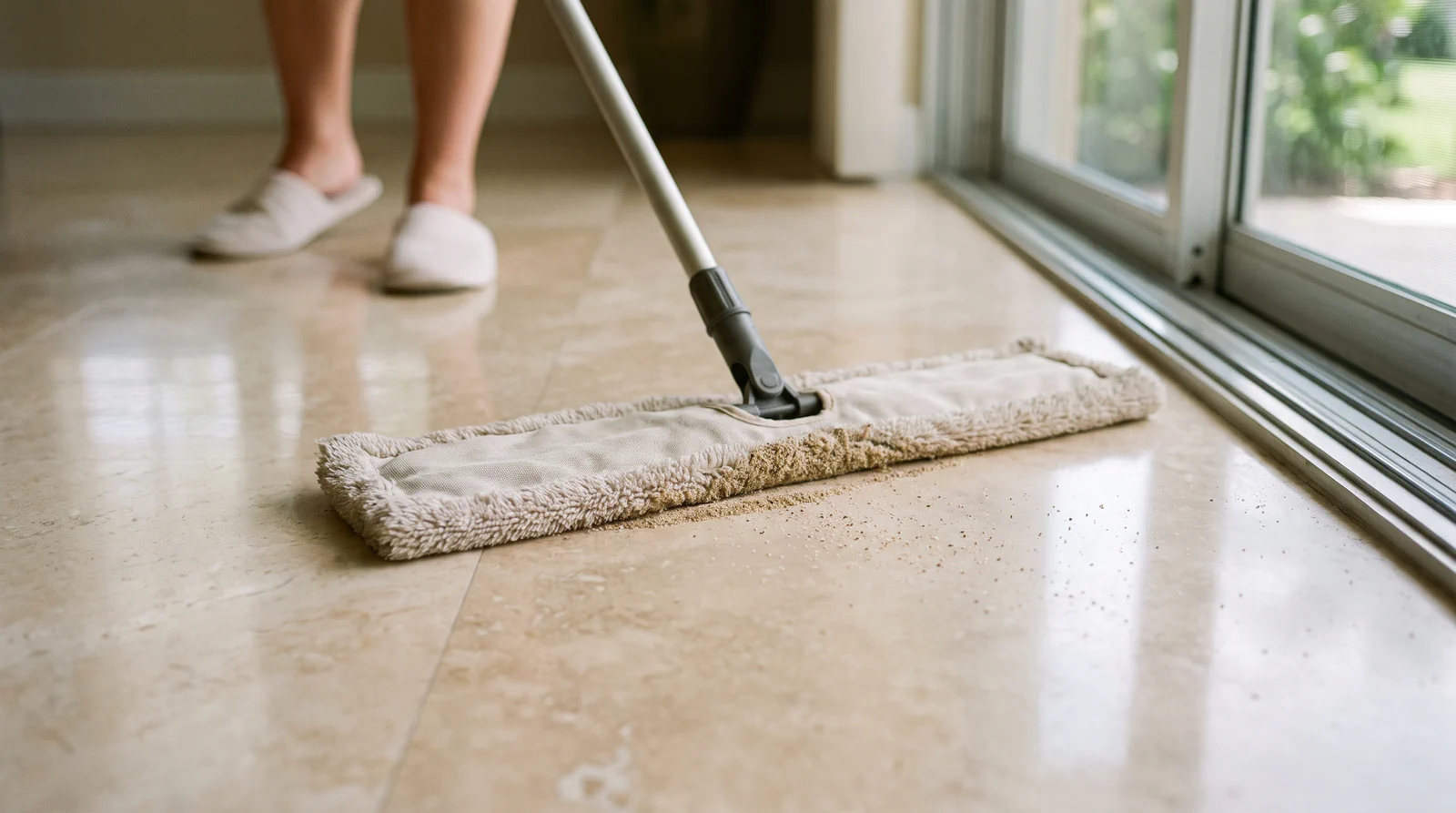
- Daily sweeping, dust mopping or vacuuming removes the grit that scratches. It's the single most valuable thing on the list, because mopping before you sweep grinds the grit into the surface.
- Weekly mopping with a pH neutral cleaner and a clean microfiber mop. Change the water when it turns grey instead of pushing dirty water around.
- Deep cleaning monthly or quarterly, depending on foot traffic and whether the house has pets or a pool door in constant use. It's the same method with more time, not a stronger product.
For a deep clean, work the floor in sections, rinse with clean water, and dry it as you go. Dry the floor after any mopping, too. In a hard water area, water left to evaporate leaves mineral spotting behind, and on stone that spotting can etch.
Spills get blotted, not wiped. Blotting lifts the liquid. Wiping spreads it across more stone and works it toward the pores, so deal with it while it's still sitting on the surface.
Which Cleaners Damage Floors, and Why?
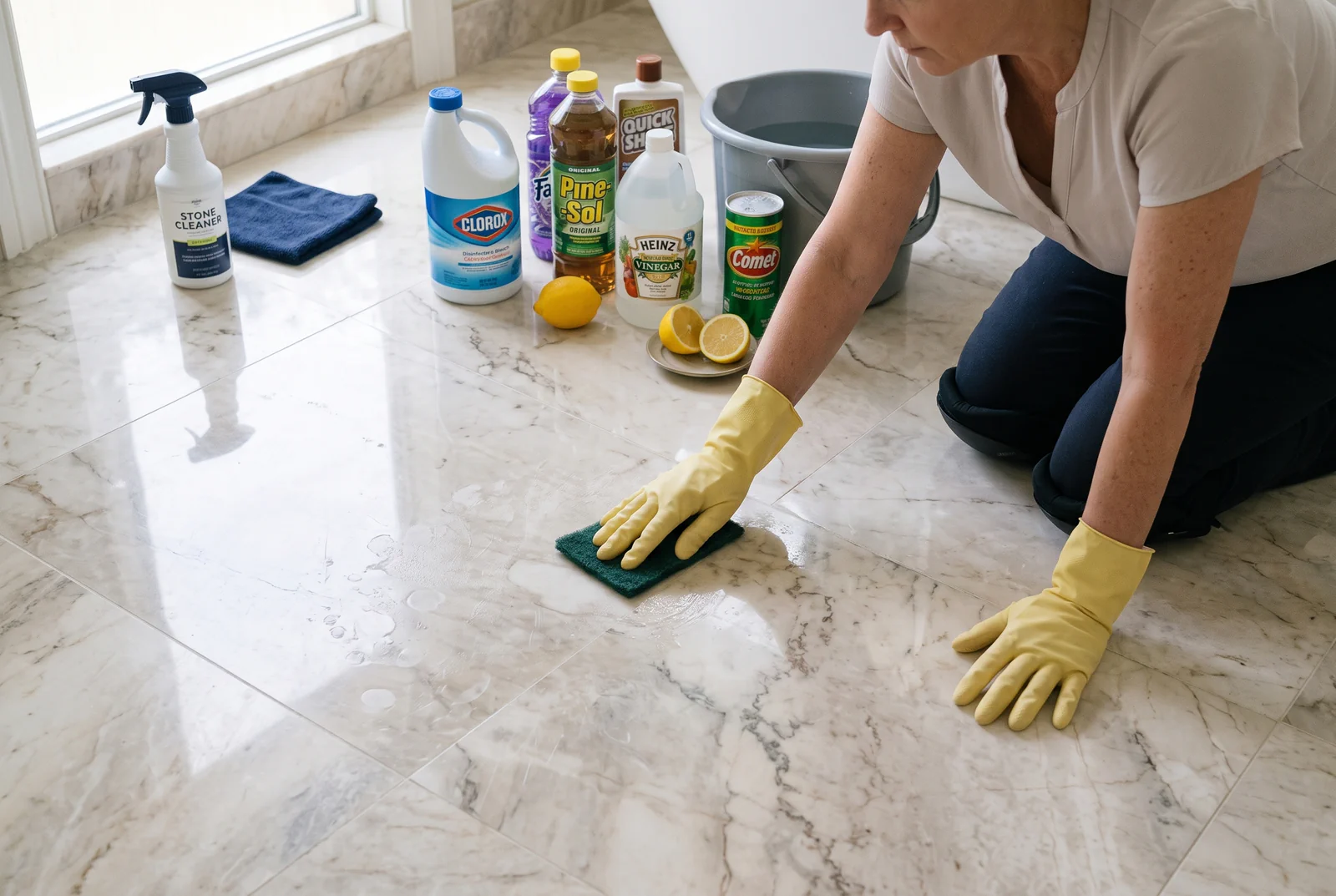
Acid is the main danger to marble, limestone and travertine, because it dissolves the calcium in the stone and leaves a dull etch mark that cleaning can't remove. Bleach strips sealer, and all purpose cleaners are made for vinyl and sealed hardwood, not stone. A pH neutral cleaner made for natural stone avoids both problems.
| Product | Verdict | Why |
|---|---|---|
| pH neutral stone cleaner | Use | It is neither acidic nor strongly alkaline, so it doesn't attack the stone or strip the sealer. It is safe on every floor in this guide. |
| Clean water and a damp microfiber mop | Use | For daily cleaning this is all that's needed. Change the water when it turns grey. |
| Vinegar or lemon juice | Avoid | Acid dissolves the calcium in marble, travertine and limestone, and it breaks down sealer on Saltillo and grout. |
| Bleach | Avoid | It strips sealer and can discolor grout and stone alike. |
| Fabuloso, Pine Sol and similar all purpose cleaners | Avoid | They're formulated for vinyl and sealed hardwood, not stone. |
| Abrasive powders, scouring pads, stiff brushes | Avoid | They leave fine scratches that dull the finish for good. |
| Wax and acrylic shine products | Avoid | They build a film that yellows and has to be stripped off before the floor can be restored. |
Look for a cleaner that says pH neutral and safe for natural stone, and follow its label for dilution. That's the line the Natural Stone Institute draws too. Be wary of a label that says safe for all floors: it's usually written with vinyl and sealed hardwood in mind, and it isn't a promise about stone. If a product isn't on the list above, ask before it goes on the floor. (813) 625-3377 reaches us for any floor not covered here.
Important
Why does this guide contradict most of the advice online?
Most floor cleaning advice on the internet is written for vinyl, laminate and sealed hardwood, which tolerate acids and strong detergents. Natural stone doesn't. A recipe that's genuinely fine on a kitchen vinyl floor will etch a marble one in the same afternoon, which is why the material has to be identified before any advice is applied to it.
Where Does the Damage Actually Come From in Your House?
Most of the grit that scratches a floor comes in through the doors. Sand and moisture arrive on shoes and paws, and in Tampa Bay the pool door and the garage door carry the most. Kitchens and bathrooms add their own kinds of damage.
The pool and garage doors. Sand and moisture come through these two more than any other opening, and floors near a pool or a beach door need checking more often than the rest of the house. The kitchen. This is where acid and grease arrive: citrus, wine, coffee and cooking oil. On calcium based stone, citrus, wine and coffee all etch the surface. The bathrooms. Hard water leaves mineral deposits where it evaporates, in showers and around sinks, and those deposits can etch into the surface if nothing is done about them.
Humidity runs through all of it, and it's the reason porous floors near a pool or a beach door deserve a water test more often than the rest of the house.
How Do You Protect a Floor Before It Is Damaged?
Mats at every entrance, felt pads under furniture, and sealer that's renewed before it fails protect a floor better than any cleaner you can buy. They cost little next to restoring a surface once it has been scratched, etched or stained.
- Place mats at every entrance to catch sand and moisture before they reach the floor. In Tampa Bay, the pool door and the garage door are the two that matter most.
- Use felt pads under furniture legs so chairs and tables don't scratch the surface every time they move.
- Keep harsh chemicals and abrasive tools off the floor entirely, whatever the label promises.
- Reseal porous surfaces on schedule rather than waiting for a stain to prove the sealer has gone.
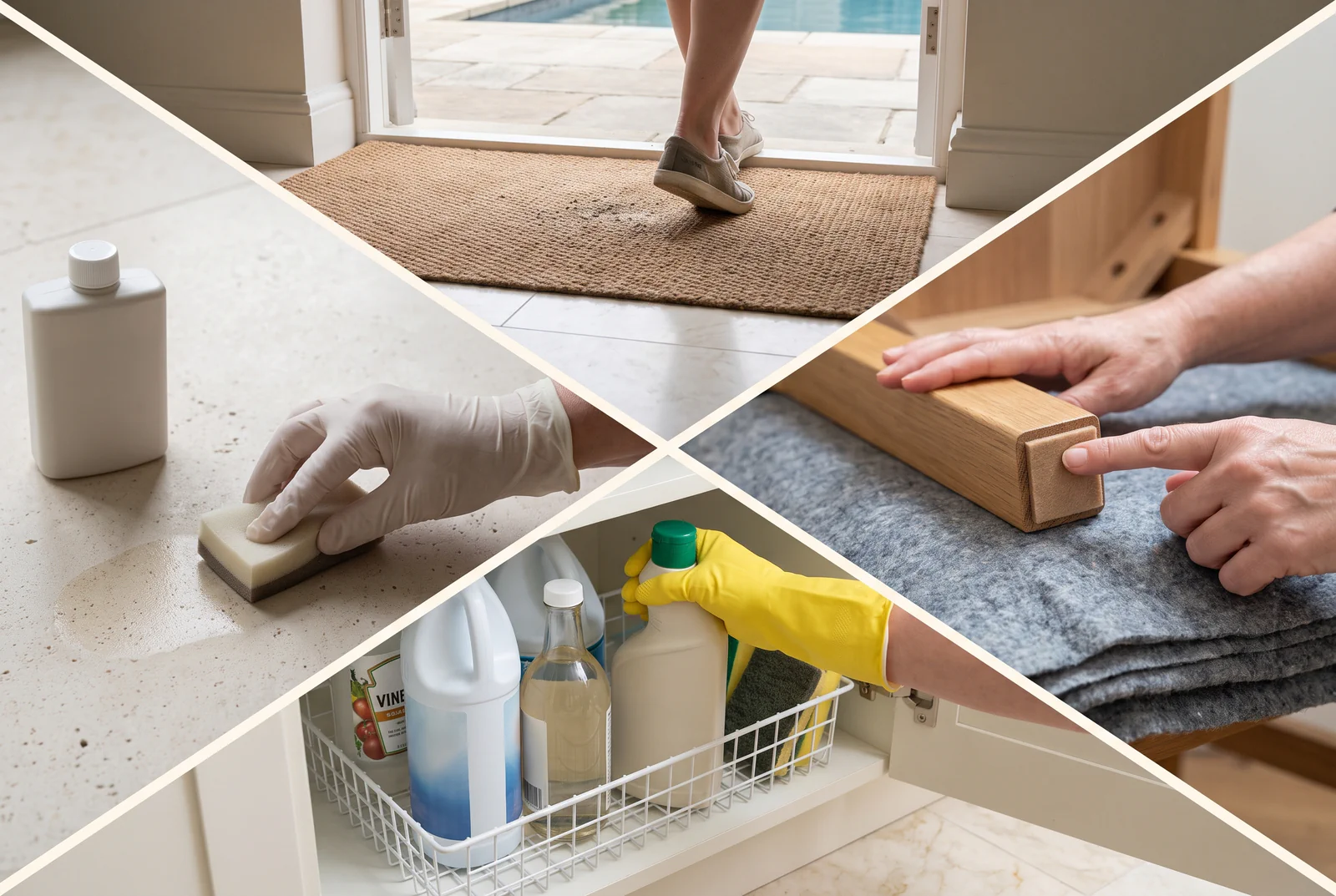
A penetrating sealer works by making spills sit on top of the stone instead of soaking in, which gives you time to blot them. How often each surface needs it is covered on the stone sealing page.
Is It Dirt, Damaged Sealer or Damaged Stone?
If a floor still looks dull right after it has been cleaned and dried, the problem isn't dirt. It's usually worn sealer, etch damage or fine scratching, and a mop won't fix any of them. Four quick checks tell you which one you have.
- Look at it once it's dry. A floor that's dull straight after cleaning has a surface problem, not a dirt problem.
- Drop water on an out of the way spot. If the spot darkens within a few minutes, the sealer has worn through and it's time to reseal.
- Look for rings and hazy patches where something acidic once sat. Those are etch marks. The polish has been dissolved away, and no cleaner will bring it back.
- Check for a film. A coating that's peeling, cloudy or yellowing has to come off before anything underneath can be judged.
| What you see | What it usually is | What it needs |
|---|---|---|
| Dull, but it comes back after a proper clean | Dirt on a sound surface | Cleaning, and sealing if the water test fails |
| Scratches, etch marks or traffic wear | Damage to the surface of the material | The damaged layer cut away with diamond abrasives. That's restoration, not cleaning |
| A peeling, cloudy or yellowing coating | A failing topical coating | The coating stripped first, then the floor judged underneath |
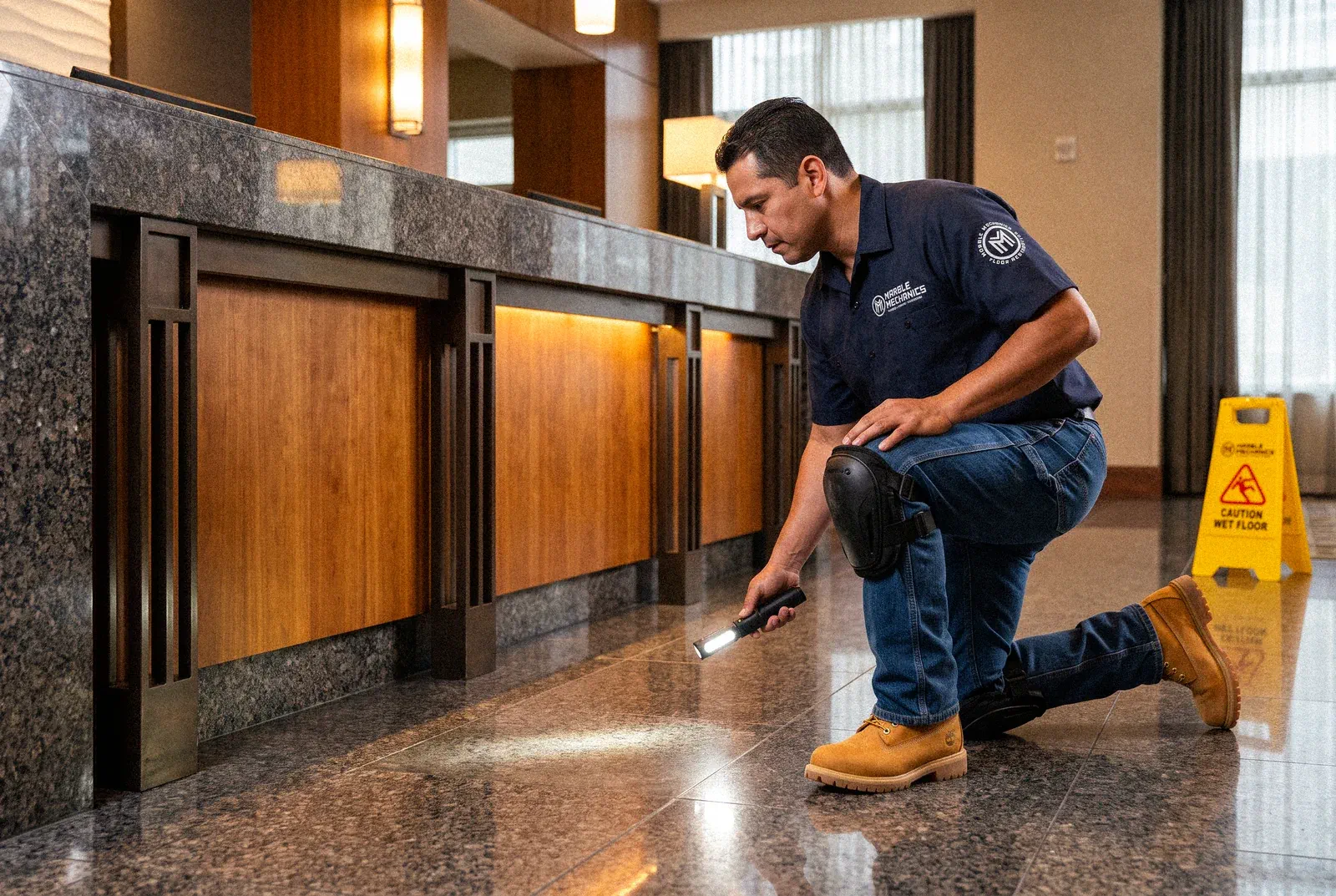
The three causes look alike from standing height, which is why guessing so often ends in the wrong product. One more distinction helps: an etch mark is not a stain and not dirt. It's a small area where the polished surface has been chemically eaten away. A stain is something that has soaked into the stone instead, and on granite a stain inside the material is the harder problem of the two. Working out which one you have is what a free assessment is for.
What Should You Keep in the House for Floor Care?
Every routine in this floor maintenance guide runs on a short kit: a pH neutral stone cleaner, a clean microfiber mop, soft cloths, felt pads and a mat for every door. Nothing on that list is expensive, and keeping it short means nobody reaches for the wrong bottle.
- A pH neutral cleaner made for natural stone, used as its label directs.
- A microfiber mop and clean cloths.
- A soft brush for grout lines.
- Felt pads for every chair and table leg.
- A mat at every entrance, starting with the pool and garage doors.
If someone else cleans your floors, hand them the same list. Many all purpose cleaning products are slightly alkaline or acidic: not enough to cause visible damage in a single use, but enough to wear the sealer down a little with every visit.
When Is It Time to Call a Professional?
Call a professional when cleaning no longer changes how the floor looks. Deep seated stains, etch damage, worn or failed sealer, cracked grout and dull patches that survive a proper clean all sit outside what home remedies can reach, and catching them early keeps a small problem small.
Cleaning removes what's sitting on top of the floor. Restoration repairs the surface of the material itself. Oscar Tineo has spent 27+ years restoring stone and tile floors across Tampa, St. Petersburg and the surrounding communities, and a large share of that work is repairing the results of well intentioned cleaning.
If you'd rather not diagnose it yourself, that's what a free assessment is for. It happens in person, because the stone has to be seen before it can be quoted. The material gets identified, its condition gets explained, and the quote covers only the work it actually needs. Marble Mechanics will tell you what the floor needs, including when the honest answer is that it needs nothing.
Find the Guide for Your Surface
This floor maintenance guide covers what every hard floor has in common. Each surface has its own page with care specific to the material, and that is where to go next once you know what your floor is made of.
- Granite, marble, limestone and terrazzo, for what each one needs day to day.
- Travertine, for filling, sealing and pool deck care.
- Saltillo tile, for the cleaning routine and the sealer it depends on.
- Stone countertops, for kitchen and bathroom surfaces.
- Tile and grout, for grout that has darkened or started to crumble.
- Sealing, for how often each surface needs it.
- Cleaner myths, for the products that cause the damage in the first place.
- Marble, for etch marks, dull patches and polishing.
- Terrazzo, for mid century floors under old coatings.