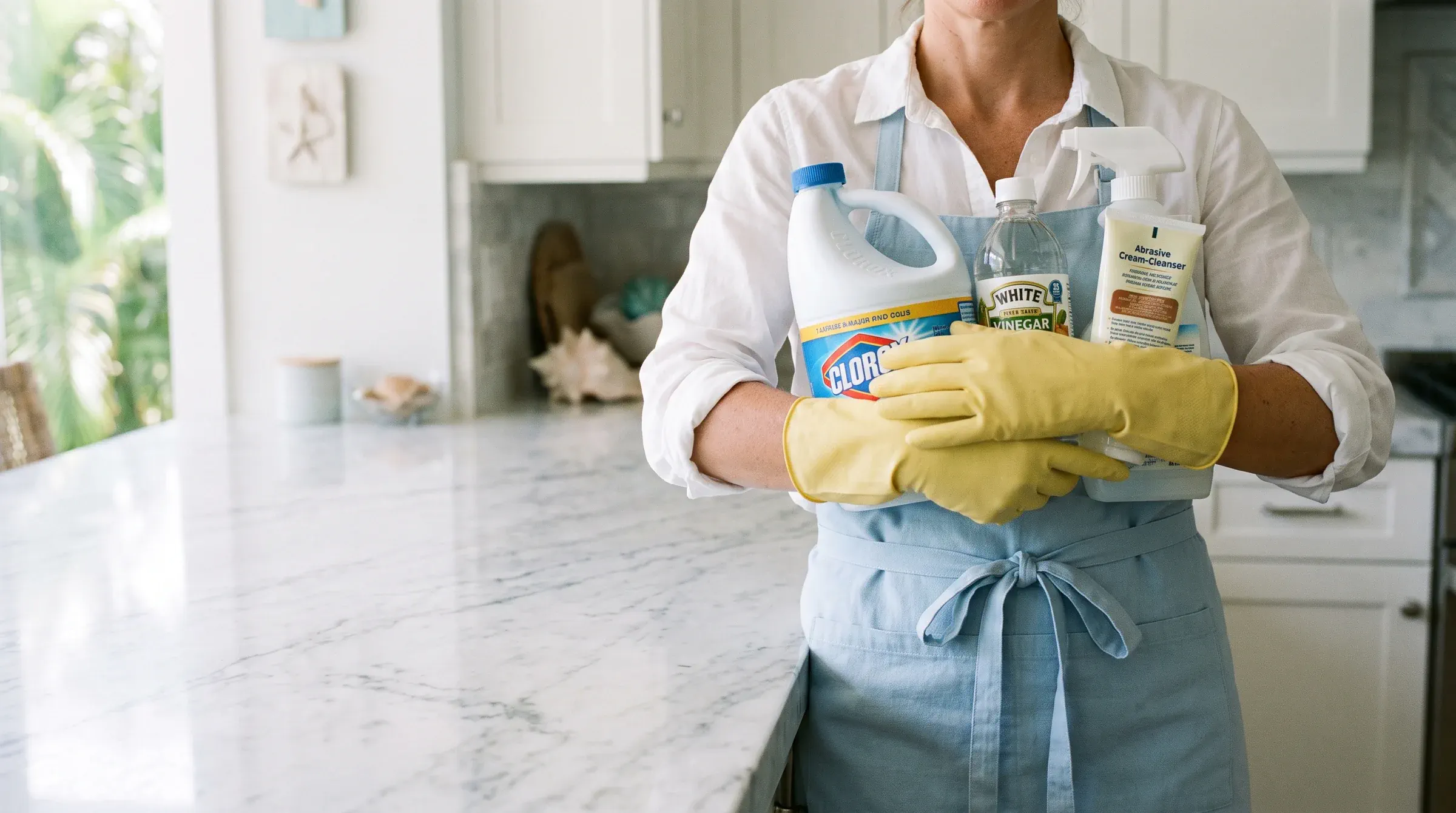
This natural stone maintenance guide is written for Tampa homes, and it starts with the thing most stone care advice online gets wrong: it treats natural stone as one material. It is not. Granite is silica based and shrugs off acid. Marble and limestone are calcium based and react to it. Terrazzo is not really stone at all. Put the same routine on all of them and three out of four will be wrong in some way that costs money later.
This guide goes material by material. Every section assumes a Tampa Bay home, because the climate here changes the intervals and, in a few cases, changes the advice.
Why Florida Conditions Change the Rules
Living in Tampa Bay means your stone faces things homeowners in drier climates never deal with.
Humidity. Tampa's average relative humidity hovers around 74%. That constant moisture means stone absorbs and releases water regularly, which leads to efflorescence, spalling, and accelerated wear on polished surfaces. Indoor stone in homes without consistent climate control is especially vulnerable.
Salt air. Properties closer to the coast, in areas like Davis Islands, Harbour Island, Beach Park and Bayshore, take salt laden air off the bay. Salt accelerates surface deterioration and can darken lighter stone over time.
Hard water. Tampa's municipal water carries high levels of dissolved minerals. Where that water evaporates, in showers and around sinks, it leaves deposits that etch into the surface. Over months and years those deposits become permanent if nothing is done about them.
Citrus. Florida kitchens see more citrus than most. Fresh squeezed orange juice, key lime, grapefruit. On any calcium based stone that is the fastest route to an etch mark there is.
The Routine Every Stone Shares
Before the differences, the part that does not change. Every hard floor in the house wants the same three habits, and they matter more than anything else on this page.
- Dry first. Sweep, dust mop or vacuum before any water touches the floor. Sand is an abrasive, and mopping without sweeping grinds it into the surface.
- Damp mop, not wet. A pH neutral stone cleaner and a clean microfiber mop. Change the water when it turns grey rather than pushing dirty water around.
- Dry after. Do not let water air dry on stone in a hard water area. That is where the mineral spotting comes from.
Spills get blotted, not wiped. Wiping spreads a spill wider and works it into the pores.
Granite
Granite is the low maintenance one. It is silica based rather than calcareous, which means lemon juice, wine and vinegar do not etch it the way they etch marble. That is why it ends up in so many Florida kitchens.
What granite does need is sealing. It is porous enough that oil and pigment will work into the stone if the sealer has worn through, and a granite stain is a harder problem than a granite etch, because it is inside the material rather than on it. Outdoor granite has a second issue: UV fades the color and salt air roughens the surface, so outdoor kitchens run on a shorter cycle than anything indoors.
Sealing is routine maintenance rather than an upgrade, which is how the Natural Stone Institute treats it across every stone in this guide. For tiled installations the Tile Council of North America covers the grout alongside it, and on most floors the grout gives out before the stone does.
When granite does go wrong, restoration is almost always the answer rather than replacement. Read granite restoration for the detail on stain extraction, chip repair and refinishing.
Marble
Marble is the opposite case. It is calcium carbonate, so acid dissolves it on contact. An etch mark is not a stain and not dirt: it is a small area where the polished surface has been chemically eaten away, and it will not clean off no matter what you use.
That makes marble care mostly a matter of what never reaches it. Citrus, wine, coffee, vinegar and toilet bowl cleaner all etch, and in a Tampa shower hard water will do it slowly on its own. Seal it, blot spills immediately, and keep acidic products off it entirely.
For residential marble floors in moderate traffic, professional polishing every 2 to 3 years keeps the finish ahead of the wear. Marble polishing and restoration covers honing, polishing and etch removal in full.
Limestone
Limestone is calcareous like marble but softer and generally more porous, which means it does everything marble does and does it faster. It etches from the same acids, it absorbs more readily, and it scratches more easily underfoot.
In practice that means limestone is the stone where sealing matters most and where grit control matters most. Doormats and regular sweeping do more for a limestone floor than any product does. Many limestone floors are honed rather than polished, which is sensible: a matte finish hides the small scratches that a soft stone inevitably collects.
Terrazzo
Terrazzo is not a stone, it is a composite: chips of stone or glass set into a binder. Tampa Bay has a lot of it, most of it mid century, and the binder is what decides the care.
Older installations are cement based. Cement is porous, so that terrazzo needs sealing and behaves much like a calcareous stone. Newer installations are epoxy based, which is not porous and does not need sealing at all. If you seal an epoxy floor you get a film sitting on top of it rather than protection in it. Age is usually the tell: if the floor went in with the house and the house is mid century, assume cement.
Travertine
Travertine is calcareous like marble, with the added complication of natural voids that trap moisture and open up as the fill wears out. It is the most common stone on Tampa Bay pool decks, which is also the harshest place to put it.
It has enough going on to deserve its own guide, so this one hands off: the travertine maintenance guide covers filling, honing, sealing and pool deck care properly.
Common question
How do I know when the sealer has gone?
Put a few drops of water on the surface and watch. If the stone darkens within a few minutes, the sealer has worn through and it is time to reseal. If the water still beads after fifteen minutes, leave it alone. This test is worth more than any interval printed on a bottle, because it measures your floor rather than an average one.
Marble vs Travertine: Which One Do You Have?
They are close relatives and people mix them up constantly, which matters because the care is not identical. Both are calcareous, so both react to acid and both etch: citrus, wine, vinegar and hard water will mark either one, and no cleaner will take an etch back off. Everything in this guide about keeping acid away from marble applies to travertine too.
The difference is the holes. Travertine forms with natural voids running through it, and those are filled at the factory so the surface arrives smooth. Marble has no voids to fill. As travertine ages the fill works loose, the voids reopen, and they start collecting grit and moisture. That is the failure mode marble simply does not have, and it is why travertine needs filling as well as honing while marble needs honing and polishing alone.
Telling them apart at home: look at the surface in raked light. Travertine shows small pits or filled spots scattered through the stone, often in bands. Marble shows veining but an unbroken surface. If you can feel a slight texture underfoot on a floor that used to be smooth, that is travertine with fill starting to go, not marble wearing out.
In practice that splits the maintenance. How to maintain marble floors is a question about the finish: sweep the grit off, keep acid away, and have them polished every 2 to 3 years so the surface stays ahead of the wear. Travertine adds the fill to that list, and outdoors on a pool deck it moves to the top of it. Full detail for each is in marble polishing and restoration and the travertine maintenance guide.
How Often Each Surface Needs Sealing
There is no single number, and anyone who gives you one is guessing. What determines it is the material, the traffic, and how much water and sun the surface takes. What is true in Tampa Bay is that the intervals run shorter than the label suggests, and that anything near a pool door, a beach door or a west facing window runs shorter still.
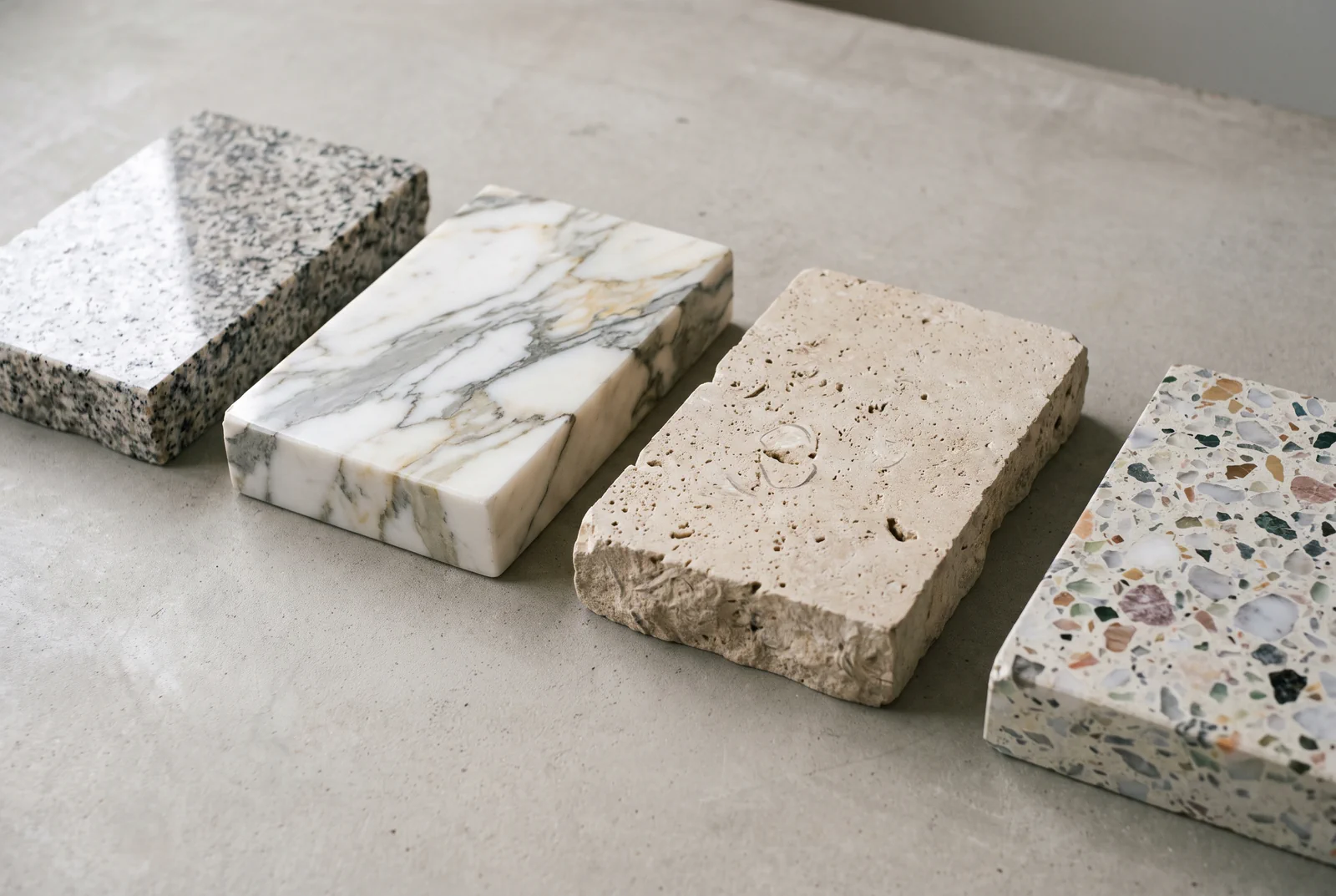
- Granite: porous but dense. Test annually, reseal when the water test says so.
- Marble: seal it, and remember that sealing prevents staining, not etching. Nothing prevents etching except keeping acid off it.
- Limestone: the most porous of the four. Test more often than the others.
- Terrazzo: cement based needs sealing, epoxy based does not. Identify the binder first.
- Travertine: see the travertine guide, and check the fill as well as the sealer.
Professional stone sealing covers what goes on each surface and how it is applied.
When Maintenance Is Not Enough
There is a clean line between a cleaning problem and a restoration problem, and it takes one second to check. Dry the surface and look at it. If the stone is dull the moment it is dry, the problem is not dirt. The finish itself has been etched, scratched or worn through, and no routine will bring it back.
At that point the surface needs honing or polishing: the damaged layer comes off with progressive diamond abrasives and the stone underneath is the finish. It removes very little material, which is why a stone floor can be refinished many times across a life measured in decades, and why restoration costs a fraction of replacement.
If you are not sure which side of that line your floor is on, that is what a free assessment is for. Marble Mechanics will tell you what the floor actually needs, in person, including when the honest answer is that it needs nothing.