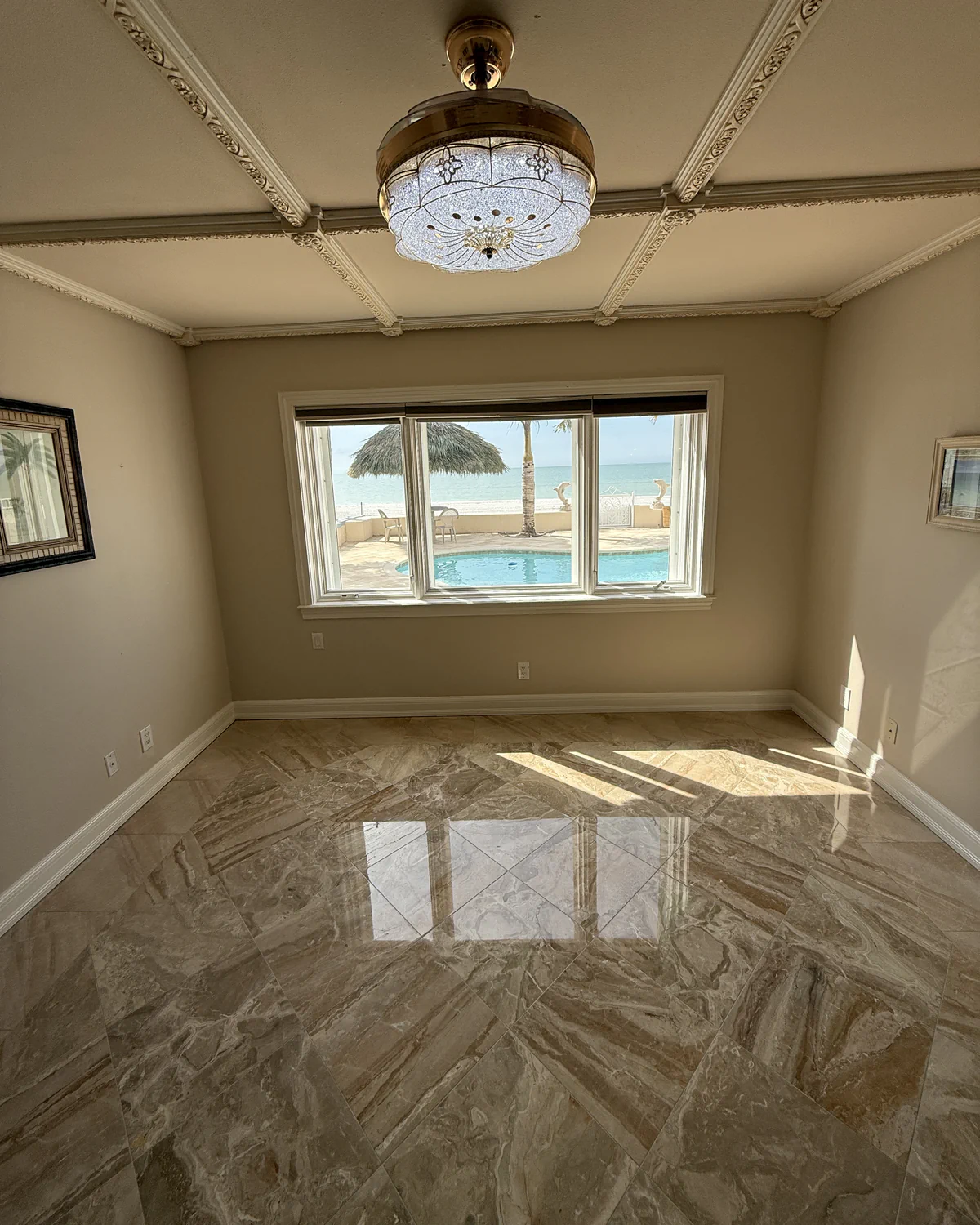
The neighborhoods that have it were laid out in the early twentieth century or built later on dredged fill, so the marble, travertine and Saltillo here have had the better part of a century to collect whatever successive owners decided to put on them. The stone is rarely the problem. What is sitting on top of it usually is. It has to come off before anyone can honestly say what condition the floor underneath is in, and that is the first rule in a city with old housing stock: nothing can be judged until the coating is off. Every stone restoration St Petersburg project Marble Mechanics takes on starts there.
Marble Mechanics works across St Petersburg: Old Northeast, Snell Isle, Venetian Isles
and the surrounding Pinellas County communities. Oscar Tineo does the work personally.
Call 813-625-3377 for a free estimate, or read on to see
what stone in this part of the county is actually up against.
Stone Restoration, Before and After
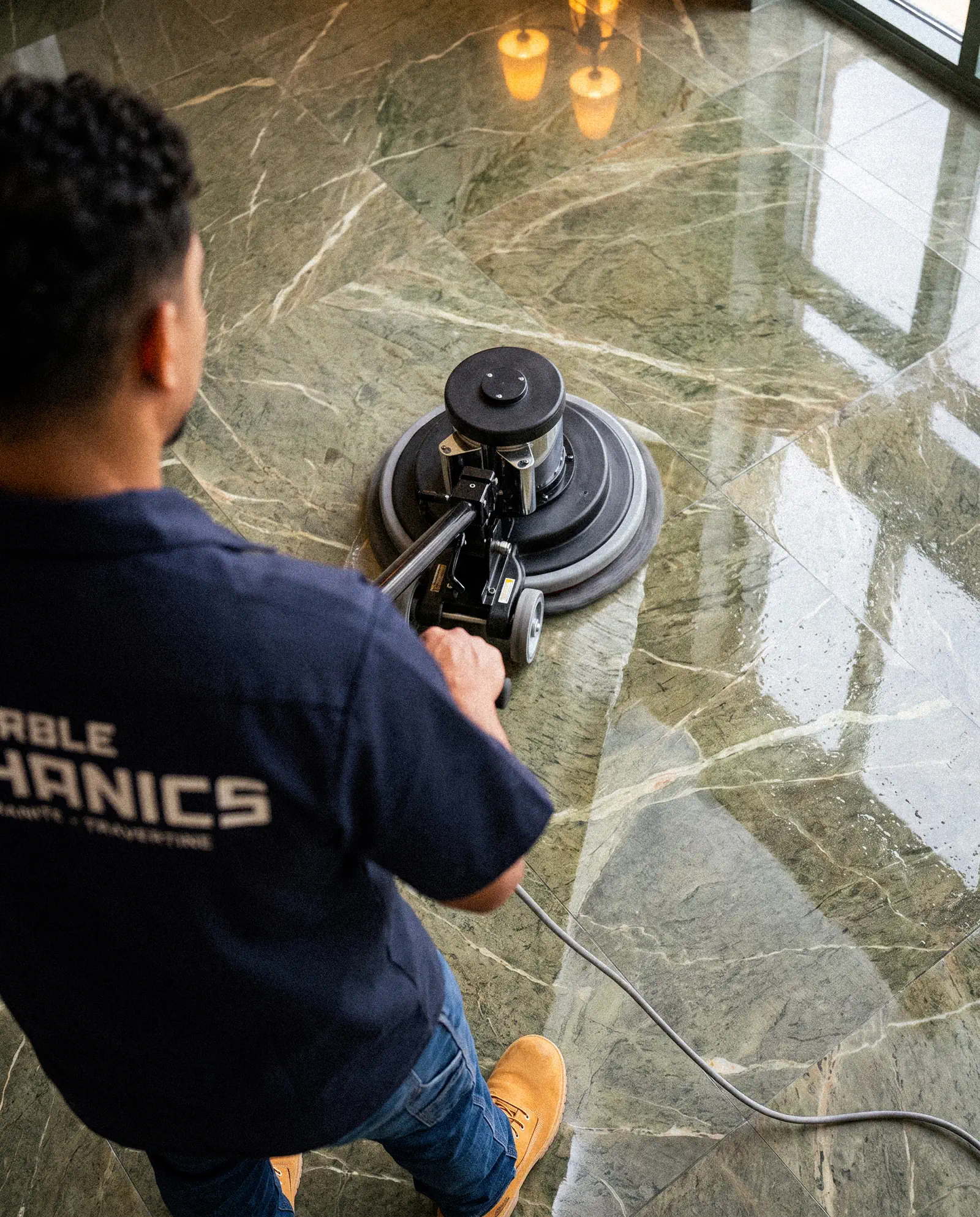
Restoration removes the damaged surface layer and rebuilds the finish on the stone you already own.
Hover 02, 03 and 04 to open them.Swipe from the before to the after.
Before
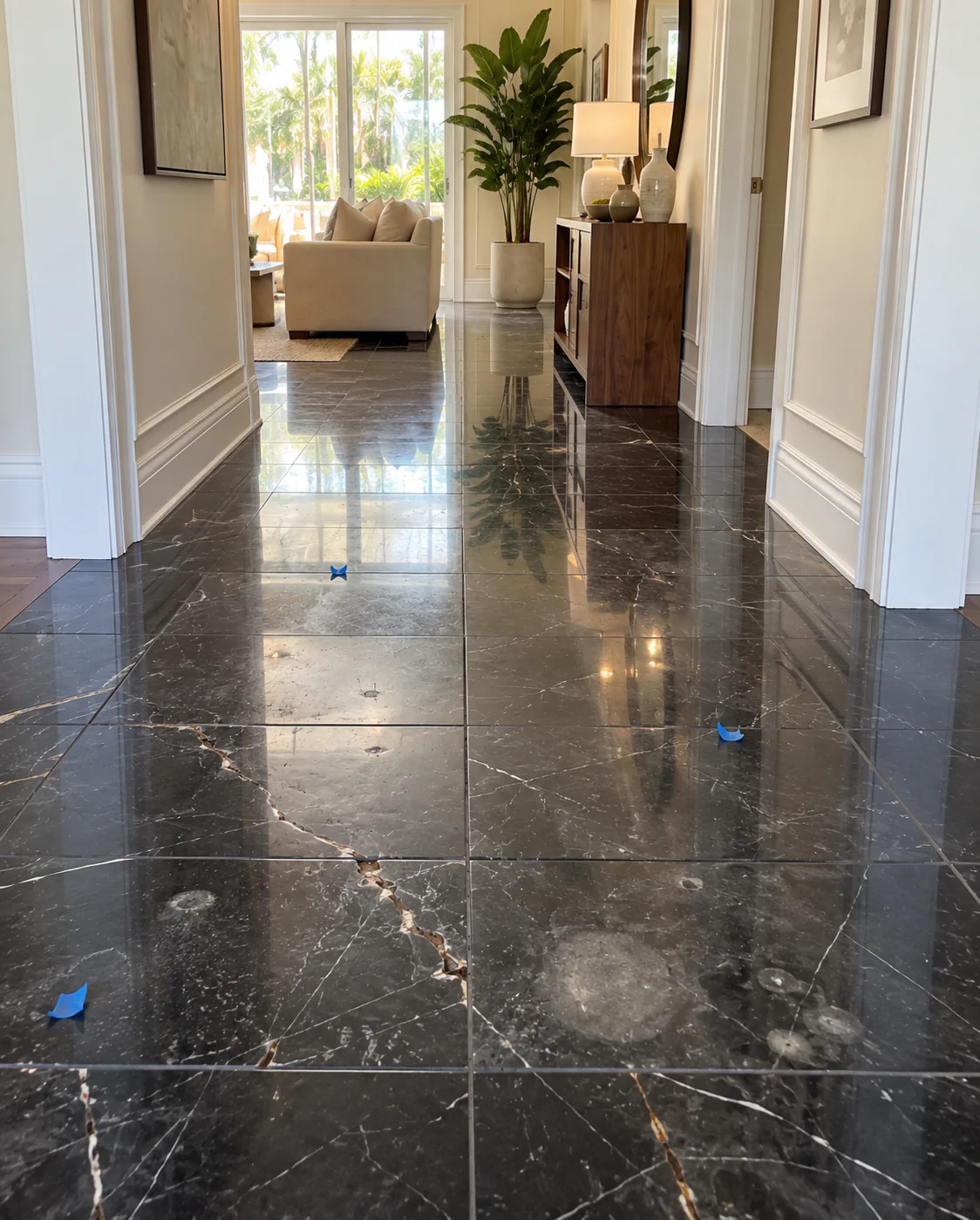
The assessment. Every defect flagged and agreed with the owner before a machine touches the floor.
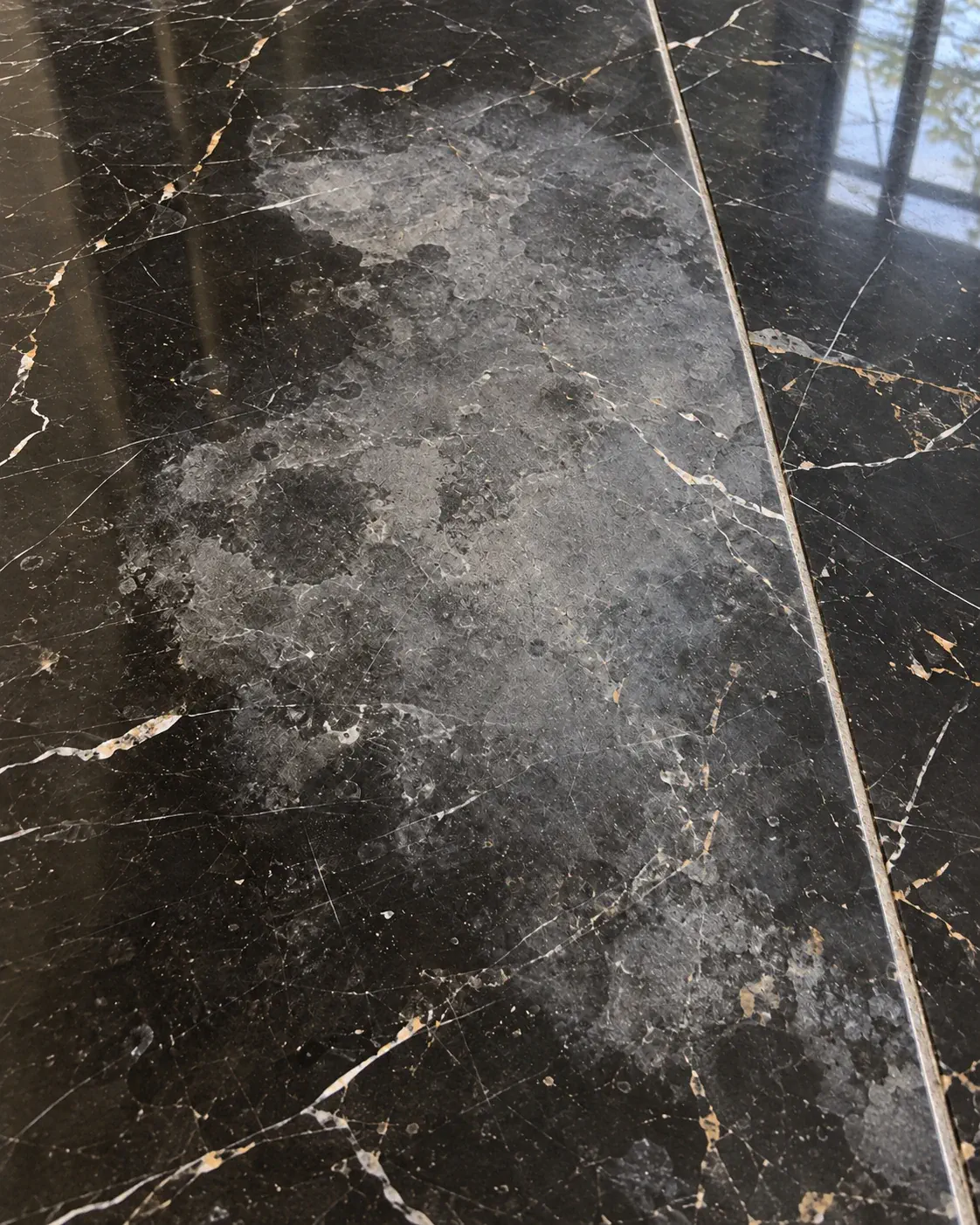
Acid burn. The polish is gone in blotches, so cleaning will never bring this back.
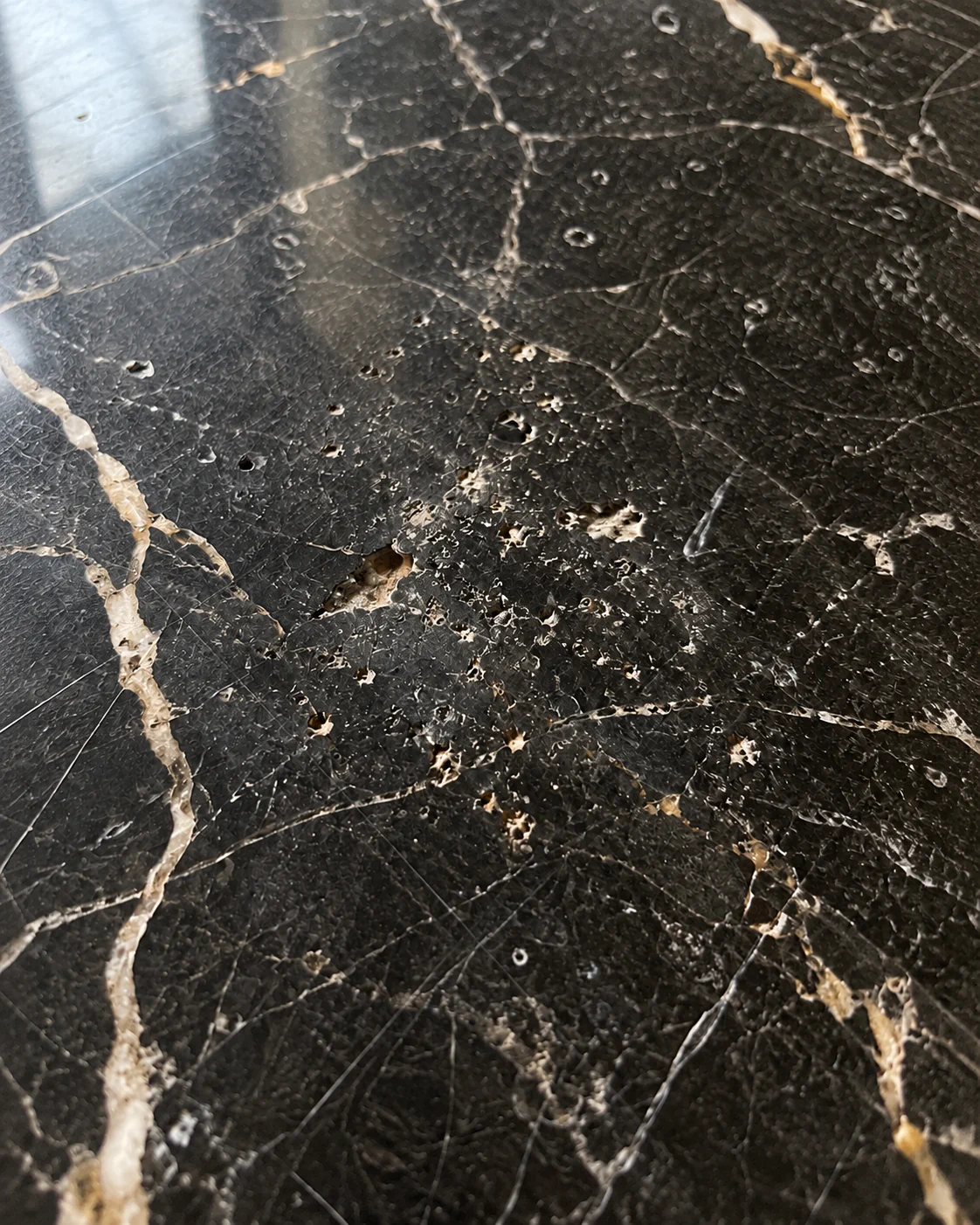
Pitting and scratches, with the softer material broken out along the veining.
After
The crack filled and color matched, the etching cut away, the floor reflecting the room again.
Old Northeast
St Petersburg's historic waterfront district of Colonial Revival, Mediterranean and Contemporary homes on brick-lined streets, most of them early 20th century, priced between $1M and $3M.
The stone is original and has had a century of owners. What comes up is layers: wax, acrylic shine products and topical coatings applied one over another, yellowing and trapping dirt between them. None of that is stone and none of it can be polished. It has to be stripped before the floor can even be assessed, and once it is, the marble underneath is usually in far better condition than anyone expected. What looks like ruined stone in a house this age is nearly always a finish problem, not a stone problem.
Snell Isle
Waterfront luxury with a $1.62M median listing, mostly Florida Mediterranean and ranch, with private water access and the highest concentration of custom stone in the city.
Constant waterfront exposure with a sealer doing more work than it would inland. Salt in the air accelerates surface deterioration and can darken lighter marble, while hard water evaporating around sinks, showers and pool entrances leaves mineral deposits that etch in and become permanent if they are left. Sealer here is worth testing rather than scheduling, because it stops beading sooner than the calendar suggests, and a penetrating sealer chosen for this exposure is not the same choice as one for an inland house.
Hover 02 and 03 to open them.Swipe to see the rest.
Venetian Isles
Man-made islands of Mediterranean-style and contemporary homes with private docks, ranging from $500K to over $3M.
Wet feet and dock traffic, all year. Stone near a pool or a dock entrance takes chlorinated or brackish water plus tracked-in grit, and grit is an abrasive that does its damage underfoot in the first few feet of floor before anyone notices. Travertine takes this worst: its fill lifts out under repeated wetting, the voids reopen and catch more grit and water, and the process accelerates from there.
Travertine Polishing in St Petersburg
If you searched for stone restoration St Petersburg and landed here with a travertine floor, this section is yours. Travertine is not marble and does not respond to a marble process. It is calcium carbonate, the same family as marble and limestone, and two facts about it explain nearly every travertine problem Marble Mechanics is called out to in Pinellas County.
It reacts to acid. Anything acidic leaves a dull, etched mark where the surface has been chemically dissolved: wine, coffee, citrus, tomato, vinegar and most household and bathroom cleaners all do it. An etch is not a stain and no amount of cleaning will remove it. And it formed with holes in it. On a finished floor those natural pits and voids are filled and honed flush so the surface reads as solid, and that fill is a wear item. Around a pool entrance or a dock door on Venetian Isles, repeated wetting breaks the fill down, the voids reopen, they catch grit and water, and the damage accelerates.
Restoration refills the open voids with color-matched material, grinds it flush, and hones the whole floor as one surface. Whether the finish then goes on to a polish is a decision rather than a degree of done. Honing stops at a mid grit and gives a smooth matte surface that hides later marks; polishing continues through finer abrasives to a reflective one. Both are equally durable and both are sealed the same way. On a lanai or a pool deck the finish is honed or tumbled for grip when wet, never polished to a gloss.
The sealer at the end is an impregnating sealer recommended by the Natural Stone Institute rather than a topical coating, so the travertine still looks and feels like natural stone. The full sequence, including showers, countertops and pool decks, is on the travertine polishing page for Tampa Bay; this page covers what is different about the floors on St Petersburg's islands.
Common question
Why has my travertine gone rough underfoot?
A floor that has gone rough, with small holes appearing across it, is telling you the fill has broken down, not that the stone has failed. Refilling uses color-matched material ground flush with the surrounding stone and then honed as one surface. Left long enough, the edges of the open voids begin to spall, and what was a refill becomes a resurfacing job. The earlier it is caught, the smaller the work.
Saltillo Tile Cleaning in St Petersburg
Saltillo is handmade clay tile, softer and more porous than marble, travertine or granite, and that makes it the opposite of the stones above. With marble the stone itself is restored. With Saltillo the sealer is the wear surface, the only thing standing between the clay and everything spilled, dropped or dragged across it, so the job is stripping a failed finish and putting a fresh one down. In a pre-war Old Northeast house there are often many coats built up over the decades, each applied over the last, and stripping is most of the work.
Day to day, Saltillo tile cleaning in St Petersburg mostly means keeping things off the floor rather than putting things on it. Wax, shine sprays and store-bought coatings trap dirt, build up unevenly and make a later restoration harder than it needed to be. Sand and grit tracked in from the beach are the biggest single cause of a dull Saltillo finish, because they grind the sealer down underfoot. Between professional visits the floor wants a pH-neutral cleaner labeled safe for sealed tile or stone, a damp microfiber mop rather than a wet one, and drying afterwards. No vinegar, no bleach, no steam and no heat: acid dulls the finish and heat softens it.
How to make Saltillo look new again, in the order Marble Mechanics does it:
Read the finish. Dry or patchy areas, dull traffic lanes, grout that stays dirty after cleaning, water that darkens the tile quickly and uneven gloss all say the sealer has worn through.
Strip the failed coatings. Old sealer, wax and shine products come off completely before anything new goes down.
Deep clean the tile and the grout. Grout almost always looks dirty before the tile does, and a soft nylon brush used patiently does what wire brushes and acids would do without taking the finish with it.
Treat the stains that got through where the sealer had worn thin and a spill sat too long.
Reseal with a Saltillo-safe protective finish that enhances the color and helps the tile resist stains, dirt, grease and scuffs.
Keep it that way. Sweep first, mop damp, dry after, lift the bucket instead of dragging it, and ask before any new cleaner or coating goes on the floor. The whole routine is on the Saltillo tile cleaning and restoration page.
Reseal timing
The sealer wears. That is normal. Reseal before it becomes a problem.
The signs are easy to read once you know where to look: the surface looks dry or patchy, water darkens the tile quickly, high-traffic lanes look dull, grout stays dirty after cleaning, spills absorb faster than before, and the floor has uneven gloss. Any of those is the floor asking for a reseal, not for a shine product from the hardware store. Do not apply wax, shine products or store-bought coatings over Saltillo without professional guidance; the wrong product traps dirt, creates buildup, and makes a future restoration much harder than it needed to be. Call 813-625-3377 before anything new goes on the floor. It costs nothing and prevents almost everything.
What the Restoration Process Involves
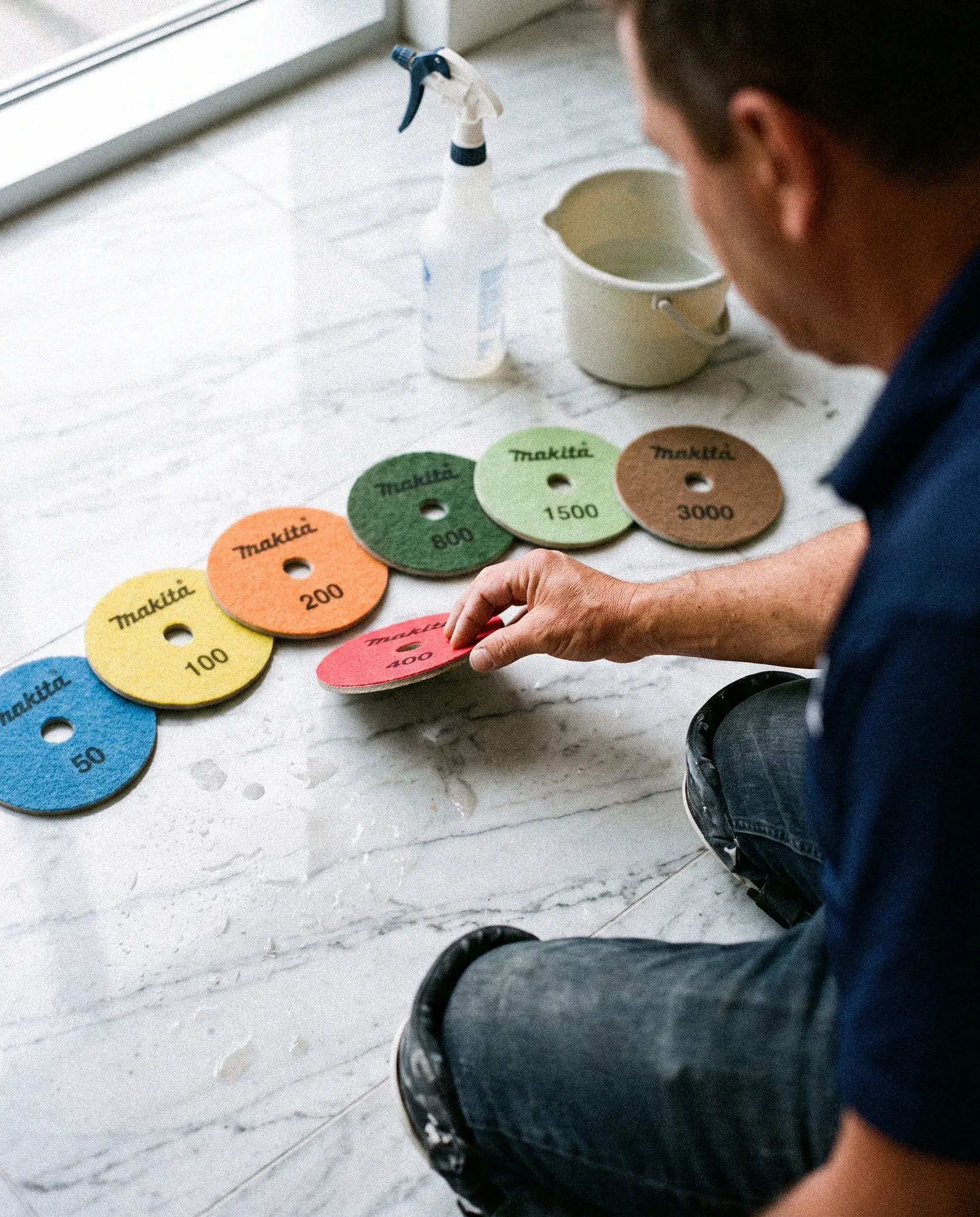
Each grit takes out the scratches the one before it left. That progression is the repair; the polish at the end is only the finish.
The sequence is consistent whatever the surface and wherever it is.
On an older St Petersburg floor the stripping step is usually the long one, and what is under the coating is the first thing the assessment has to establish.
Assessment. What the stone is, what has been put on it, and whether the problem is on the surface or in it.
Stripping, where needed. Old wax and acrylic coatings come off before anything else can be judged.
Honing. Progressive diamond abrasives remove scratches, etch marks and traffic lane wear. This is the step that does the actual repair.
Polishing. Successively finer abrasives bring the surface to the finish you want, matte through to a mirror.
Sealing. A penetrating, impregnating sealer of the kind the Natural Stone Institute recommends for natural stone, chosen for the exposure, which on a coastal property is not the same choice as inland.
For residential floors in moderate traffic, professional polishing every 2 to 3 years keeps
the finish ahead of the wear. Commercial and common-area floors in a busy building need
attention sooner.
What Stone Restoration in St Petersburg Costs
Every job is priced after we see the stone. Two floors that look identical from across the
room can need very different work once you get close to them.
What determines the cost:
Square footage, and whether it is one area or a whole circuit.
How far the finish has been worn down, which sets the starting grit and the number of passes.
Whether there are coatings to strip before the stone can be worked.
How much etching, scratching and traffic lane wear there is.
Local factor
What moves the price most in St Petersburg?
How many layers of previous coating have to be stripped before the stone can be worked, which on a pre-war floor is the largest single variable. A stone restoration St Petersburg quote from Marble Mechanics is written line by line after the assessment, never over the phone.
Every project starts with a free on-site assessment and a written, line-by-line quote before
any work begins. For association work that is the document your board needs in order to
approve it.
Why choose Marble Mechanics
Why Choose Marble Mechanics
Owner-Operated, Not a Franchise
Oscar Tineo has 27+ years of hands-on stone restoration experience. When you call Marble Mechanics you get Oscar, not a rotating crew following a corporate manual.
Old Pinellas Housing Stock
A floor from the early twentieth century and a floor from the last decade are not the same job. Marble Mechanics has spent 27+ years on Tampa Bay's older installations, where the first question, St Petersburg included, is what previous owners put on the stone, not what the stone is.
Diamond Polishing, Not Coatings
We restore the stone itself using progressive diamond abrasives. The results are permanent until new damage occurs. We never use wax, acrylic coatings, or temporary shine products that wear off in weeks.
Free Assessment, Written Quote
Every job starts with a free on-site assessment and a written, line-by-line quote before any work begins. Associations get the same document their board needs to approve it.
Frequently asked
St Petersburg Stone Restoration FAQ
The questions homeowners ask us most, answered before you book.
The questions St Petersburg owners, boards and managers ask most.
Yes, and in St Petersburg it is the normal case rather than the exception. Old marble is rarely worn out. It is covered up. Wax, acrylic shine products and topical coatings applied one over another for decades yellow, trap dirt between the layers and cannot be polished, because none of it is stone. Once that is stripped, the marble underneath is usually in far better condition than anyone expected. Etching, scratches and worn traffic lanes in the stone itself come out with progressive diamond abrasives, which repair the surface rather than coat it. Whether the floor went down in the early twentieth century or in the last decade, restoration works on the stone, and the stone is still there.
How to bring old marble back to life?
In this order: assess, strip, hone, polish, seal. Assessment establishes what the stone is, what has been put on it, and whether the problem is on the surface or in it. Stripping takes off old wax and acrylic, which have to go before anything can be judged. Honing with progressive diamond abrasives removes the scratches, etch marks and traffic lane wear, and is the step that does the actual repair. Polishing runs through successively finer abrasives to the finish you want, matte through to a mirror. Sealing finishes it with a penetrating sealer chosen for the exposure, which on a Snell Isle waterfront is not the same choice as inland. What does not bring old marble back is anything from a bottle that promises shine, because that is a coating, and a coating is what most old St Petersburg floors are already suffering from.
Can you polish travertine stone?
Yes. Travertine is calcium carbonate like marble and takes a diamond polish the same way, through progressively finer abrasives until the stone itself reflects light. The difference is what comes first. Travertine formed with pits and voids, and on a finished floor those are filled and honed flush. Before it can be polished, any fill that has broken down is replaced with color-matched material and ground flush, otherwise the polish shines up a surface full of holes. Many owners choose to stop at a honed finish instead: smooth, matte, equally durable, and better at hiding the next etch mark. Both are sealed the same way. Outdoors it is always honed or tumbled for grip when wet.
How much does it cost to polish travertine?
It is priced after the floor has been seen, and the free on-site assessment ends in a written, line-by-line quote before any work begins. Four things move the number on travertine. The square footage, and whether it is one room or a floor plus a shower. How far the finish has been worn down, which sets the starting grit and the number of passes. How much fill has been lost, and whether the travertine was filled or unfilled to begin with. And whether there are coatings to strip first, which on an older St Petersburg floor is the largest single variable. Two floors that look identical from across the room can need very different work once you get close to them, so a price given over the phone would be a guess.
What does vinegar do to travertine?
It etches it. Travertine is calcium carbonate and vinegar is an acid, so wherever it touches the surface it dissolves a little of the stone and leaves a dull, lighter mark where the polish used to be. That is an etch, not a stain: there is nothing sitting on the surface to clean off, because the surface itself is missing. Sealing does not prevent it and no cleaner reverses it. The same is true of wine, coffee, citrus, tomato and most household and bathroom cleaners. The only thing that removes an etch is honing the surface back to an even finish with diamond abrasives, which in almost every case takes it out completely. For routine cleaning use a pH-neutral cleaner labeled for natural stone and nothing else.
Can Saltillo tile be resurfaced?
Yes, and resurfacing is the right word for it. Saltillo is fired clay under a topical sealer, and the sealer is the wear surface. Resurfacing means stripping every layer of failed sealer, wax and shine product back to clean clay, deep cleaning the tile and the grout, treating any stains that got through where the finish had worn thin, and applying a fresh Saltillo-safe protective finish that brings the color back. Old sealer is not polished or buffed. It comes off. In a St Petersburg house where several owners have each added a coat, the stripping is most of the job, and it is also what decides how well the new finish holds.
How often does Saltillo tile need to be resealed?
There is no fixed calendar, and it is better to read the floor than a date. The finish wears down in high-traffic areas first, and sand and grit tracked in from the beach are the biggest cause. The signs that it is time: the surface looks dry or patchy, water darkens the tile quickly, traffic lanes look dull, grout stays dirty after cleaning, spills absorb faster than before, and the gloss is uneven. Ignoring worn sealer is the mistake that turns a reseal into a restoration, because once the finish is gone, spills and moisture reach the clay itself. A sealer evaluation is part of every free assessment, and the full care routine is on the Saltillo tile cleaning and restoration page.
How to make Saltillo tile look new again?
Not with anything from the shelf. Wax, mop-and-glow products and shine sprays give a short-lived gloss and then trap dirt in a layer that has to be stripped later. Making Saltillo look new again is a sequence: strip the failed coatings completely, deep clean the tile and the grout with a pH-neutral cleaner and a soft nylon brush, treat the stains, then reseal with a Saltillo-safe protective finish that enhances the color and resists stains, dirt and scuffs. Between visits, sweep or vacuum on a hard-floor setting before mopping, mop damp rather than wet, dry the floor afterwards, lift the bucket instead of dragging it, and keep steam and heat off the tile, because heat softens the finish.
Is it worth it to have tile professionally cleaned?
For Saltillo and natural stone, yes, and for a specific reason. Household cleaning removes what is sitting on the surface. It does nothing about a sealer that has worn through, fill that has lifted out of travertine, an etch mark, or a coating that has yellowed, because those problems are in the surface rather than on it. A floor that has been cleaned repeatedly and still looks dull is telling you exactly that. Professional work strips, repairs and reseals, and the sealer it leaves behind is what makes home cleaning work again afterwards. If the floor still responds to a damp mop and a pH-neutral cleaner, keep doing that. If it does not, the free assessment will say what is actually wrong and the written quote will say what it costs to fix.
What is the process of stone restoration?
A St Petersburg floor goes through the same sequence as any other: assessment, stripping where needed, honing, polishing and sealing. Assessment identifies the stone and what has been put on it. Stripping removes wax and acrylic coatings, which are not stone and cannot be honed. Honing with progressive diamond abrasives repairs the surface, removing etches, scratches and traffic lanes. Polishing brings it to the chosen finish. Sealing protects it with a penetrating sealer rather than a coating. What changes from floor to floor is the starting grit, the number of passes, and on a pre-war St Petersburg floor, how long the stripping takes. The work is done wet, so dust is minimal and you stay in the house.
Service areas
Serving St Petersburg and Pinellas County
Marble Mechanics works throughout Pinellas County and the wider Tampa Bay region, including Clearwater, Largo, Dunedin, Palm Harbor, Safety Harbor, Tarpon Springs.
Stone restoration across 79 cities in Tampa Bay. Based in Tampa.
Hillsborough County33
Tampa, South Tampa, Davis Islands, Hyde Park, Bayshore Beautiful, Palma Ceia, Beach Park, Culbreath Isles, Avila, Swann Estates, Harbour Island, Westshore, Channelside, Brandon, Riverview, Valrico, Seffner, Mango, Lithia, Fish Hawk, Plant City, Ruskin, Sun City Center, Apollo Beach, Gibsonton, Carrollwood, Lutz, Temple Terrace, Westchase, New Tampa, Town N Country, Ybor City, Seminole Heights
Pinellas County19
St. Petersburg, Clearwater, Largo, Dunedin, Palm Harbor, Safety Harbor, Tarpon Springs, Tierra Verde, St. Pete Beach, Treasure Island, Madeira Beach, Indian Rocks Beach, Redington Beach, Indian Shores, Seminole, Pinellas Park, Gulfport, Belleair, Pass-a-Grille
Pasco County9
Wesley Chapel, Land O Lakes, New Port Richey, Port Richey, Hudson, Odessa, Trinity, Zephyrhills, Dade City
Manatee County8
Bradenton, Palmetto, Lakewood Ranch, Anna Maria Island, Holmes Beach, Longboat Key, Parrish, Ellenton