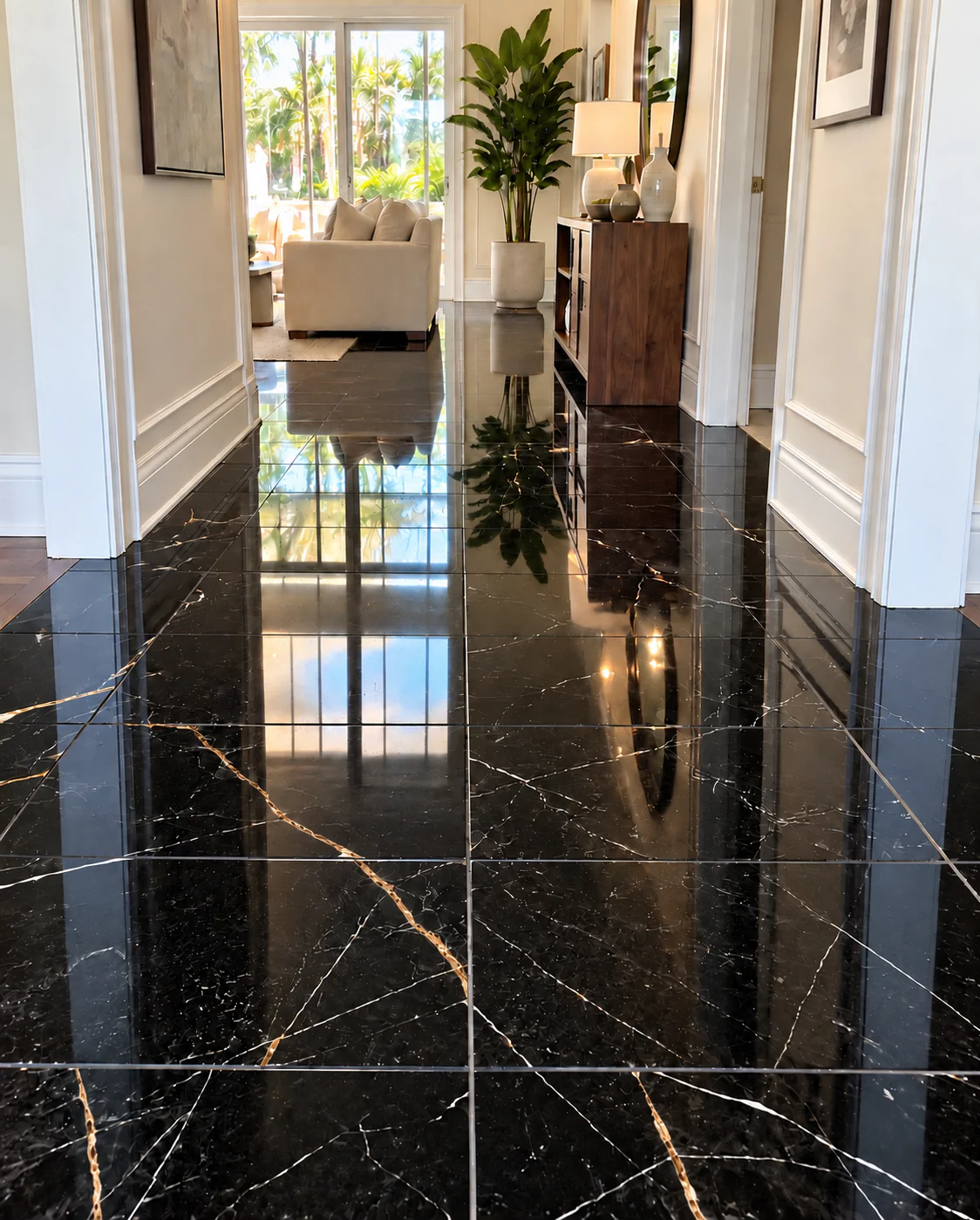
Sarasota's marble is the youngest and the most expensive in the region, and that changes what marble polishing Sarasota's bayfront homes actually need.
On Sarasota Bay and out on the keys the stone was specified by an architect or a designer, often within the last twenty years: large format, long continuous runs, and frequently a honed finish chosen on purpose rather than a polish that happened to be standard. Nobody here is asking to have years of old wax and coatings taken off a floor they inherited. They are asking for a finish somebody chose to be matched exactly, across a floor big enough that a patch would show from the doorway, on stone that is sometimes not marble at all. That is a different job from the one most of Tampa Bay calls about, and it starts with a question rather than a machine: what is this floor, and what was it meant to look like?
Marble Mechanics works across Sarasota: Harbor Acres, Bird Key, Siesta Key, West of the Trail
and the surrounding Sarasota County communities. Oscar Tineo does the work personally.
Call 813-625-3377 for a free estimate, or read on to see
what stone in this part of the county is actually up against.
What Restoration Looks Like
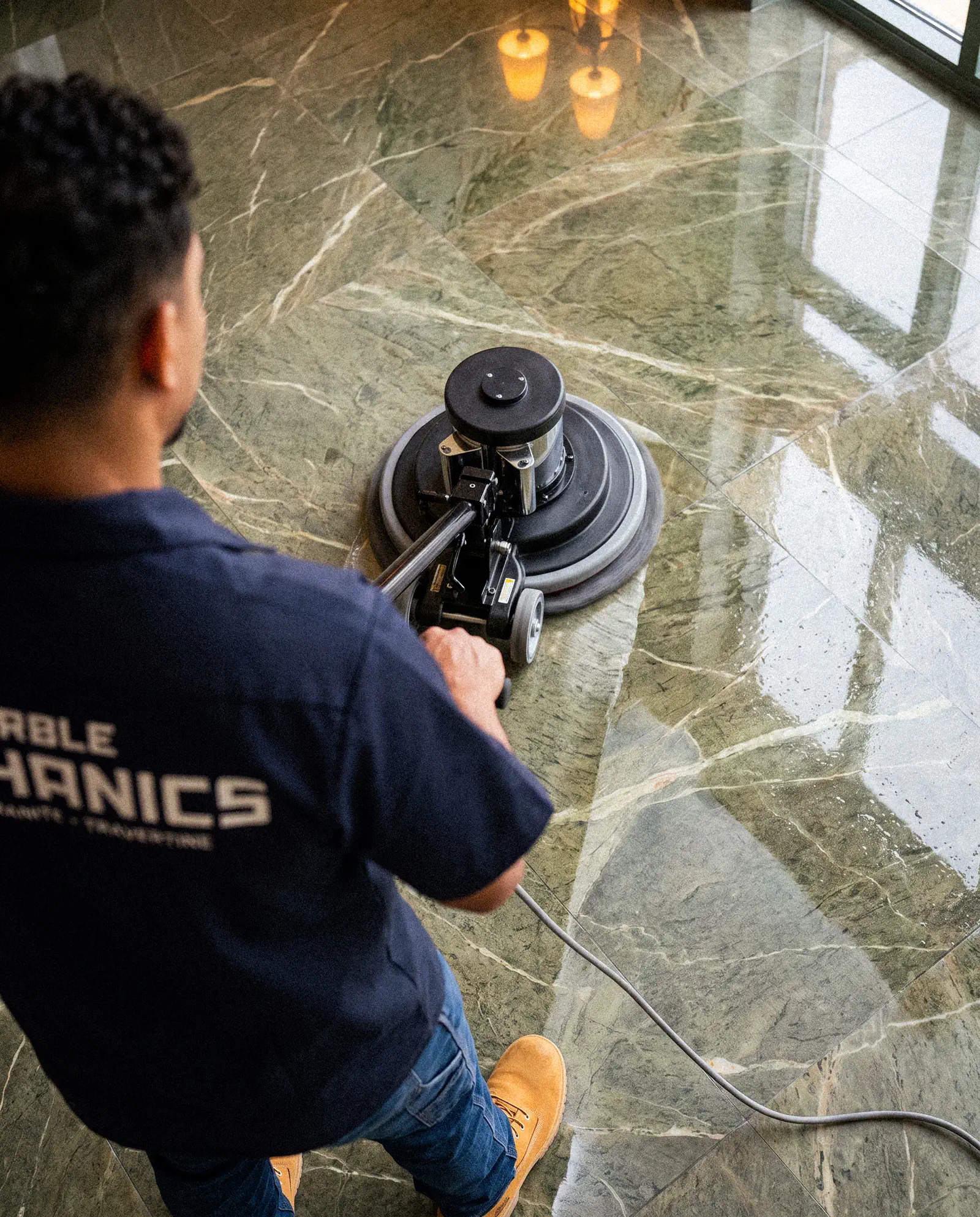
Restoration removes the damaged surface layer and rebuilds the finish on the stone you already own.
Hover 02, 03 and 04 to open them.Swipe from the before to the after.
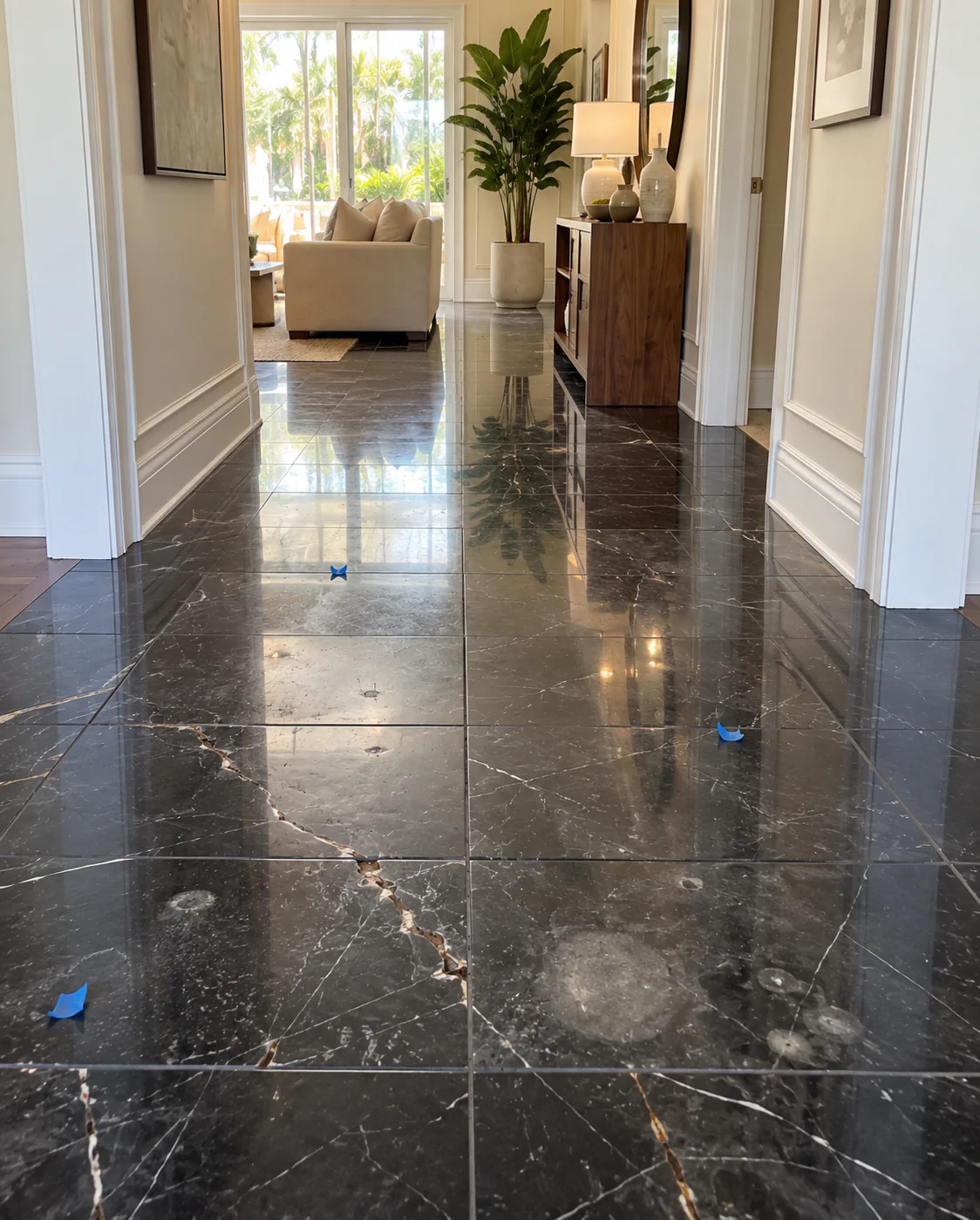
Before
The assessment. Every defect flagged and agreed with the owner before a machine touches the floor.
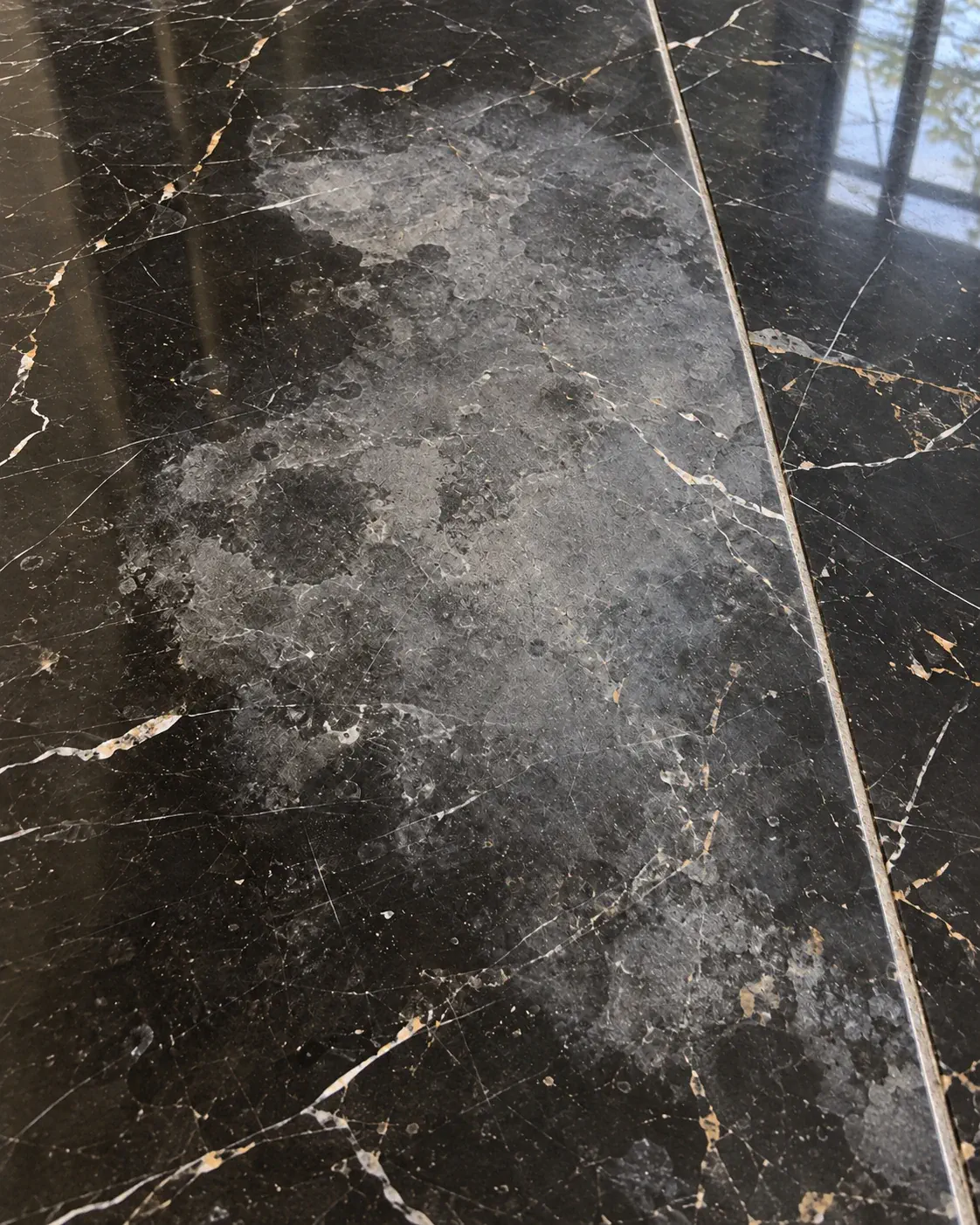
Acid burn. The polish is gone in blotches, so cleaning will never bring this back.
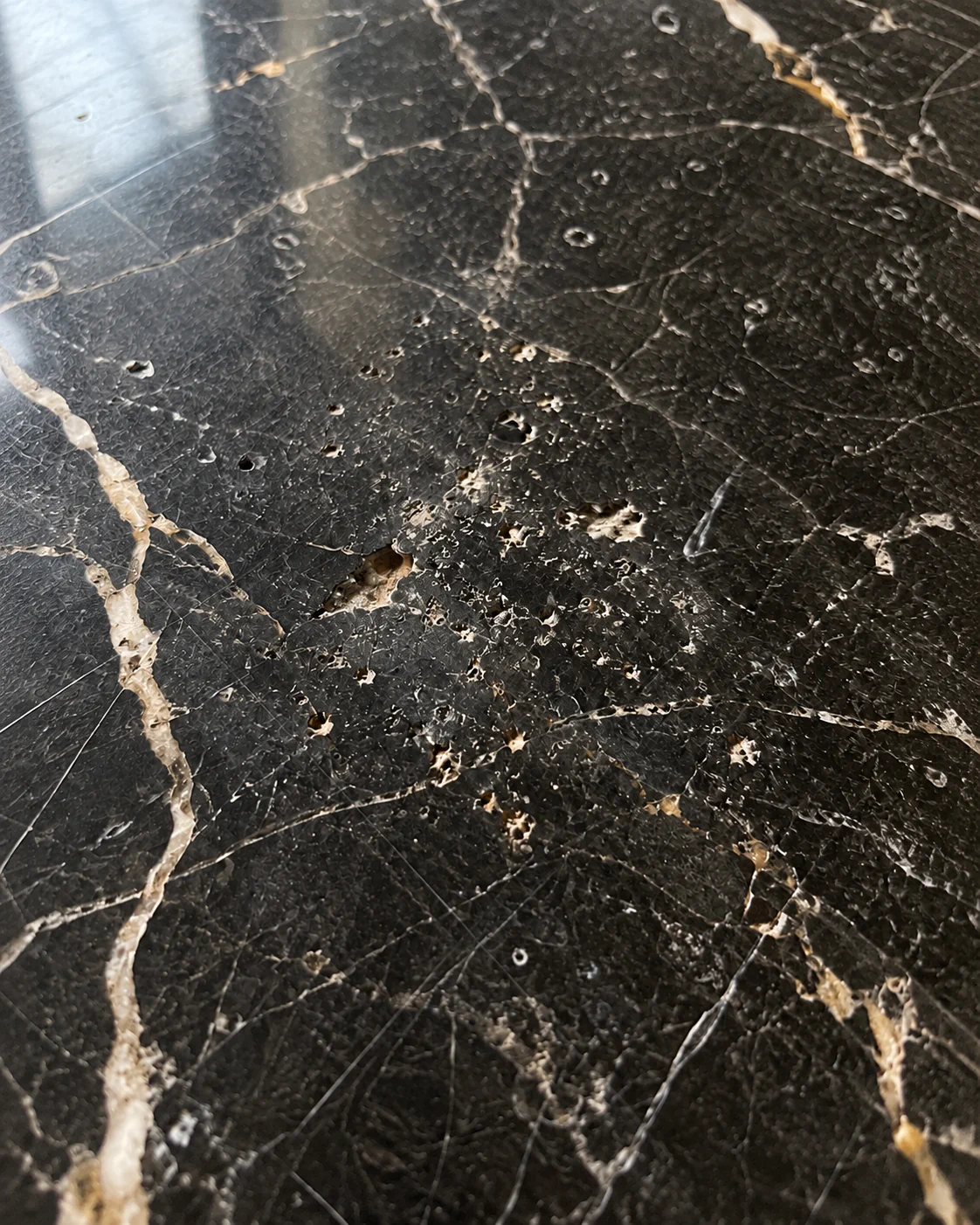
Pitting and scratches, with the softer material broken out along the veining.
After
The crack filled and color matched, the etching cut away, the floor reflecting the room again.
Harbor Acres
Large waterfront estates along Sarasota Bay: 166 properties, priced from $2M to $21.6M, with the waterfront homes between $5M and $15M or more. The houses are big, the floors are bigger, and the stone in them tends to have been chosen for the house rather than inherited with it.
Scale is the problem here, before anything else. A floor that runs from the entry through the living areas to the doors onto the water is one surface, and one surface has to be finished as one surface. When a single worn room in a run like this is worked on its own it comes back brighter and flatter than everything around it, so the repair reads more obviously than the wear ever did. The only honest answer is to take the whole run back to one even finish, and that turns a technical job into a logistical one: furniture, access, the order the rooms are worked in, and keeping a route through the house open while the floor is wet. Marble Mechanics plans a floor like this as a circuit rather than a room, and the written quote is built the same way, so the owner can see exactly where the square footage is and why none of it can be skipped.
Bird Key
An exclusive gated island community of 504 homes with 24-hour security, deep water on every side and a yacht club, priced from $1.5M away from the water to $3M to $10M on it.
Bird Key is where a chosen finish meets the water. A floor specified for a house that opens onto the bay is often honed rather than polished, a matte surface picked because it hides future scratches longer, and a honed floor is repaired differently from a polished one. It is not immune to damage: deep water on every side means salt in the air all year, salt accelerates surface deterioration on marble and can darken the lighter varieties over time, and constant humidity has the stone taking on and giving up moisture continually, which wears any finish faster than it would inland. When an etch or a worn lane on a honed floor is repaired, the work has to stop at exactly the same matte level as the rest of the floor rather than carrying on to a polish, because a glossy patch on a honed floor is as obvious as a dull patch on a polished one. That is a judgment about where to stop, not a setting on a machine, and it is agreed with the owner before the first pass. The penetrating sealer that goes on at the end is chosen for this exposure rather than for an inland house.
Siesta Key
A world-renowned beach with luxury single-family homes and gated communities, the Sanderling Club among them, a median home value around $967,934 and luxury properties from $1.5M up. Most of the houses are a short walk from the sand, and the sand comes home with everyone.
The sand on Siesta Key is quartz. That is a published fact about the beach rather than anything Marble Mechanics measured, and it matters because quartz is harder than calcite, the mineral marble is made of. Grains tracked in from this beach are a more aggressive abrasive on a calcium carbonate floor than ordinary silica-and-shell beach sand, so the same amount of foot traffic does more damage here than it would almost anywhere else on the coast. The damage is mechanical: fine scratches in the entry and the first few feet of floor that dull the reflection long before anyone can point to a single mark, and by the time the entry looks tired the scratching usually reaches further into the house than the dull patch suggests. Honing removes it, with progressive diamond abrasives taking the surface down below the scratches before polishing brings the finish back up, but prevention is cheaper than repair. A mat outside and inside every door that opens toward the beach, and a dry sweep or dry microfiber before anything wet touches the floor, do more good on Siesta Key than they would on almost any other floor in Sarasota County.
West of the Trail
The most-referenced luxury area in Sarasota, taking in Bay Point Park, Whitakers Lane, Harbor Acres and Lincoln Park, with multi-million dollar homes throughout. When somebody in Sarasota says west of the Trail they mean the good streets, and the floors reflect it.
Designer-specified stone, which raises the question that comes before any polishing: what is this floor? A surprising share of the floors chosen for houses like these in the last twenty years are not marble at all, and the ones that are marble were often installed with a finish that was a decision, matte, honed or polished, rather than whatever came off the truck. Marble Mechanics treats identification as the first step of every assessment west of the Trail, because a process that restores marble does not behave the same way on a stone that only looks like marble, and because polishing a floor to a mirror when it was specified honed is a mistake that is far easier to avoid than to undo. So the target finish is agreed with the owner first and demonstrated on a test area before the rest of the floor is touched. Guessing, in either direction, leaves either a floor too shiny for the house or one that never comes up at all.
What the Restoration Process Involves
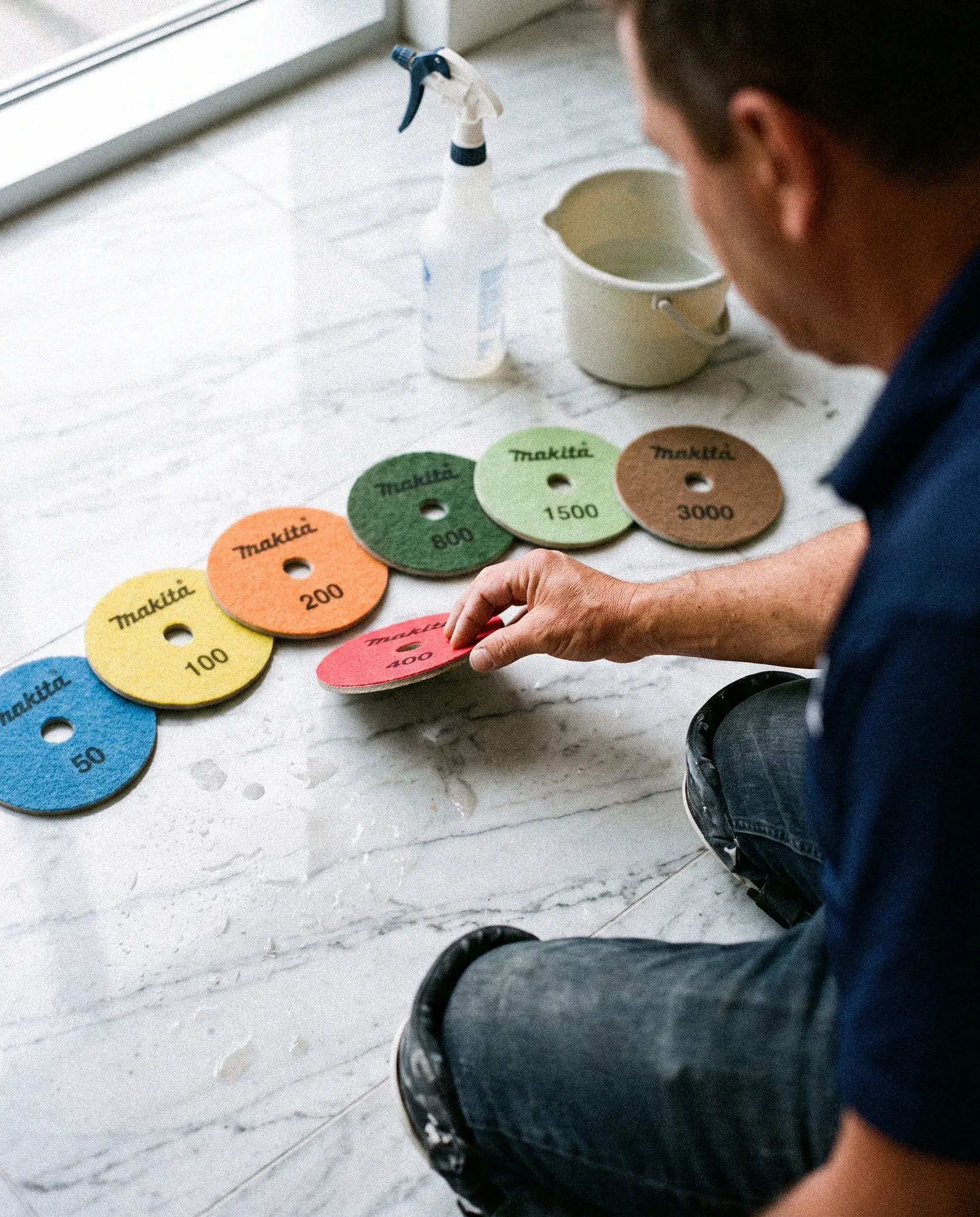
Each grit takes out the scratches the one before it left. That progression is the repair; the polish at the end is only the finish.
The sequence is consistent whatever the surface and wherever it is.
On a specified Sarasota floor the assessment starts by identifying the stone and the finish it was installed with; the target is then agreed and demonstrated on a test area before the rest of the floor is worked, because matte, honed and polished are decisions rather than degrees of done.
Assessment. What the stone is, what has been put on it, and whether the problem is on the surface or in it.
Stripping, where needed. Old wax and acrylic coatings come off before anything else can be judged.
Honing. Progressive diamond abrasives remove scratches, etch marks and traffic lane wear. This is the step that does the actual repair.
Polishing. Successively finer abrasives bring the surface to the finish you want, matte through to a mirror.
Sealing. A penetrating, impregnating sealer of the kind the Natural Stone Institute recommends for natural stone, chosen for the exposure, which on a coastal property is not the same choice as inland.
For residential floors in moderate traffic, professional polishing every 2 to 3 years keeps
the finish ahead of the wear. Commercial and common-area floors in a busy building need
attention sooner.
What Marble Polishing in Sarasota Costs
Every job is priced after we see the stone. Two floors that look identical from across the
room can need very different work once you get close to them.
What determines the cost:
Square footage, and whether it is one area or a whole circuit.
How far the finish has been worn down, which sets the starting grit and the number of passes.
Whether there are coatings to strip before the stone can be worked.
How much etching, scratching and traffic lane wear there is.
Local factor
What moves the price most in Sarasota?
Whether the floor is one continuous run that has to be taken back as a whole, which on a Sarasota estate is the difference between a room and a wing, and whether the target is a honed finish that has to be matched rather than a polish that has to be reached.
Every project starts with a free on-site assessment and a written, line-by-line quote before
any work begins. For association work that is the document your board needs in order to
approve it.
Why choose Marble Mechanics
Why Choose Marble Mechanics
Owner-Operated, Not a Franchise
Oscar Tineo has 27+ years of hands-on stone restoration experience. When you call Marble Mechanics you get Oscar, not a rotating crew following a corporate manual.
Finish Matching, Not Just Shine
Marble polishing, Sarasota or anywhere else, should give back the finish the house was built with, matte through to a mirror, not the shiniest result the machine can reach. On a designer-specified floor Marble Mechanics agrees the target finish first, proves it on a test area, and only then works the whole run to match it.
Diamond Polishing, Not Coatings
We restore the stone itself using progressive diamond abrasives. The results are permanent until new damage occurs. We never use wax, acrylic coatings, or temporary shine products that wear off in weeks.
Free Assessment, Written Quote
Every job starts with a free on-site assessment and a written, line-by-line quote before any work begins. Associations get the same document their board needs to approve it.
Frequently asked
Sarasota Marble Polishing FAQ
The questions homeowners ask us most, answered before you book.
The questions Sarasota owners, boards and managers ask most.
Nobody can price that from the number alone, and anyone who does is guessing. A floor that size is almost always a continuous run through several rooms rather than one room, so it is planned and priced as a circuit: the per-square-foot rate is set by what the assessment finds, and the square footage is set by where the finish has to stay continuous. What moves the rate is how far the finish has worn, which decides the starting grit and the number of passes; whether the target is a polish or a honed finish that has to be matched; how much etching and scratching there is to hone out; and access, which on an estate means furniture, wet floors and keeping a route through the house open. That is what makes marble polishing Sarasota's larger floors a logistics job as well as a technical one. Marble Mechanics looks at the floor first, then writes a line-by-line quote that shows where every square foot is. The assessment is free: 813-625-3377.
Is marble polishing worth the cost?
On a floor that was specified for the house, almost always, because the alternative is replacing stone that is not worn out. Polishing restores the surface of the marble itself with progressive diamond abrasives, so the result is permanent until new damage occurs; nothing is applied that wears off. The cases where it is not worth it are real, and Marble Mechanics will say so at the assessment: a floor that only needs honing and sealing gets that recommendation, and a floor that turns out not to be marble gets a different process or an honest no. What is never worth paying for is a coating that looks good for a few weeks, wears unevenly, and then has to be stripped before the job can be done properly.
Can marble be polished again?
Yes. Marble can be polished again as many times as it needs it, because polishing takes off a very thin layer of stone rather than adding anything to it, and the amount removed is tiny compared with the thickness of the tile. A floor that was polished when it was installed and has dulled since is the normal case, not a problem case. What decides the work is what happened in between: wear and light scratching come back with polishing alone, etch marks and deeper scratches need honing first, and a coating someone put on to postpone the call has to be stripped before either. In Sarasota there is one extra question, which is what finish the floor started with, so that the second polish matches the first rather than overshooting it.
Can you polish marble yourself?
You can buy a polishing compound and a hand buffer, and on a small countertop with light dulling you may get a result you are happy with. On a floor, and especially on a large-format designer floor, the honest answer is no. Professional marble polishing is progressive diamond abrasion under a weighted floor machine, run wet, through a sequence of grits that has to be kept flat and even across the whole surface. A hand buffer leaves the surface uneven, with bright patches that show from the doorway, and a store-bought compound is often a coating in disguise that will have to be stripped later. The bigger risk is the finish: taking a honed floor to a gloss in one spot cannot be undone at home. Cleaning with a pH-neutral stone cleaner, mats at the doors and wiping spills as they happen is the DIY that pays.
Is Dawn dish soap ok for marble?
It will not etch the marble, which is the good news: dish soap sits close to neutral on the pH scale, so unlike vinegar or citrus cleaners it does not dissolve the surface. The problem is what it leaves behind. Dish soap is made to hold grease in suspension and it does not rinse clean off stone. A little residue stays on the floor every time, builds into a film that dulls the reflection, holds dirt, and leaves a polished floor looking hazy and streaked. If it has been used for a while, the fix is plain water rinses until the floor stops feeling slick, and then a pH-neutral cleaner made for natural stone from that point on, used as its label directs. Nothing needs to be mixed at home.
How do I get my marble to shine again?
It depends on why it stopped shining. If the floor is dull all over from cleaning product residue or an old coating, the shine is still there underneath, and stripping the film and cleaning with a pH-neutral stone cleaner brings a surprising amount of it back. If the dullness is in the traffic lanes and the entry, the finish has been worn away and no cleaner will restore it: the surface has to be honed with diamond abrasives to below the scratches and then polished back up through finer grits until the stone itself reflects light again. If the dull marks are rings and splashes, those are etch marks from something acidic, and they are honed out the same way. Shine sprays and waxes put a temporary film over all three problems and make the real fix harder, so they are the one thing not to reach for.
How do professionals polish marble?
With diamonds, water and weight, in a fixed order. First the assessment: what the stone is, what has been put on it, how deep the etching and scratching go, and what finish the floor was installed with. Then stripping, if a coating is present. Then honing, which is the repair step: progressive diamond abrasives, run wet under a floor machine with weighted heads that keep the pressure consistent across the whole floor, cut the surface down flat until scratches, etch marks and traffic lanes are gone. Then polishing, which continues through successively finer diamond grits until the calcium carbonate crystals in the stone reflect light on their own, or stops earlier at a honed level if that is the finish the floor was specified with. Last, a penetrating sealer chosen for the exposure. What a professional never does is put a coating on top. The shine has to come out of the stone.
What does Windex do to marble?
Windex is a glass cleaner, formulated for a surface that does not react with anything. Marble reacts. The solvents and surfactants in a glass cleaner leave a film on a polished floor that streaks, dulls the reflection and shows every footprint, and they do nothing for the dirt that actually sits in stone. Some glass cleaner formulas are acidic, the vinegar-based ones in particular, and an acidic cleaner does permanent damage: it dissolves the calcium carbonate at the surface and leaves a dull spot that cleaning will never remove and only honing will. Keep glass cleaners on glass. Marble wants a pH-neutral cleaner made for natural stone, a damp mop rather than a wet one, and spills wiped as they happen.
What does vinegar do to a marble floor?
It etches it. Vinegar is an acid, marble is calcium carbonate, and the two react on contact: the acid dissolves the polished surface at a microscopic level and leaves a dull, lighter mark in the exact shape of the spill or the mop stroke. Etching is the number one marble problem in Florida, and vinegar cleaning is one of the main causes, because people reach for it as a natural alternative to chemicals. It is not a stain. Nothing you can clean with will bring the shine back, because the shine has been dissolved rather than covered. An etch is removed by honing the surface flat with diamond abrasives and polishing it back to match the surrounding stone. Prevention costs nothing: a pH-neutral cleaner made for natural stone, and nothing acidic on the floor at all.
How much does it cost to polish marble floors per square foot?
Per square foot is the right unit, and the rate is set by the floor rather than by a menu. Marble polishing Sarasota's designer floors is priced after the stone has been seen, because two floors of the same size can need very different work: one wants a light repolish and a seal, the other wants a coating stripped, deep etching honed out and a honed finish matched across a whole run. The rate rises with the number of grit stages the floor needs, with etching and scratching, with a coating to strip, and with access; it falls on a big, open, continuous floor where the machine runs uninterrupted. The figure you get from Marble Mechanics is a written, line-by-line quote for your floor after a free on-site assessment, and it is the only per-square-foot number worth relying on. Call 813-625-3377 to book it.
Service areas
Serving Sarasota and Sarasota County
Marble Mechanics works throughout Sarasota County and the wider Tampa Bay region, including Osprey, Venice, Nokomis, Siesta Key.
Stone restoration across 79 cities in Tampa Bay. Based in Tampa.
Hillsborough County33
Tampa, South Tampa, Davis Islands, Hyde Park, Bayshore Beautiful, Palma Ceia, Beach Park, Culbreath Isles, Avila, Swann Estates, Harbour Island, Westshore, Channelside, Brandon, Riverview, Valrico, Seffner, Mango, Lithia, Fish Hawk, Plant City, Ruskin, Sun City Center, Apollo Beach, Gibsonton, Carrollwood, Lutz, Temple Terrace, Westchase, New Tampa, Town N Country, Ybor City, Seminole Heights
Pinellas County19
St. Petersburg, Clearwater, Largo, Dunedin, Palm Harbor, Safety Harbor, Tarpon Springs, Tierra Verde, St. Pete Beach, Treasure Island, Madeira Beach, Indian Rocks Beach, Redington Beach, Indian Shores, Seminole, Pinellas Park, Gulfport, Belleair, Pass-a-Grille
Pasco County9
Wesley Chapel, Land O Lakes, New Port Richey, Port Richey, Hudson, Odessa, Trinity, Zephyrhills, Dade City
Manatee County8
Bradenton, Palmetto, Lakewood Ranch, Anna Maria Island, Holmes Beach, Longboat Key, Parrish, Ellenton