Marble Mechanics 813-625-3377
Marble polishing Clearwater

Marble Polishing Clearwater

Clearwater marble lives closer to the water than almost any in Tampa Bay. On the barrier islands it sits in condominium lobbies that take a thousand footfalls a day, and in waterfront homes where salt air never lets up. Both wear differently from marble in an inland home, and both come back.

  • Free on-site assessment
  • Written quote before any work begins
  • No obligation
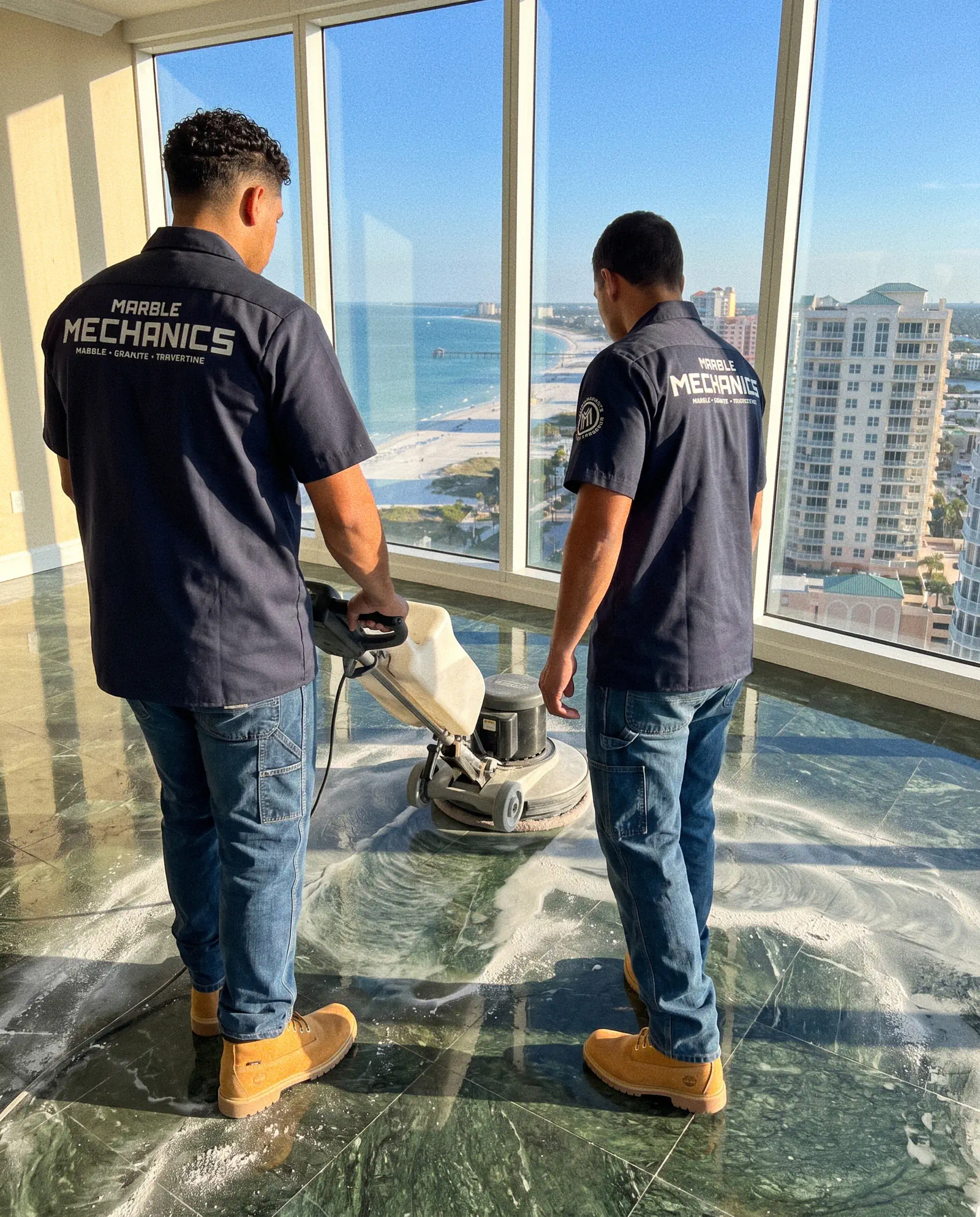
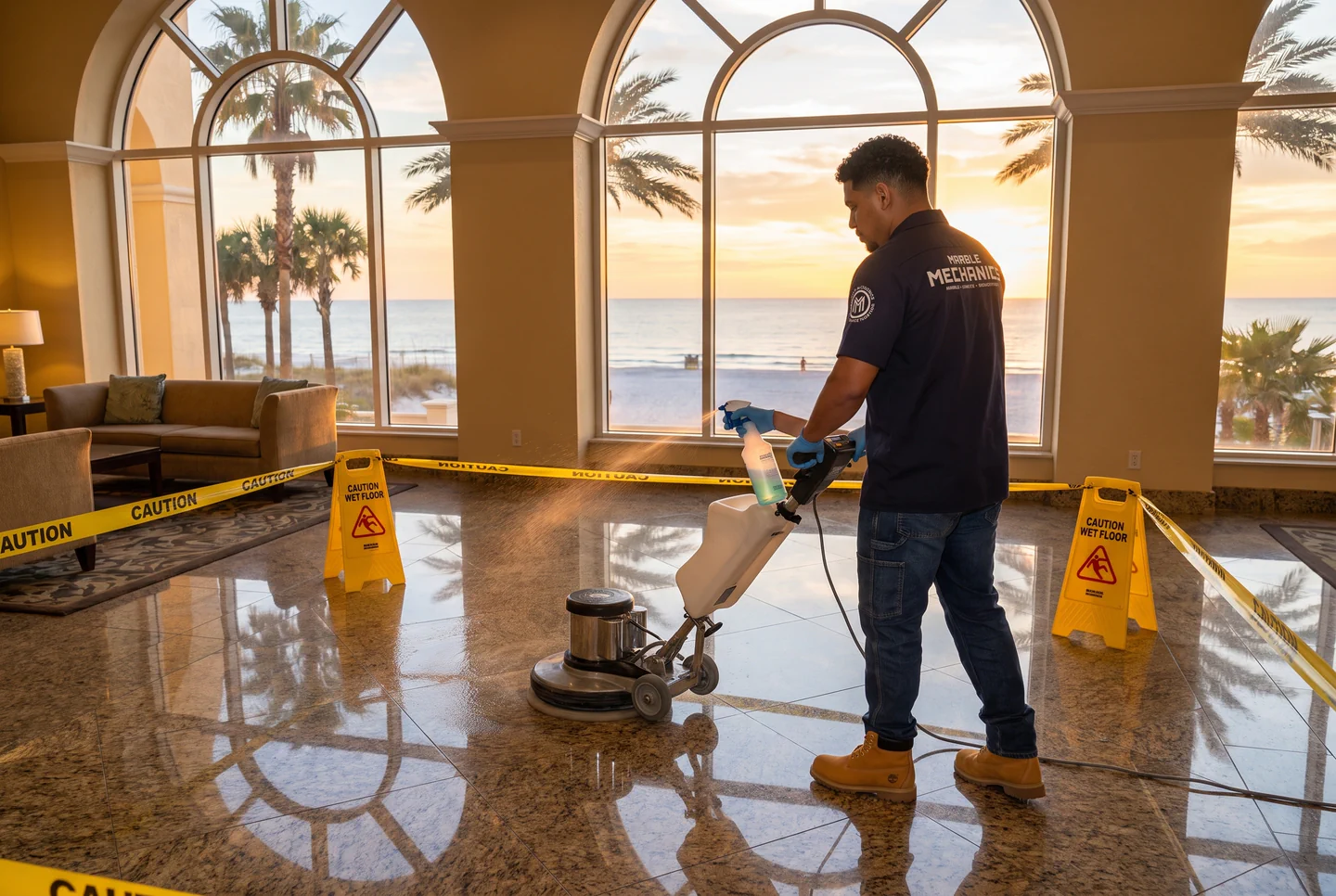
Marble polishing in Clearwater: two Marble Mechanics technicians running a rotary floor machine across a marble floor in a Clearwater Beach high-rise condominium
27+ Years of experience Restoring marble, travertine, granite and other natural stone.
27+Years of Experience
Five-Star Google Rating
79Cities Served
FreeOn-site Assessments

Marble Mechanics polishes and restores marble across Clearwater: Clearwater Beach, Sand Key, Island Estates, Harbor Oaks, Countryside and the surrounding Pinellas communities. Condominium lobbies and common areas, coastal single-family homes, and older installations buried under decades of coatings. Oscar Tineo does the work personally.

Call 813-625-3377 for a free estimate, or read on to see what marble in this part of the county is actually up against.

Why Clearwater Marble Wears Differently

Marble is calcium carbonate. It is chemically reactive, physically softer than most people assume, and it responds to its environment. In Clearwater the environment is unusually hard on it.

Salt air, continuously. Clearwater Beach, Sand Key and Island Estates are island addresses, and properties along Clearwater Harbor are barely less exposed. Salt accelerates surface deterioration and can darken lighter marble varieties over time. This is not an occasional storm event, it is a constant load.

Humidity. Tampa Bay's average relative humidity hovers around 74%, so marble absorbs and releases moisture continually. In buildings where the climate control is not consistent, and a beachfront lobby with doors opening all day is exactly that, the effect is more pronounced.

Hard water. The municipal water here carries high levels of dissolved minerals. Wherever it evaporates on marble, around a sink, in a shower, at a pool entrance, it leaves deposits that etch into the surface and become permanent if left.

Sand. The one that is specific to a beach community. Sand tracked in on feet is an abrasive, and it does its damage underfoot in the entry and the first stretch of corridor before anyone notices.

Marble Polishing, Before and After

Restoration removes the damaged surface layer and rebuilds the finish on the stone you already own.

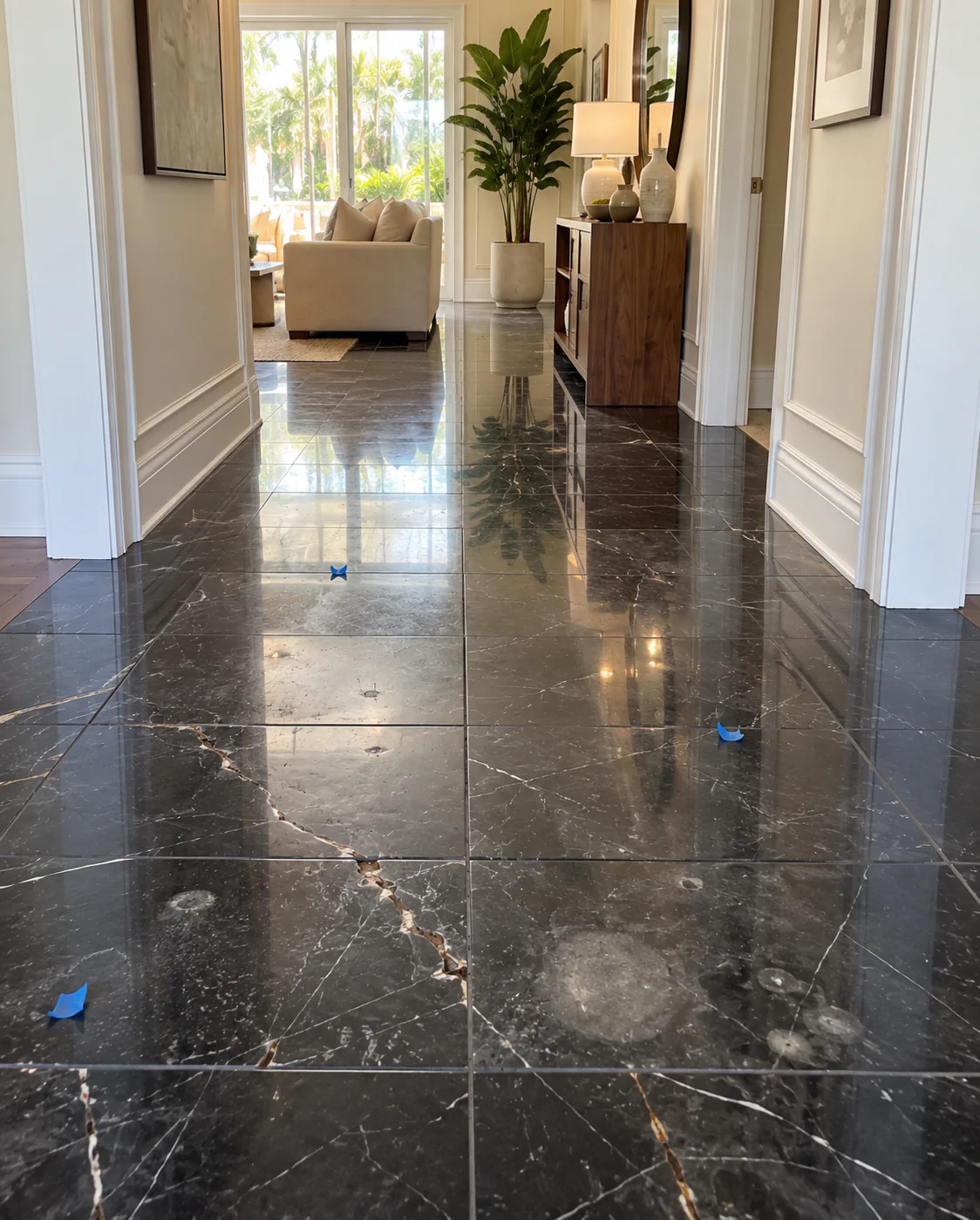
Blue tape marking every defect on a black marble entry floor during a walkthrough with the homeowner in Tampa Bay
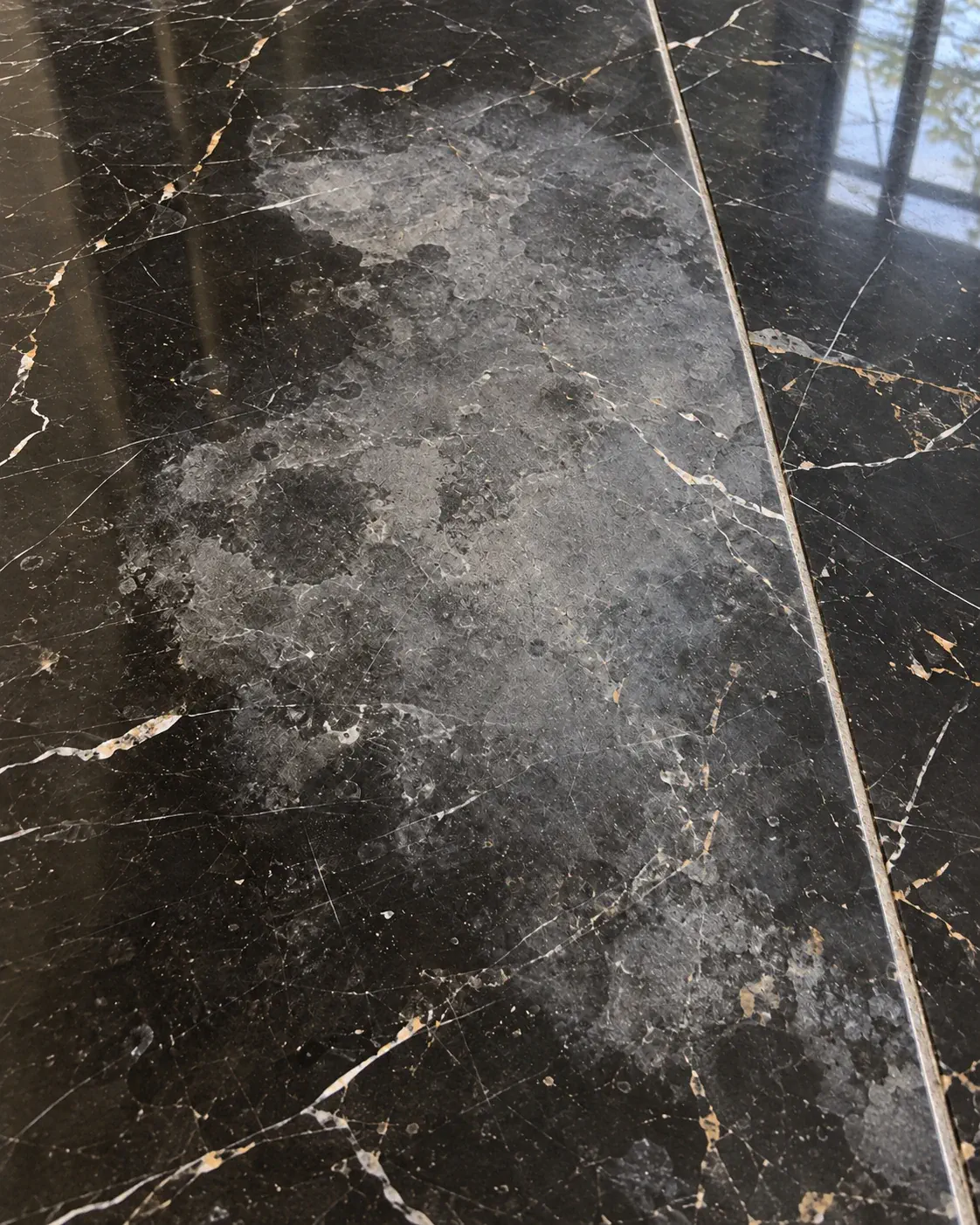
Etched, blotchy black marble tile where acid has burned through the polish, before restoration in Tampa Bay
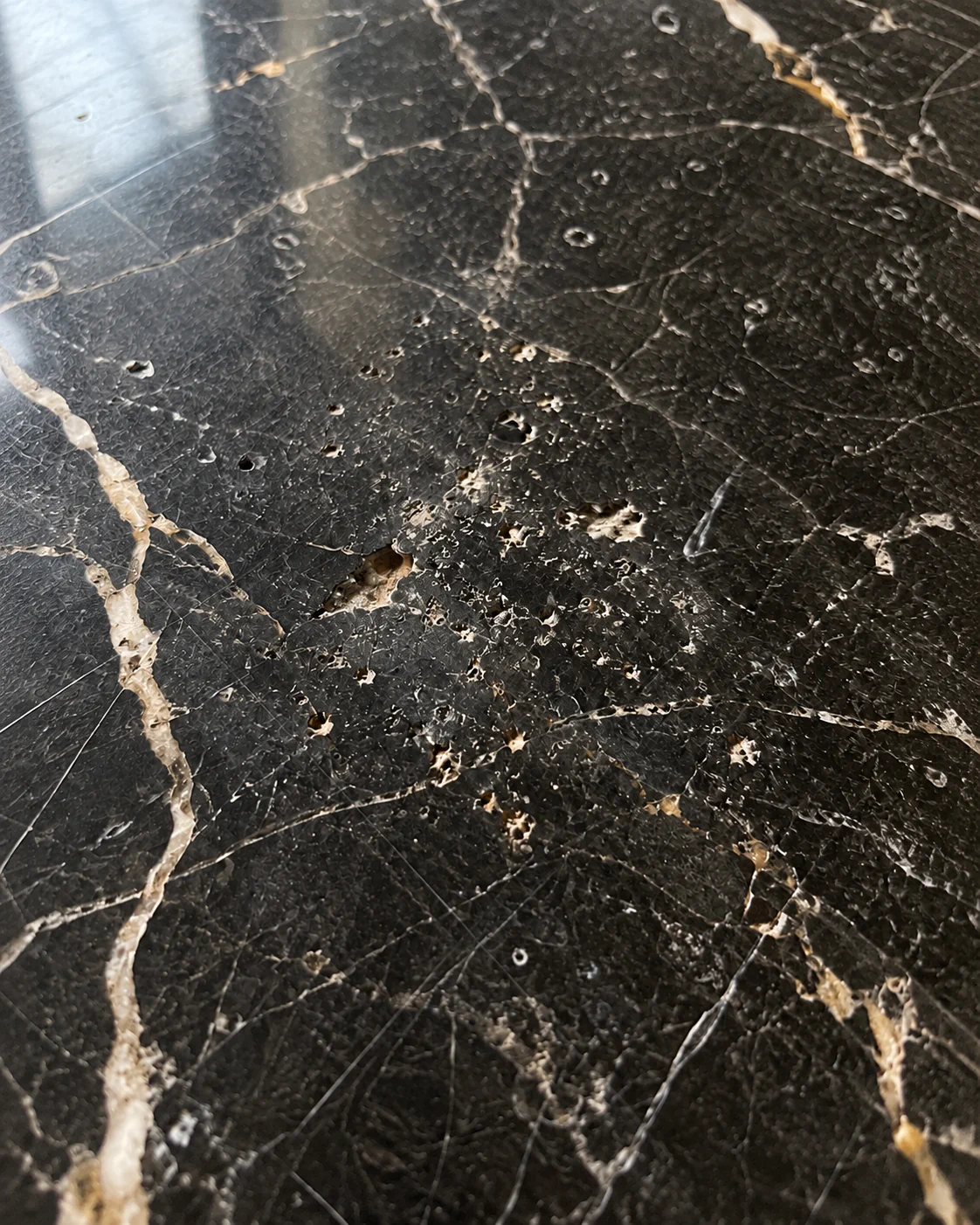
Heavily pitted and scratched black marble tile before repair by Marble Mechanics in Tampa Bay
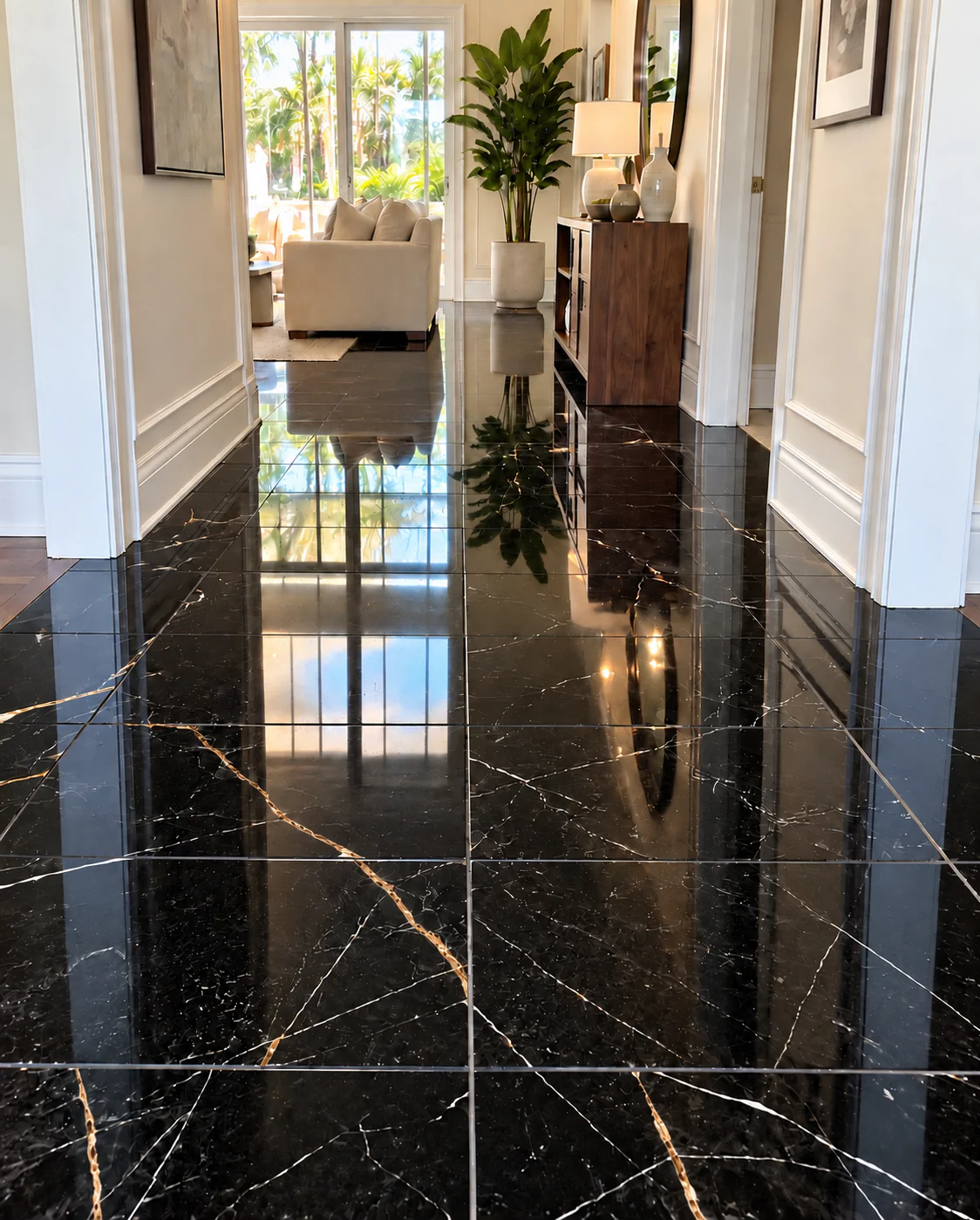
The same black marble entry floor polished to a mirror finish by Marble Mechanics in Tampa Bay

Hover 02, 03 and 04 to open them. Swipe from the before to the after.

Blue tape marking every defect on a black marble entry floor during a walkthrough with the homeowner in Tampa BayEtched, blotchy black marble tile where acid has burned through the polish, before restoration in Tampa BayHeavily pitted and scratched black marble tile before repair by Marble Mechanics in Tampa Bay Before

The assessment. Every defect flagged and agreed with the owner before a machine touches the floor.

Acid burn. The polish is gone in blotches, so cleaning will never bring this back.

Pitting and scratches, with the softer material broken out along the veining.

The same black marble entry floor polished to a mirror finish by Marble Mechanics in Tampa Bay After

The crack filled and color matched, the etching cut away, the floor reflecting the room again.

Clearwater Beach and Sand Key: Condominium Marble

Most of the marble on the barrier islands is not in a house. It is in a building: lobby floors, elevator landings, corridors, unit entries and amenity spaces in the towers along Gulf Boulevard and the Clearwater Beach waterfront.

That changes the problem in three ways. The floor takes commercial traffic rather than residential, so it develops traffic lanes, dull channels worn through the finish exactly where people walk. The doors open onto sand and salt all day. And the work has to happen around residents, which makes scheduling as much a part of the job as the polishing.

Restoration takes the whole floor back to an even finish rather than patching the worn lane, because a repaired stripe through a polished floor reads more obviously than the wear did. Polishing is done wet, so dust stays minimal and a route through the space stays open.

Marble polishing in Clearwater: a Marble Mechanics technician running a rotary floor machine in a beachfront condominium lobby, the work zone taped off
Marble polishing in Clearwater: a beachfront lobby polished wet and cordoned off, so the building keeps working around it.

Island Estates and the Waterfront Homes

Island Estates is single-family and waterfront, which means the marble is residential in scale but coastal in exposure. Entry floors, kitchen and bathroom surfaces, and pool-adjacent stone all take salt air, and pool entrances add chlorinated water and wet feet to the mix.

The sealer is doing more work on a property like this than on an inland one, and it is worth testing rather than scheduling. The point at which it stops beading arrives sooner here.

Sealing is routine maintenance on marble rather than an upgrade, which is how the Natural Stone Institute treats it, and on a Gulf-facing property the interval is shorter than the national guidance assumes.

Harbor Oaks and the Older Installations

Harbor Oaks is Clearwater's historic district, sitting on the bluff above Clearwater Harbor, and the homes there have had a long time to accumulate whatever previous owners put on the floor.

The common finding in an older installation is layers: wax, acrylic coatings, shine products, one over another, yellowing and trapping dirt. None of that is marble, and none of it can be polished. It has to come off before the stone underneath can even be assessed properly. Once it does, the marble is usually in better condition than the owner expected, because the coating was hiding it rather than damaging it.

Important

Why we never put a coating back on

Marble Mechanics restores the stone itself with progressive diamond abrasives, so the finish is the marble rather than a film sitting on it. A coating looks good for a few weeks, wears unevenly, and has to be stripped off before the next person can do the job properly. That is the situation we are usually called in to undo.

Countryside and Inland Clearwater

Inland north Clearwater is a different profile again: suburban, later construction, and out of the salt. The marble there is usually in entries, bathrooms and kitchen surfaces rather than across whole floors, and the problems are the ordinary ones. Etch marks from cleaning products and citrus, scratches from grit, and a sealer that quietly expired years ago.

Ordinary does not mean minor. An etch is a place where acid has chemically eaten the polished surface away, and no amount of cleaning will bring it back. It needs the surface taken down to an even finish, which is a restoration job rather than a cleaning one.

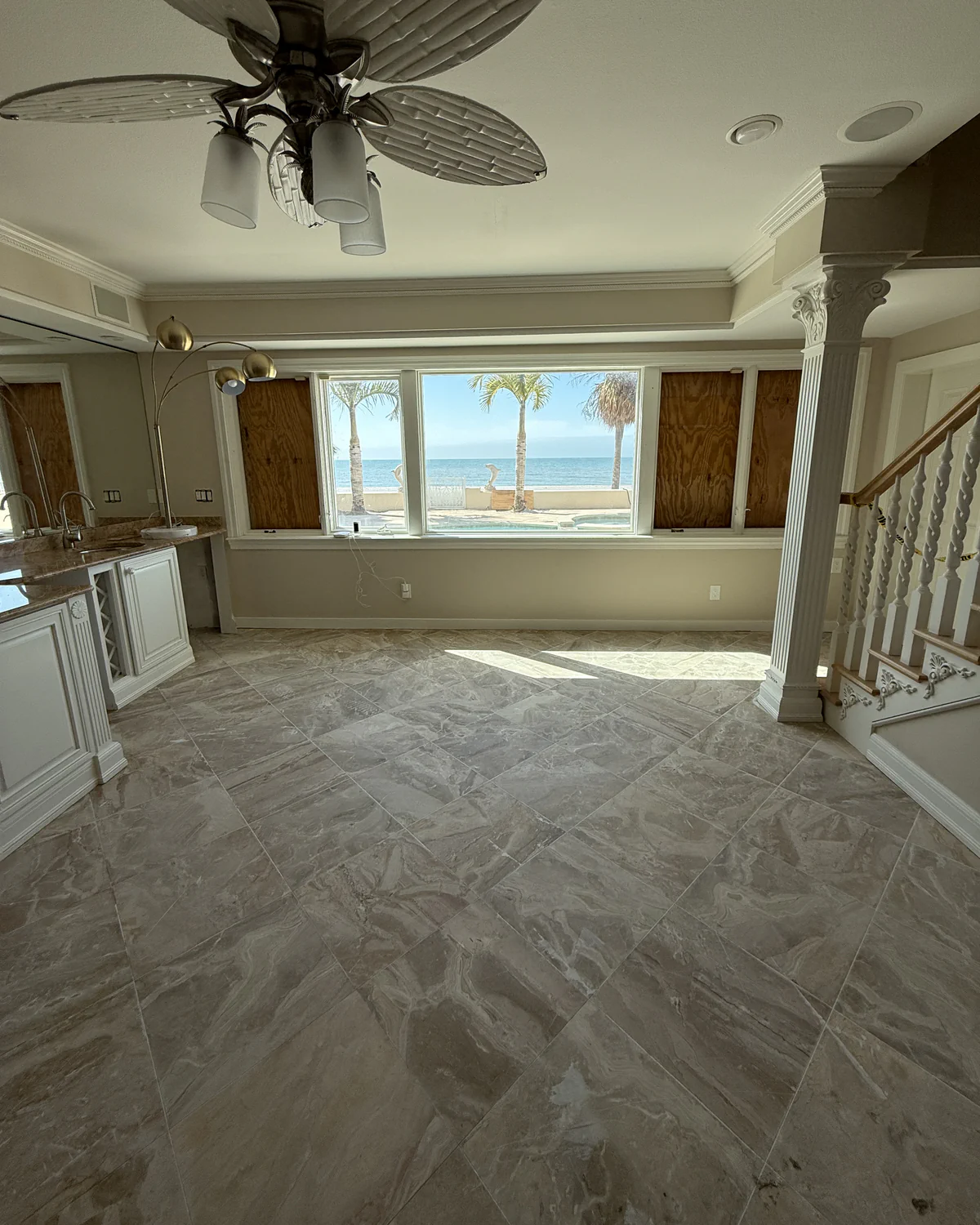
Marble polishing: a marble floor honed flat to cut out etching and scratches, before the polish goes back on
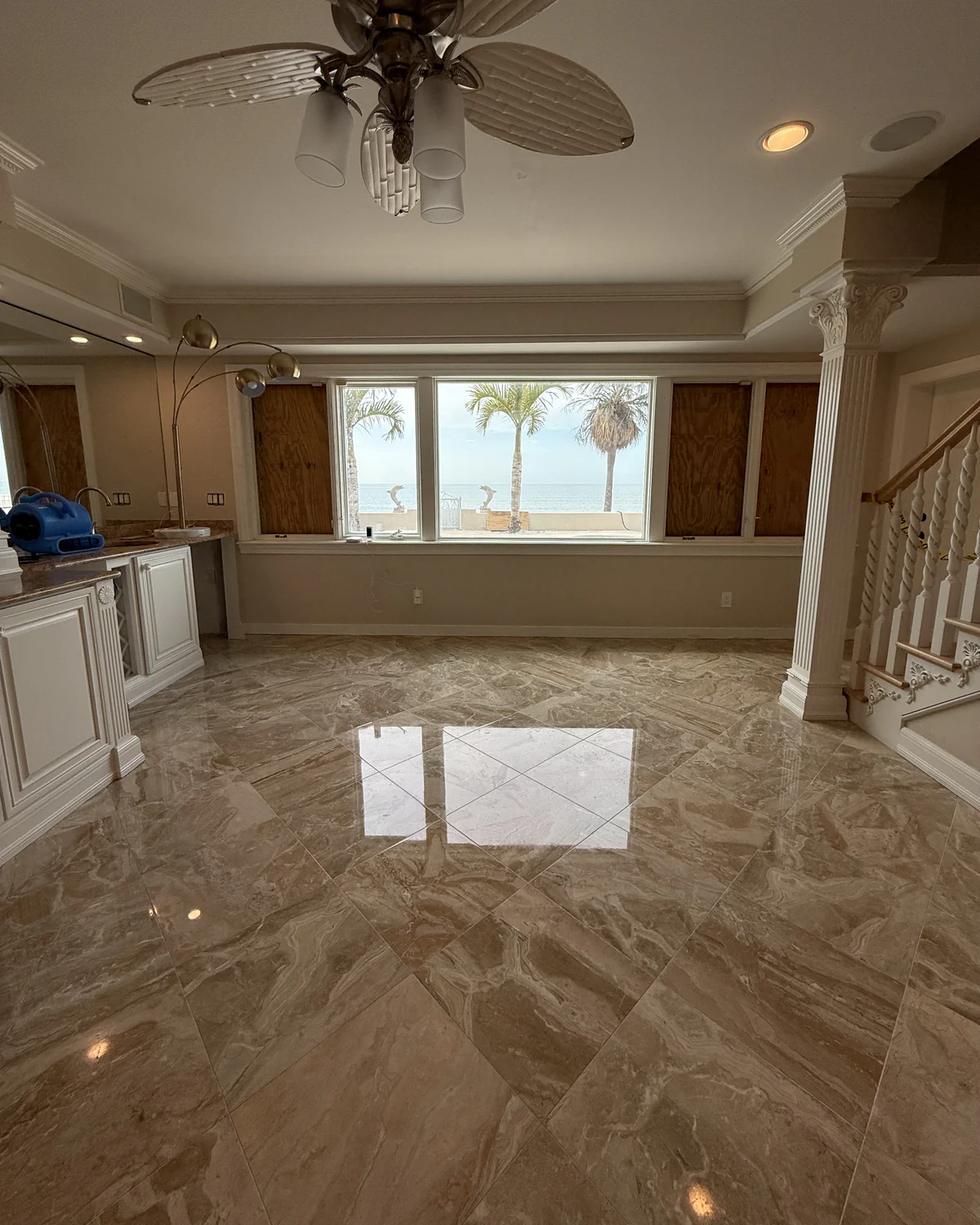
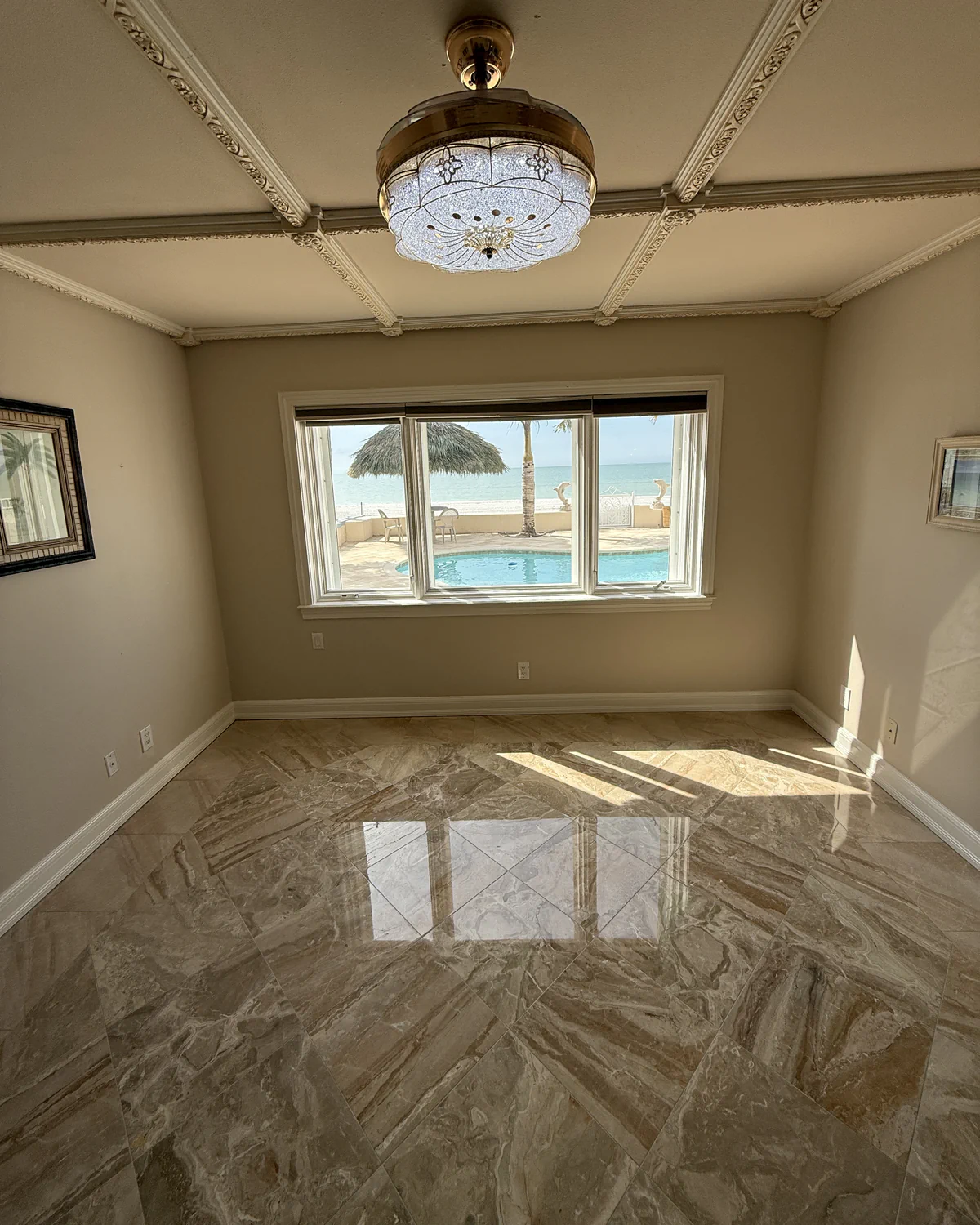
Marble polishing: the same marble floor honed, polished, crystallized and sealed, returning a clean window reflection
Marble polishing: the next room carried through the same four stages so both floors read as one

Hover 02 and 03 to open them. Swipe to see the rest.

What the Restoration Process Involves

The sequence is consistent whether the floor is a beachfront lobby or a Countryside entry. What changes is the starting grit, the number of passes, and the sealer at the end.

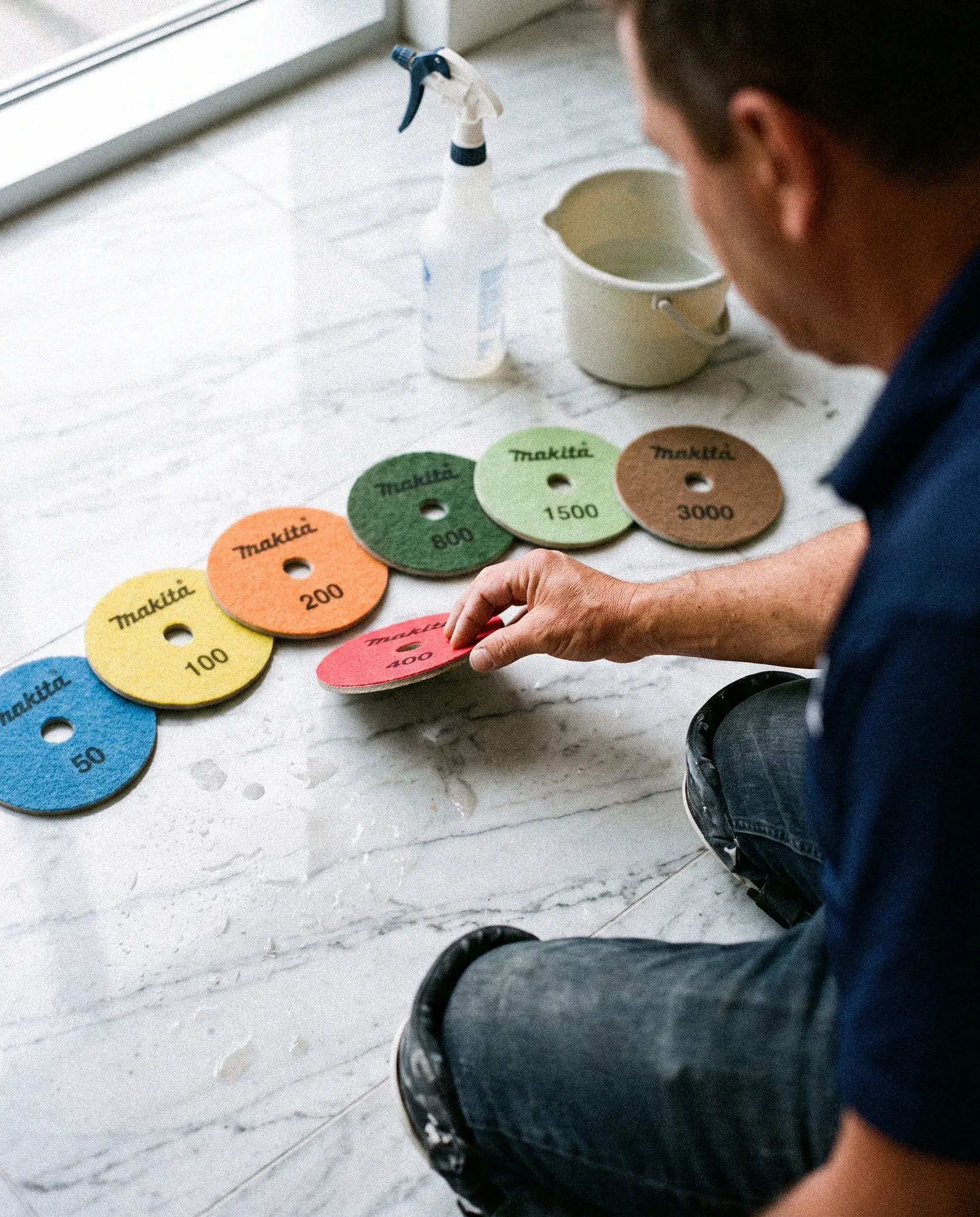
A Marble Mechanics technician laying out diamond polishing pads in grit order on a white marble floor, from the coarsest to the finest
Each grit takes out the scratches the one before it left. That progression is the repair; the polish at the end is only the finish.
  • Assessment. What the stone is, what has been put on it, and whether the problem is on the surface or in it.
  • Stripping, where needed. Old wax and acrylic coatings come off before anything else can be judged.
  • Honing. Progressive diamond abrasives remove scratches, etch marks and traffic lane wear. This is the step that does the actual repair.
  • Polishing. Successively finer abrasives bring the surface to the finish you want, matte through to a mirror.
  • Sealing. A penetrating sealer chosen for the exposure, which on a Gulf-facing property is not the same choice as inland.

For residential marble floors in moderate traffic, professional polishing every 2 to 3 years keeps the finish ahead of the wear. Commercial and common-area floors in a busy building need attention sooner.

What Marble Polishing in Clearwater Costs

Every job is priced after we see the stone. Two floors that look identical from across the room can need very different work once you get close to them.

What determines the cost:

  • Square footage, and whether it is one area or a whole common-area circuit.
  • How far the finish has been worn down, which sets the starting grit and the number of passes.
  • Whether there are coatings to strip before the marble can be worked.
  • How much etching, scratching and traffic lane wear there is.
  • Access and scheduling in an occupied building, which is a real factor on the islands.

Every project starts with a free on-site assessment and a written, line-by-line quote before any work begins. For association work that is the document your board needs in order to approve it.

Why choose Marble Mechanics

Why Choose Marble Mechanics

Owner-Operated, Not a Franchise

Oscar Tineo has 27+ years of hands-on marble restoration experience. When you call Marble Mechanics you get Oscar, not a rotating crew following a corporate manual.

Coastal Pinellas Knowledge

Salt air, Gulf humidity and hard water do things to marble that a technique learned in a drier state does not account for. Marble Mechanics has worked exclusively in this market for 27+ years.

Diamond Polishing, Not Coatings

We restore the stone itself using progressive diamond abrasives. The results are permanent until new damage occurs. We never use wax, acrylic coatings, or temporary shine products that wear off in weeks.

Free Assessment, Written Quote

Every job starts with a free on-site assessment and a written, line-by-line quote before any work begins. Associations get the same document their board needs to approve it.

Frequently asked

Clearwater Marble Polishing FAQ

The questions homeowners ask us most, answered before you book.

The questions Clearwater owners, boards and managers ask most.

Book an estimate
Does MARBLELIFE work on countertops?

Marble Mechanics works on countertops as well as floors, and the process is the same stone work at a smaller scale: hone out the etching and scratches with diamond abrasives, bring the finish back up, then seal. Kitchen islands, bathroom vanities, bar tops and shower surrounds are all routine. On a counter the acid damage is usually worse than on a floor, because that is where the lemon, wine and cleaning spray land.

Does MARBLELIFE clean grout?

Marble Mechanics cleans and seals grout, and on a stone floor it is part of the same visit rather than a separate trade. Grout lines hold dirt long after the tile is clean, so the floor still reads as dull once the stone is done. Lines are scrubbed individually, and color sealing is available where the grout is stained beyond cleaning. In a condominium the work is staged so a route stays open and the building keeps running.

How do you make cultured marble look new again?

Cultured marble is not stone. It is a resin and dust casting with a gel coat on top, so the diamond work that restores real marble will cut straight through it. What brings cultured marble back is compounding and buffing the gel coat, which is closer to auto body work than stone restoration. If the gel coat has worn through, it needs refinishing rather than polishing. Natural marble is the opposite case: it is solid through its thickness, so the surface can be taken down and recut as many times as it needs.

How long do marble floors last?

Centuries, which is the point of restoring rather than replacing. Marble is solid stone through its full thickness, so what wears out is the finish on top rather than the floor itself. A lobby floor walked on for thirty years is not worn out, it has a worn surface, and that surface can be ground flat and recut. Floors that get replaced are nearly always replaced because nobody knew the stone could be brought back.

What is the lifespan of marble flooring?

Longer than the building in most cases, as long as the surface is maintained. Marble installed in Tampa Bay in the 1980s and 1990s is still sound stone today. What has usually failed on those floors is the sealer, the old wax or acrylic coating somebody put down, and the finish itself, all of which come off and go back. The stone underneath is what it was when it was laid.

How often does coastal marble need to be resealed?

More often than inland marble, and the honest answer comes from testing rather than a calendar. Put a few drops of water on the stone: if it beads, the sealer is working; if the marble darkens as it absorbs, the sealer has gone. On a Gulf-facing property that point tends to arrive sooner than the manufacturer's interval suggests.

Can I use Swiffer wet mop on marble floors?

Not with the wet pads, no. Swiffer wet refills carry cleaning agents that are not pH neutral, and on marble anything acidic etches the surface: a dull mark that is the stone dissolved away, not dirt sitting on it. The dry pads are fine for picking up grit, which is worth doing often because grit is what scratches marble underfoot. For washing, use a pH neutral cleaner made for stone, a damp microfiber mop rather than a wet one, and dry the floor after.

What should you not clean marble with?

Nothing acidic and nothing abrasive. Vinegar, lemon, bleach, bathroom and tile cleaners and most general purpose sprays etch marble on contact, and an etch is not dirt: it is the surface dissolved away, so cleaning will never take it out. Scouring powders scratch it. Wax and shine products build up and yellow. A pH neutral cleaner made for stone, a damp microfiber mop and drying afterwards is the whole routine, and etching that has already happened is honed out and repolished rather than cleaned off.

Service areas

Serving Clearwater and Pinellas County

Marble Mechanics works throughout Pinellas County and the wider Tampa Bay region.

Marble Mechanics stone restoration service area map for Tampa Bay The 6 Florida counties Marble Mechanics serves: Hillsborough, Pinellas, Pasco, Manatee, Sarasota, Polk. 40 cities are marked. Hillsborough County, 33 cities served Pinellas County, 19 cities served Pasco County, 9 cities served Manatee County, 8 cities served Sarasota County, 5 cities served Polk County, 5 cities served Valrico, Hillsborough County Westchase, Hillsborough County Carrollwood, Hillsborough County Lutz, Hillsborough County Ruskin, Hillsborough County Apollo Beach, Hillsborough County Temple Terrace, Hillsborough County Sun City Center, Hillsborough County Largo, Pinellas County Dunedin, Pinellas County Palm Harbor, Pinellas County Tarpon Springs, Pinellas County Seminole, Pinellas County Pinellas Park, Pinellas County St. Pete Beach, Pinellas County Land O Lakes, Pasco County New Port Richey, Pasco County Trinity, Pasco County Zephyrhills, Pasco County Palmetto, Manatee County Lakewood Ranch, Manatee County Parrish, Manatee County Osprey, Sarasota County Siesta Key, Sarasota County Winter Haven, Polk County Auburndale, Polk County Bartow, Polk County Davenport, Polk County Tampa, Hillsborough County Tampa Brandon, Hillsborough County Brandon Plant City, Hillsborough County Plant City St. Petersburg, Pinellas County St. Petersburg Clearwater, Pinellas County Clearwater Wesley Chapel, Pasco County Wesley Chapel Dade City, Pasco County Dade City Bradenton, Manatee County Bradenton Sarasota, Sarasota County Sarasota Venice, Sarasota County Venice Lakeland, Polk County Lakeland Riverview, Hillsborough County Riverview
Stone restoration across 79 cities in Tampa Bay. Based in Tampa.
Hillsborough County 33

Tampa, South Tampa, Davis Islands, Hyde Park, Bayshore Beautiful, Palma Ceia, Beach Park, Culbreath Isles, Avila, Swann Estates, Harbour Island, Westshore, Channelside, Brandon, Riverview, Valrico, Seffner, Mango, Lithia, Fish Hawk, Plant City, Ruskin, Sun City Center, Apollo Beach, Gibsonton, Carrollwood, Lutz, Temple Terrace, Westchase, New Tampa, Town N Country, Ybor City, Seminole Heights

Pinellas County 19

St. Petersburg, Clearwater, Largo, Dunedin, Palm Harbor, Safety Harbor, Tarpon Springs, Tierra Verde, St. Pete Beach, Treasure Island, Madeira Beach, Indian Rocks Beach, Redington Beach, Indian Shores, Seminole, Pinellas Park, Gulfport, Belleair, Pass-a-Grille

Pasco County 9

Wesley Chapel, Land O Lakes, New Port Richey, Port Richey, Hudson, Odessa, Trinity, Zephyrhills, Dade City

Manatee County 8

Bradenton, Palmetto, Lakewood Ranch, Anna Maria Island, Holmes Beach, Longboat Key, Parrish, Ellenton

Sarasota County 5

Sarasota, Osprey, Venice, Nokomis, Siesta Key

Polk County 5

Lakeland, Winter Haven, Auburndale, Bartow, Davenport