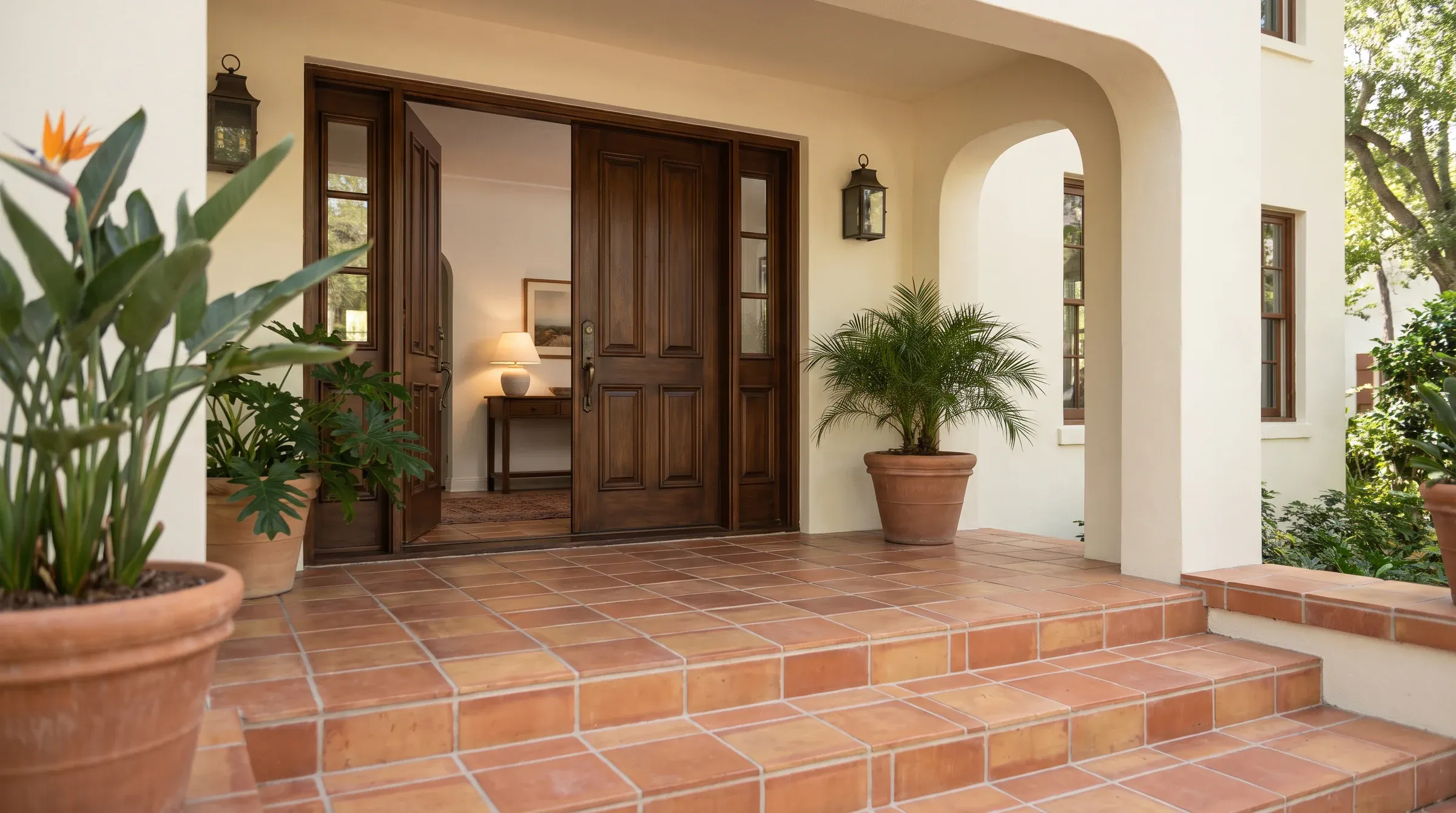
Walk through the front door of a 1920s Mediterranean Revival bungalow in Hyde Park, a waterfront estate on Davis Islands, or a Spanish Colonial on Snell Isle. Odds are, the floor underfoot is Saltillo tile. That warm, handmade clay tile from Saltillo, Mexico has defined Tampa Bay's most characterful homes for over a century.
It's also one of the most misunderstood surfaces in Florida. Homeowners inherit it, struggle with it, or unknowingly ruin it with the wrong cleaner. Tampa Bay's heat, humidity, and seasonal storms don't help. After Hurricanes Helene and Milton struck Siesta Key in October 2024 with up to five feet of storm surge, Saltillo tile was the only flooring type to survive intact in many coastal homes while wood floors warped and carpet was destroyed.
Saltillo is fired clay, not stone, so tile standards govern it rather than stone ones. The Tile Council of North America is the reference for its installation and grout, and the Natural Stone Institute covers the sealing side, which is where most of the damage we are called to repair actually starts.
This guide covers where Saltillo tile lives in Tampa Bay, which neighborhoods are most likely to have it, why Florida's climate attacks it faster than anywhere else, and what professional restoration actually involves.
TL;DR: Tampa Bay's beloved handmade Mexican Saltillo clay tile thrives in historic districts from Hyde Park to Old Northeast St. Pete and in luxury estates across Davis Islands, Culbreath Isles, and Siesta Key. Florida humidity forces resealing every 1 to 2 years outdoors. Professional restoration costs $4 to $10 per square foot versus $10 to $20 per square foot to replace. Marble Mechanics has 27+ years restoring Saltillo across Tampa Bay.
Where Did Saltillo Tile Come From, and Why Did Tampa Bay Fall for It?
Artisans in Saltillo, Coahuila, Mexico have handcrafted these clay tiles using the same sun-dried, kiln-fired methods since the 1500s. That's over 500 years of continuous production. Natural river clay is extracted, shaped by hand in wooden molds, sun-dried, and kiln-fired for 18 to 24 hours. The result is a porous, unglazed tile with warm earth tones that no manufactured product fully replicates.
Tampa Bay's Spanish Revival and Mediterranean building booms of the 1920s through the 2000s were the perfect landing spot for this material. The Mediterranean Revival architectural style, with its stucco walls, arched windows, red clay tile roofs, and wrought-iron details, demanded surfaces that felt crafted rather than factory-made. Saltillo delivered exactly that. Its reds, burnt oranges, and sandy browns fit the aesthetic perfectly. And before central air conditioning, the tile's thermal properties meant it stayed noticeably cooler underfoot than ceramic or porcelain, a practical advantage in Florida's heat.
That's why Saltillo tile installations in Tampa Bay cluster in two distinct eras. The first is the 1920s to 1940s historic home wave, when Mediterranean Revival and Spanish Colonial builders in Hyde Park, Ybor City, and Seminole Heights specified it as part of original construction. The second is the 1980s to 2000s luxury estate wave, when custom home builders in gated communities from Davis Islands to Avila chose Saltillo to evoke that same warm, handcrafted character in newer builds.
Our finding: A Saltillo floor installed in a 1928 Hyde Park bungalow and one installed in a 2001 Davis Islands estate are the same material, but they require very different restoration approaches. The older floor has likely had 15 to 20+ coats of sealer applied over decades and often needs multiple stripping passes before restoration can begin. The newer floor typically has failed sealer from Florida humidity but retains a cleaner clay surface underneath.
What's made Saltillo endure is the very thing that makes it challenging to maintain: no two tiles are identical. Color variations, organic texture differences, and the occasional animal paw print from the sun-drying stage are features of authentic Saltillo, not defects. That irreplaceable handmade character is why restoration almost always makes more sense than replacement. You can learn about our full Saltillo tile restoration process on the service page.
Which Tampa Bay Neighborhoods Still Have Saltillo Tile Floors?
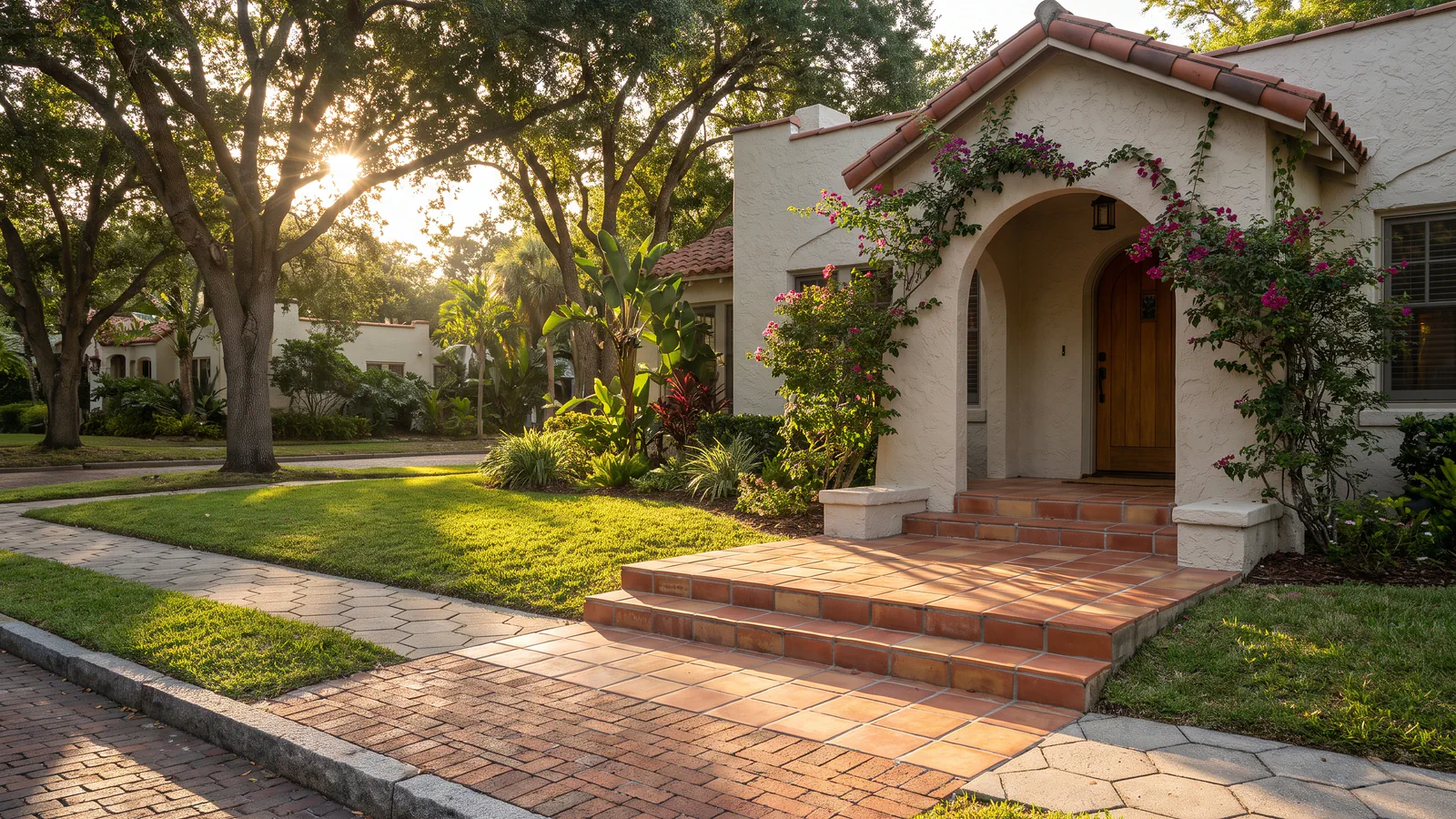
Tampa Bay's Saltillo tile concentrates most heavily in neighborhoods built during the Spanish Revival and Mediterranean Revival periods of the 1920s to 1940s, where it was specified as part of original construction. Today, six neighborhoods across the metro are the most reliable addresses for original clay tile floors.
Hyde Park: Tampa's First Planned Luxury Historic District
Hyde Park is home to 1,264 contributing historic buildings across 560 acres, making it one of Florida's most intact collections of early 20th-century residential architecture. Its Mediterranean Revival homes, some dating to 1905, frequently retain original Saltillo tile in entryways, kitchens, and interior courtyards. These floors are now 80 to 100 years old, and they've often accumulated decades of sealer buildup that requires full professional stripping before restoration is possible.
Seminole Heights: Where Terra Cotta Built the Aesthetic
The City of Tampa's own design guidelines describe Seminole Heights plainly: "Stucco, terra cotta tile and cast concrete were used to create a fantasy land of Spanish castles and Venetian palazzos." Seminole Heights bungalows from the 1910s and 1920s used terra cotta tile, a close relative of Saltillo, as a defining material. Many homeowners doing renovations today find original clay tile floors hidden under linoleum and carpet installed in the 1950s to 70s.
Ybor City: 956 Historic Buildings with Spanish-Cuban Roots
Ybor City's 956-building historic district carries one of the most concentrated collections of Spanish-Cuban architecture in the United States. The cigar factories and worker housing of the 1880s to 1920s used clay and terra cotta tile extensively. Ybor's ongoing renovation wave keeps uncovering original floors that haven't been properly maintained in 40+ years.
Old Northeast, St. Petersburg: A National Register Mediterranean Showcase
Across the bay, Old Northeast is listed on the National Register of Historic Places and described as "one of the best-preserved examples of early 20th-century residential architecture in Florida." Its Mediterranean Revival, Mission Revival, and Colonial Revival homes share the same design DNA as Hyde Park, including the same prevalence of original clay tile floors. Home prices here run $1M to $3M, attracting buyers who want both historic character and modern renovation quality.
Snell Isle and Venetian Isles: St. Pete's Waterfront Mediterranean Enclaves
Snell Isle ($1.62M median listing) and Venetian Isles both feature Mediterranean-style custom waterfront homes. These premium St. Petersburg neighborhoods have private docks, luxury finishes, and a high concentration of Saltillo tile on interior floors, outdoor lanais, and pool decks.
Saltillo Tile in Tampa Bay's Luxury Estates: What to Know Before You Call
Davis Islands ($1.39M median), Culbreath Isles ($2.94M median), and the gated estates of Avila are among Tampa Bay's highest-value addresses, and also among the most likely to have Saltillo tile on interior floors, outdoor lanais, and pool decks. Most was installed during custom home construction between the 1970s and early 2000s, making these floors 20 to 50 years old and frequently overdue for professional attention.
After 27 years restoring tile and stone across Tampa Bay, we've seen a consistent pattern: the more expensive the home, the more likely the Saltillo was installed correctly, but the less likely it's been properly maintained. High-end homes that have passed through multiple owners often have 15 to 20 layers of failed sealer on the tile surface. The tile itself is usually in excellent structural condition underneath all of it. Complete stripping back to bare clay reveals that condition every time.
Here's where Saltillo appears most reliably across Tampa Bay's luxury market:
- Davis Islands: Mediterranean-inspired architecture, custom estates, listings to $20M. Grand foyers and open great rooms frequently feature Saltillo. Pool decks and outdoor lanais are common locations.
- Culbreath Isles: Deep-water canal gated community, $2.94M median, $2,000/month HOA fees. Interior Saltillo in kitchens and living rooms was a popular original specification in its 1970s to 90s builds.
- Avila (North Tampa): 900-acre gated golf community with Mediterranean Tuscan and brick Colonial architecture. Custom homes over 4,000 sq ft, with Saltillo appearing frequently in outdoor living areas and poolside spaces.
- Palma Ceia: Historic luxury neighborhood with a country club and $1.18M median sale price. Older homes are prime candidates for original Saltillo or terra cotta in kitchens and entryways.
- Bayshore Beautiful: Along Bayshore Boulevard, waterfront properties with sweeping water views and extensive natural stone designs. Saltillo shows up frequently in screened lanais and outdoor entertainment areas.
- Siesta Key: When Hurricanes Helene and Milton pushed storm surge into coastal homes in October 2024, Saltillo was the only flooring product to survive the flooding intact. Many Siesta Key homeowners are currently having their post-hurricane tile professionally stripped and resealed.
Why Does Saltillo Tile Fail Faster in Tampa Bay Than Almost Anywhere Else?
Saltillo tile needs professional resealing every 1 to 2 years for outdoor Tampa Bay installations, roughly twice as often as in drier climates like Arizona or Texas. Florida's combination of high soil moisture, heavy seasonal rain, and UV intensity attacks the sealer from three directions simultaneously. Knowing why helps homeowners catch problems before they become expensive.
Efflorescence: The White Stuff That Won't Quit
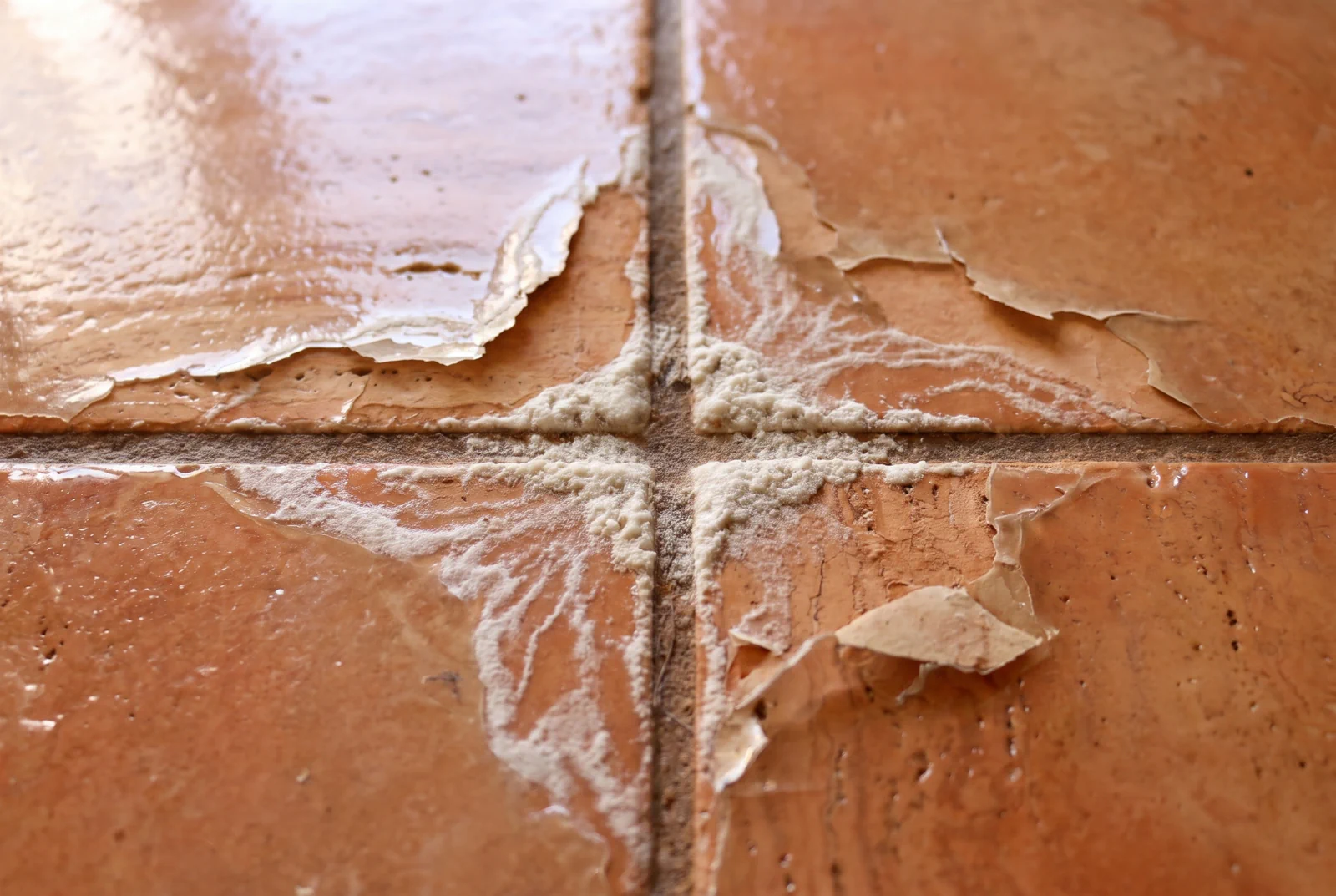
Efflorescence is Tampa Bay's most common Saltillo tile complaint. Moisture migrates upward through the porous clay from damp soil beneath the slab, carrying dissolved mineral salts. When that moisture evaporates at the tile surface, the salts remain as white, chalky deposits that no amount of mopping removes. Tampa's high annual rainfall and humidity keep the soil beneath ground-floor slabs perpetually damp, making efflorescence a near-constant pressure rather than a seasonal issue.
Sealer Failure: Layers Upon Layers
High-gloss sealers are especially prone to peeling and turning milky-white in Florida's humidity. New coatings applied over failing ones trap moisture beneath them, causing delamination throughout the surface. It's not unusual to find 8 to 12 failed sealer layers on a Tampa Bay Saltillo floor that's had multiple owners. Each layer feels solid when you walk on it, but the adhesion failure underneath accelerates the deterioration of everything above.
UV Fading on Outdoor Tile
Florida's UV index is among the highest in the continental United States. Without UV-protective topical sealers, outdoor Saltillo tile on south- and west-facing patios can fade from warm burnt orange to a flat, pinkish-beige within 5 to 10 years of installation.
Hurricane Flood Recovery
The 2024 hurricane season demonstrated something counterintuitive: Saltillo tile handles flooding better than most other flooring options. When Hurricanes Helene and Milton drove five feet of storm surge into coastal Siesta Key homes, wood floors warped, carpets were destroyed, and laminate products failed. Saltillo tile remained structurally intact. Flooded Saltillo still needs professional restoration (strip, efflorescence treatment, reseal), but the tile itself doesn't buckle or delaminate from flooding.
Saltillo Tile Restoration vs. Replacement
Professional Saltillo tile restoration in Tampa Bay runs $4 to $10 per square foot for a full strip, clean, stain treatment, and reseal, compared to $10 to $20 per square foot to purchase and professionally install new tile. Restoration typically costs 50 to 70% less than replacement, and it preserves the original handmade character that no factory tile can reproduce.
That math matters even more when you consider what replacement actually means. Can you replace a 1928 Hyde Park Saltillo floor with new material and get the same result? Not really. Factory-pressed tiles lack the hand-formed irregularities, natural color variation, and patina of original tile. You can't buy your way back to that.
Our finding: Based on 27 years of Tampa Bay restoration work, more than 80% of Saltillo floors that homeowners initially believe need replacement can be fully restored. The deciding factors are structural tile damage (beyond 30% cracked makes restoration less economical), depth of sealer contamination, and whether efflorescence has caused subsurface damage to the clay body. In the vast majority of cases, even floors neglected for 35+ years, stripping back to bare clay reveals tile in excellent structural condition.
Restoration makes sense when:
- 70%+ of tiles are structurally intact
- The floor has architectural significance (historic home, original installation)
- Budget matters: restoration runs 50 to 70% less than replacement
- You want to preserve irreplaceable handmade character
Replacement makes sense when:
- More than 30% of tiles are severely cracked or missing
- The subfloor has structural water damage requiring full demolition
- You're doing a complete architectural renovation that changes the floor plan
You can get a free estimate for your Saltillo tile before deciding either way.
What Professional Saltillo Tile Restoration in Tampa Bay Actually Involves
Professional Saltillo restoration in Tampa Bay requires six sequential steps and specific equipment, including a 175 RPM rotary floor machine and commercial hot water extraction, that separates specialist work from the general tile cleaning services most homeowners call first. Here's what the process looks like from assessment through final seal.
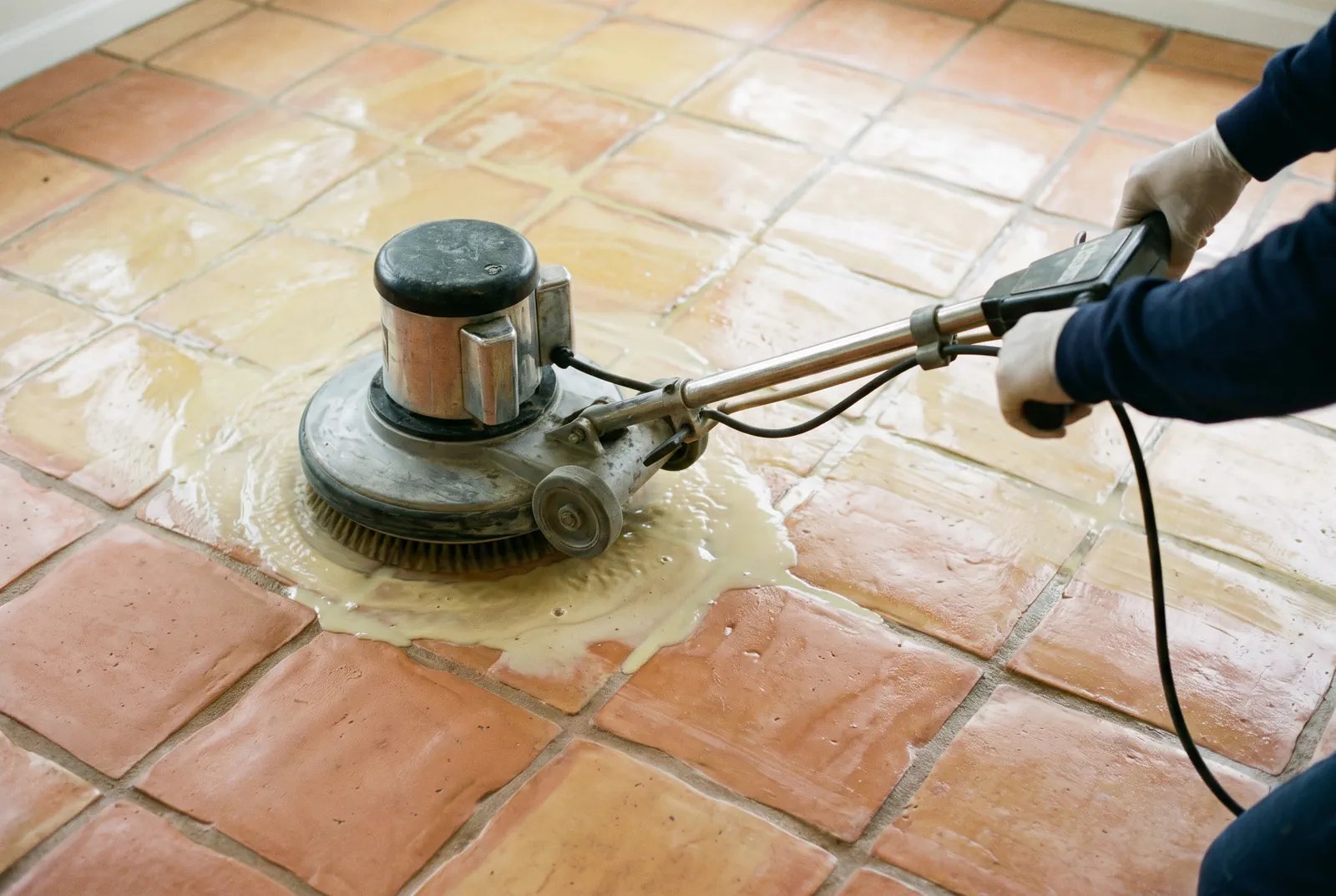
Step 1: Assessment and protection. The specialist identifies the existing sealer type, documents cracked tiles and stain locations, and protects baseboards, cabinets, and walls. This step determines whether the project is a one-day cleaning and reseal or a multi-day full restoration.
Step 2: Sealer stripping. Professional stripping solution penetrates the old sealer, a rotary machine scrubs the floor, and commercial vacuum equipment extracts the dissolved slurry. For floors with years of sealer buildup, this repeats until bare clay is fully exposed. Skipping this step and applying new sealer over old is the single most common DIY mistake: new sealer applied over failing old sealer fails within months.
Step 3: Deep cleaning. pH-neutral cleaners designed for natural clay surfaces clean the exposed tile without eroding it. Grout lines get individual scrubbing. Hot water extraction removes all chemical residue. Vinegar, bleach, and acidic cleaners that homeowners often try first are permanently damaging to Saltillo's clay body; they erode the surface and destroy the sealer.
Step 4: Stain treatment and crack repair. Poultice treatments draw embedded stains from within the clay. Cracked tiles get color-matched filler or individual replacement. Deteriorated grout gets repaired and color-sealed.
Step 5: Color enhancement (optional). Professional penetrating stains restore faded color or allow homeowners to shift from classic terra cotta to modern gray or whitewash finishes. Because the stain soaks into the clay body rather than sitting as a surface coating, it won't peel or chip.
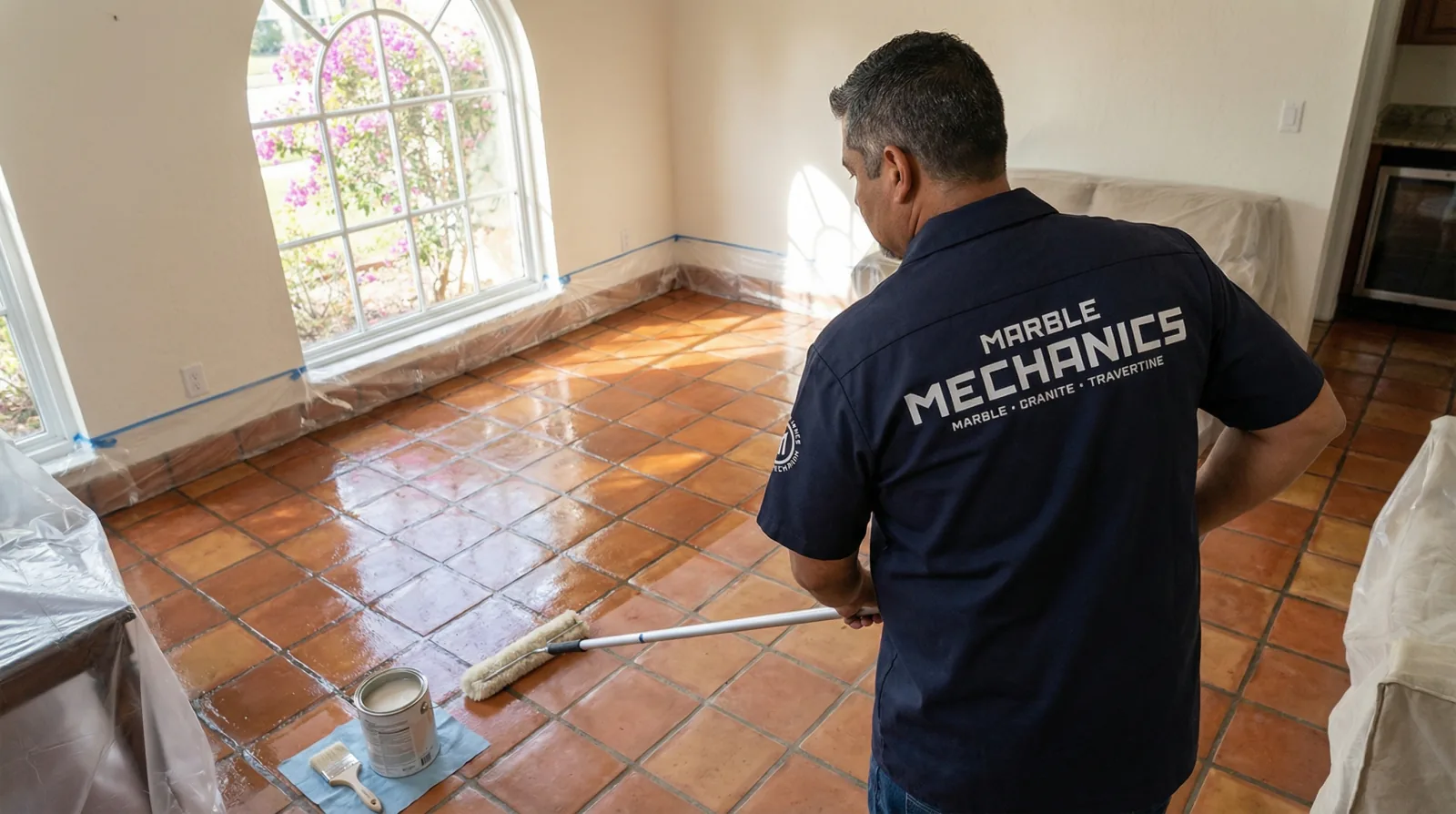
Step 6: Professional sealing. Three to four coats of premium sealer, applied with microfiber applicators. For Tampa Bay outdoor installations (patios, lanais, pool decks), solvent-based acrylic sealers rated for moisture and UV are essential. Interior floors use water-based urethane. Finish options: high gloss, satin, or matte. You can explore sealing options for Saltillo tile in more detail.
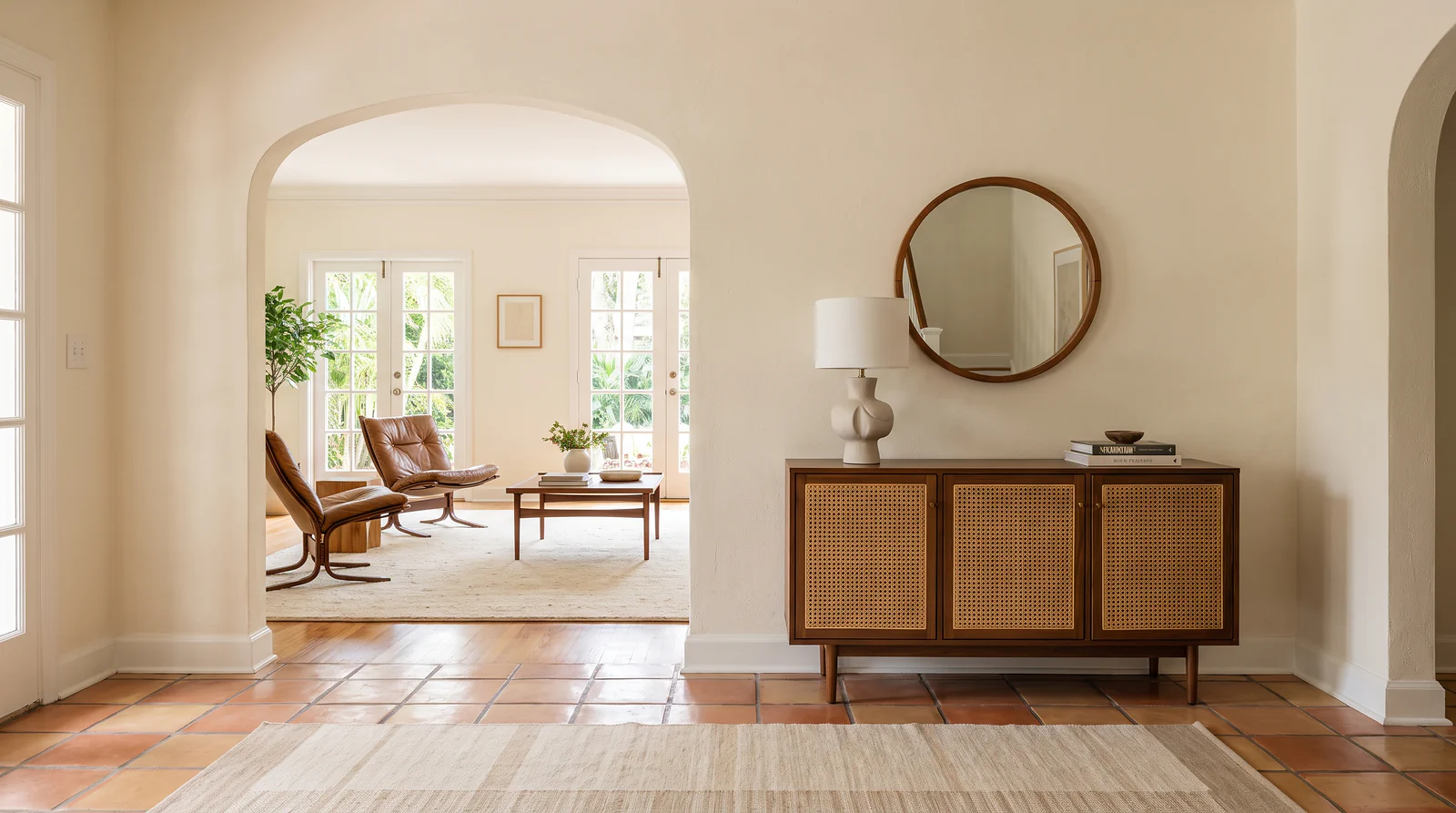
Saltillo Tile in Tampa Bay Is Worth Preserving
Saltillo tile is woven into the historic fabric of Hyde Park, Seminole Heights, Ybor City, and Old Northeast. Custom home builders in some of the region's most valuable waterfront estates have specified it for decades. It survived Florida's floods. It can survive Tampa Bay's climate. What it can't survive is neglect.
Florida's humidity will attack unsealed Saltillo within months. Efflorescence will cloud the surface. UV will fade the color. Bad cleaners will erode the clay. Every one of those problems is reversible with the right specialist, almost always for a fraction of what replacement costs.
If your floors look tired, cloudy, or faded, whether you're in a 1920s Hyde Park bungalow, a Culbreath Isles waterfront estate, or a coastal Siesta Key home still recovering from last hurricane season, contact Marble Mechanics for a free estimate. We've been restoring Saltillo tile across Tampa Bay for 27+ years.