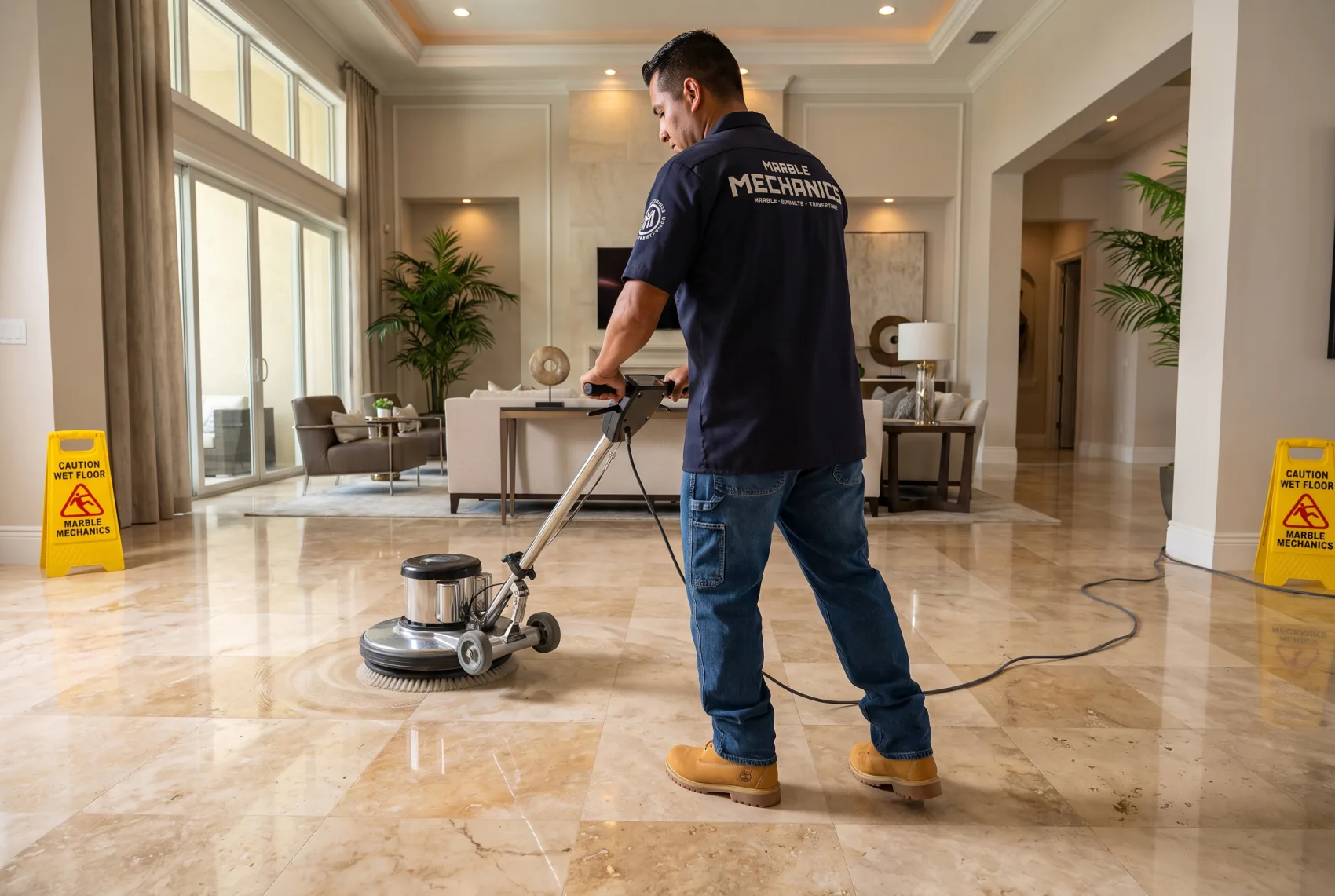
Restoration
- Scratch Removal
- Etch Removal
- Stain Removal
- Crack Repair
- Hole and Pit Filling
Travertine is the most common natural stone in Florida homes and the least understood.
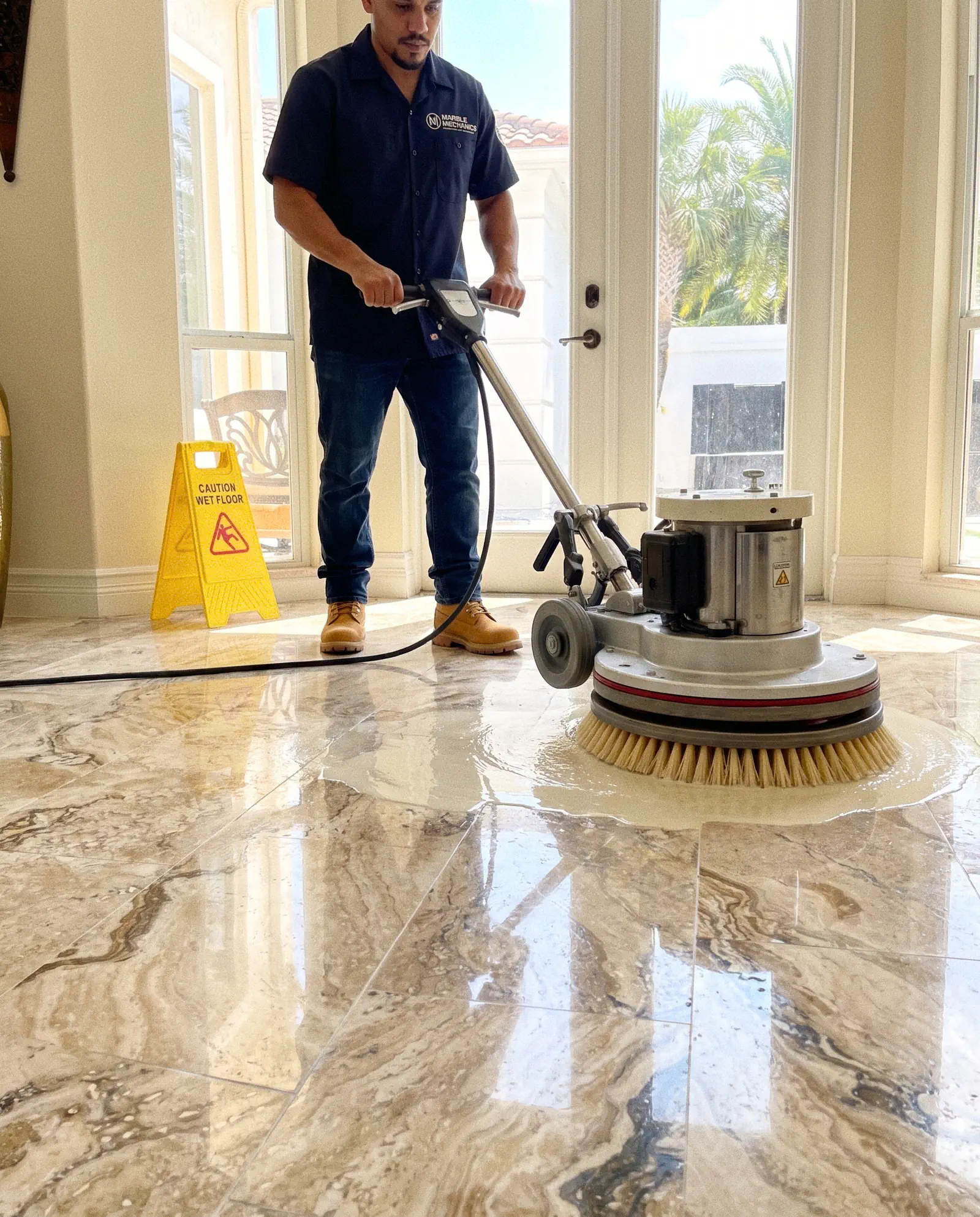
Marble Mechanics restores travertine across Tampa Bay: floors, showers, countertops, pool decks and lanais. Etch and scratch removal, hole and pit filling, honing, polishing and penetrating sealer, using progressive diamond abrasives on the stone itself rather than a coating laid over the top of it. Oscar Tineo does the work personally.
That approach, repairing and refinishing the stone rather than coating it, is what the Natural Stone Institute describes as restoration, and it is the difference between work that lasts and a shine that wears off.
Call (813) 625-3377 for a free estimate, or read on for what actually goes wrong with travertine and what fixing it involves.
Travertine is a sedimentary stone formed over thousands of years from mineral-rich water in hot springs and caves. It is mostly calcium carbonate, the same family as marble and limestone. Two consequences follow, and between them they explain nearly every travertine problem we are called out to.
It reacts to acid. Anything acidic leaves a dull, etched mark where the surface has been chemically dissolved. Wine, coffee, citrus, tomato, vinegar and most household and bathroom cleaners all do it. An etch is not a stain and no amount of cleaning will remove it.
It formed with holes in it. Travertine has natural pits and voids running through it. On a finished floor those are filled and honed flush so the surface reads as solid. That fill is a wear item. As it breaks down the voids reopen, catch grit and water, and the process accelerates.
Everything else follows from those two facts: it is porous, it scratches and dulls from abrasive cleaning, and moisture left sitting on it will eventually push past the sealer.
This is the most common misunderstanding about travertine, and the reason people assume a floor or a counter is ruined when it is not.
A stain sits in the stone: something pigmented or oily has soaked into the pores, and it shows as a darker patch. An etch is missing stone: an acid has dissolved the polished surface, and it shows as a dull, lighter mark. Sealing prevents the first and does nothing about the second, because there is nothing sitting on the surface to clean off.
Etches are removed by taking the surface back to an even finish with progressive diamond abrasives. In almost every case they come out completely. On polished travertine an etch is more visible than on honed, simply because there is more shine for it to interrupt.
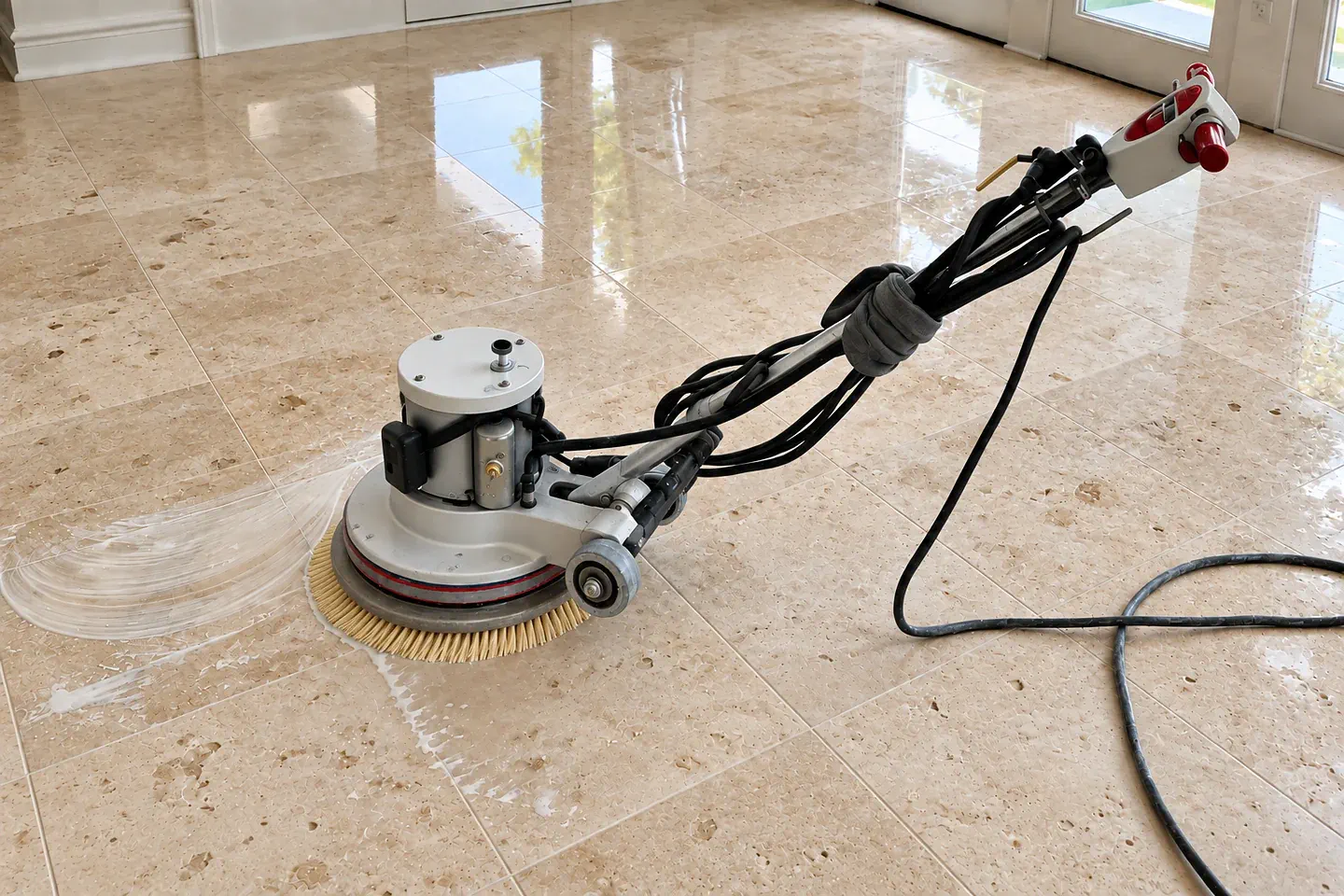
The second signature travertine problem. A floor that has gone rough underfoot, with small holes appearing across it, is telling you the fill has broken down, not that the stone has failed.
Filled travertine has resin or grout in its natural voids and behaves much like a flat tile. Unfilled travertine has those pits open, and they collect grit, water and whatever gets spilled. Most Tampa Bay residential installations are filled and honed, but it is one of the first things worth establishing, because it changes what the job is: an unfilled floor needs filling before any finishing happens.
Refilling uses color-matched material, ground flush with the surrounding stone and then honed as one surface. Left long enough, the edges of open voids begin to spall, and what was a refill becomes a resurfacing job.
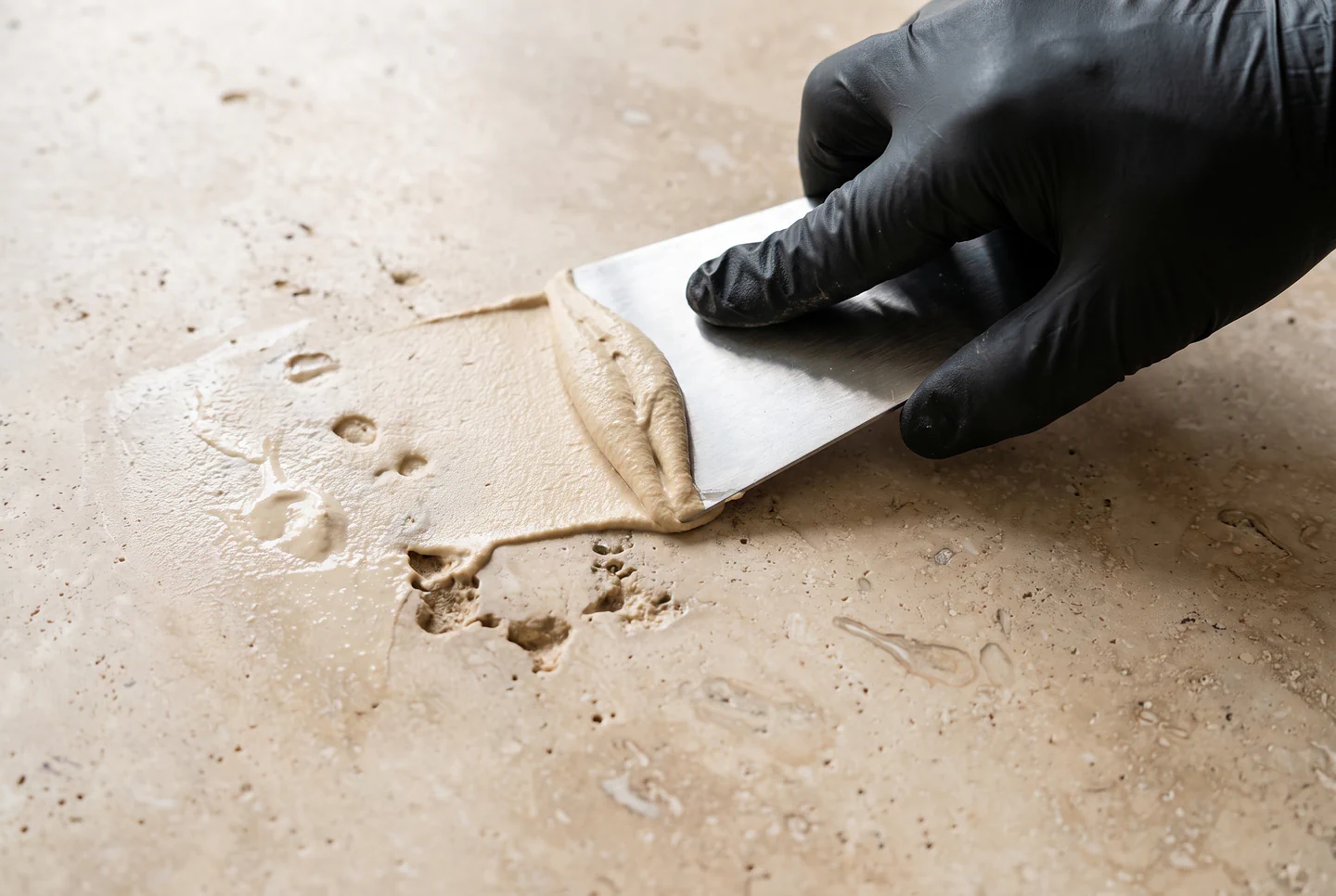
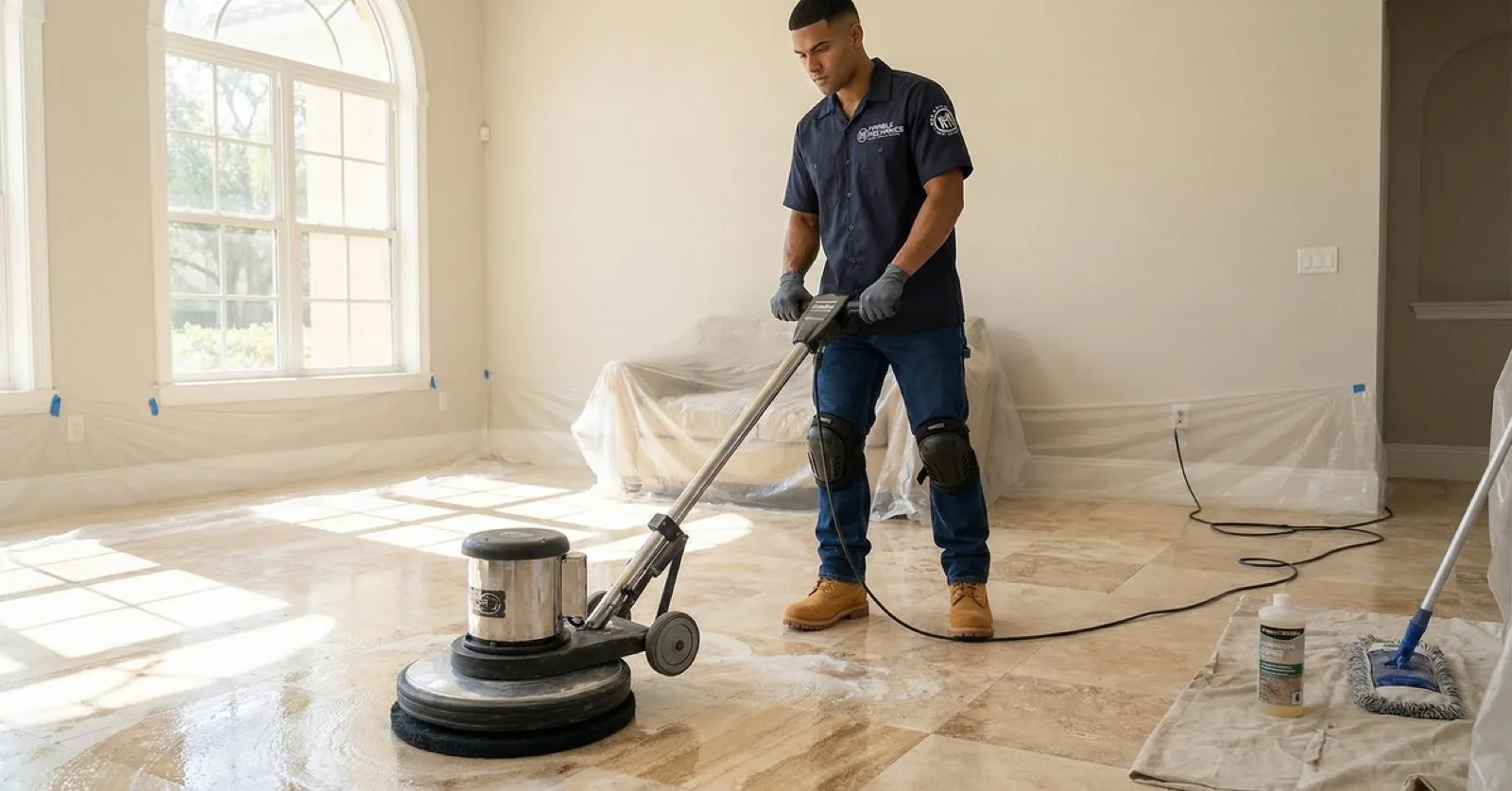
The sequence is consistent. What changes is the starting grit, the number of passes, and how much filling happens along the way.
The polishing is done wet, which keeps dust to a minimum, so you do not need to leave your home. A typical residential floor takes one to two days depending on square footage and condition.
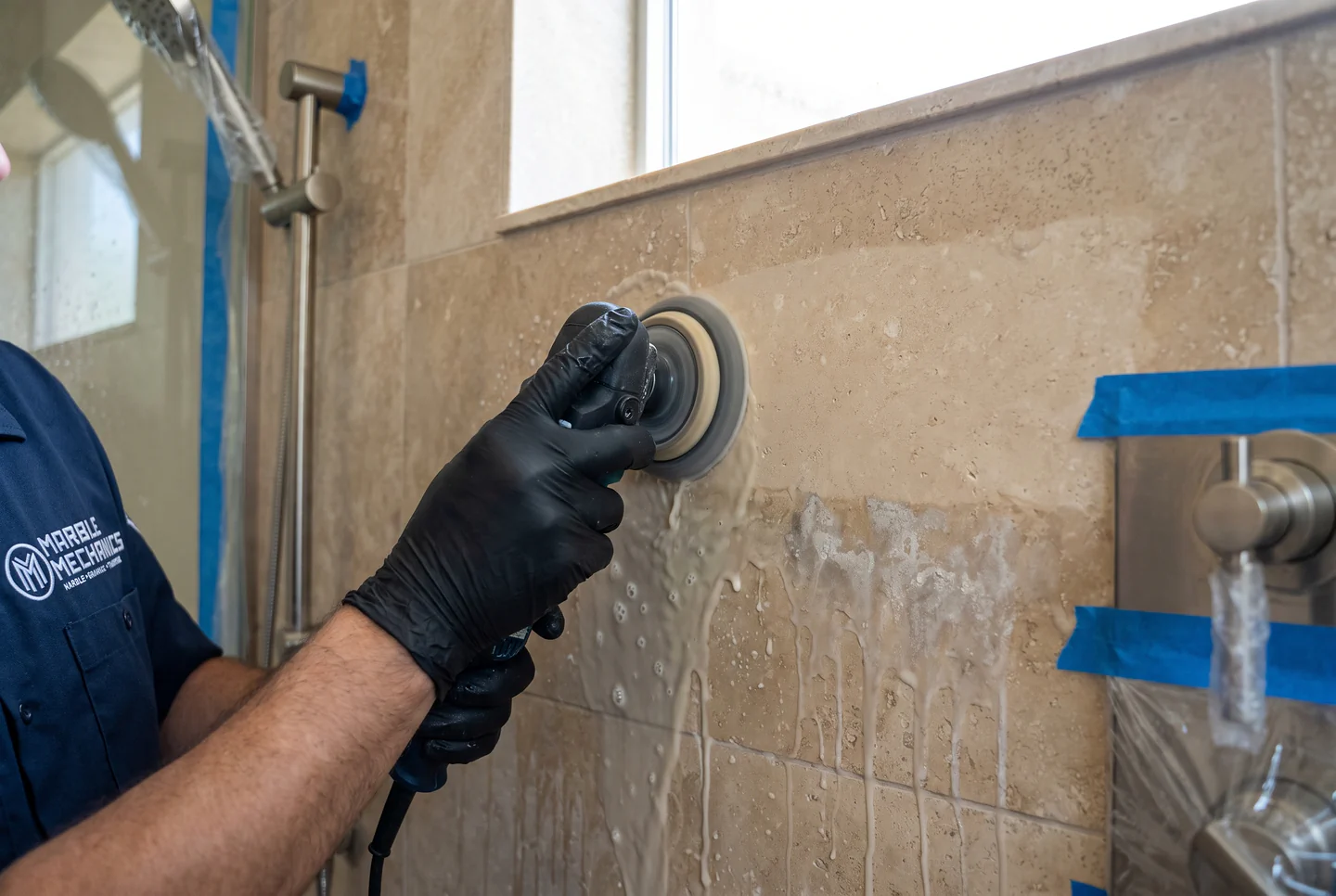
Travertine in a shower is beautiful and demanding for one reason: it stays wet. The threats are not dramatic, they are cumulative. Standing water, soap film, shampoo drips and hard water mineral deposits.
Tampa's municipal water carries high levels of dissolved minerals, so wherever it evaporates on a shower wall it leaves deposits that etch into the surface underneath. Cleaning takes the deposit off. It does not take the etch off. Restoring the surface does both, and the work is hard water removal, etch correction, honing and resealing, with the grout cleaned as part of the same visit.
Many shampoos and body washes are mildly acidic, which is why bottles left standing directly on a travertine bench leave rings. Trays and caddies solve it permanently.
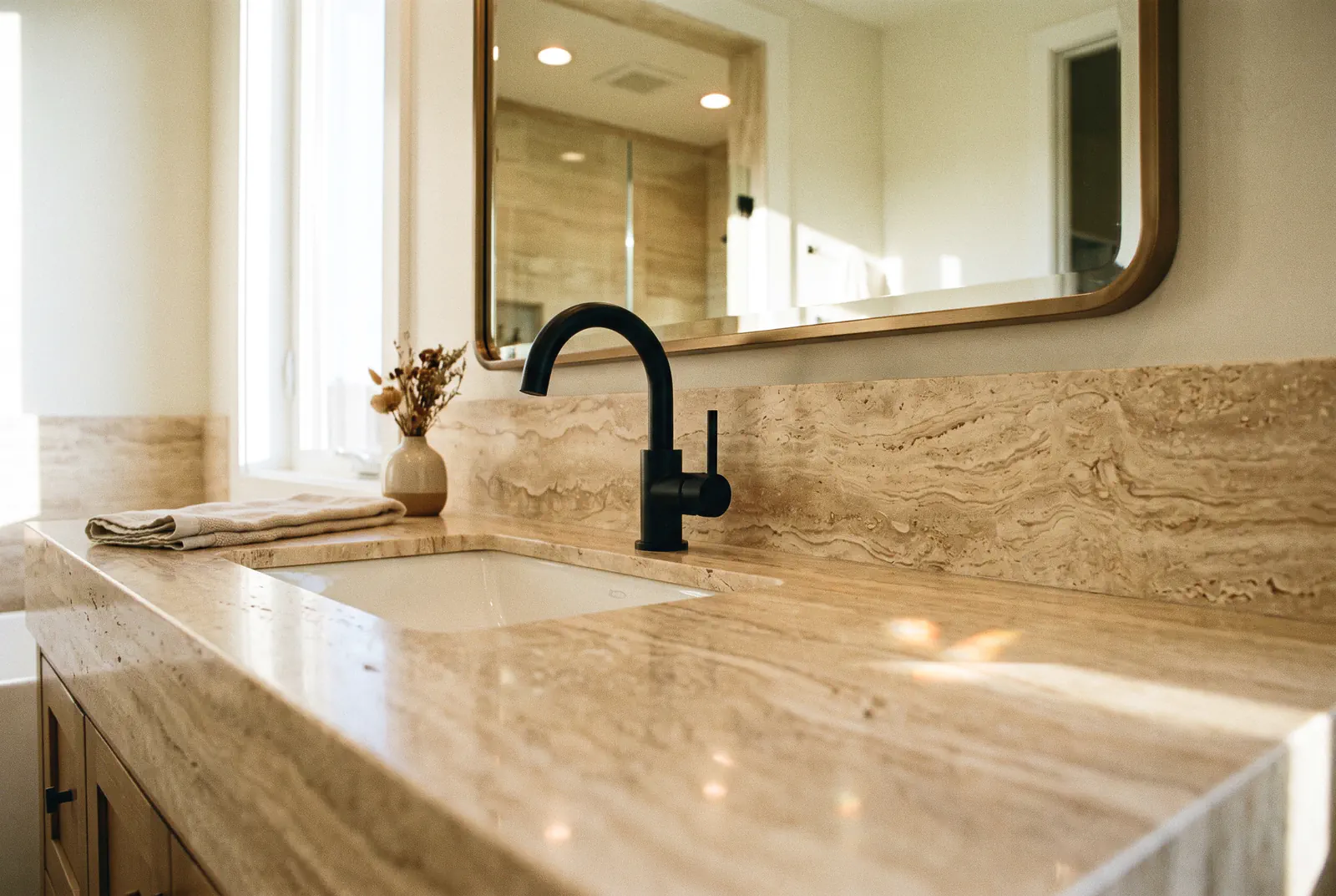
A travertine counter takes the same acids as a marble one and shows them the same way. Wine, juice, coffee, tomato and vinegar dressings can begin etching in under a minute, and most bathroom and glass cleaners are acidic enough to do it too.
Restoration is the same principle at a smaller scale: the etched surface is honed back to an even finish, voids refilled where the fill has gone, then polished and sealed. Chips at an edge or around a sink cutout are repaired with color-matched fill before finishing.
Day-to-day care for a travertine counter is covered in the stone countertop maintenance guide.
Outdoor travertine is the harshest case in Tampa Bay. Full sun degrades fill and sealer, summer rain drives moisture through the stone, pool chemistry works on the splash zone around the coping, and salt air adds to it on coastal properties.
The distinctive outdoor problems are efflorescence, the white chalky bloom left when mineral salts migrate to the surface and the water evaporates, and voids reopening faster than they would indoors. Efflorescence has to be treated and the deck has to be genuinely dry before any sealer goes down, because sealing over it traps it underneath.
An exterior deck is finished honed or tumbled for grip when wet, never polished to a gloss. For Clearwater and the barrier island properties, where this is most of the travertine on the ground, travertine polishing in Clearwater covers that market specifically. If the surface in question is brick or concrete paver rather than travertine, paver sealing is the right page.
Travertine lobby floors, corridors and entrances develop traffic lanes: dull channels worn through the finish exactly where people walk. Restoration takes the whole area back to an even finish rather than patching the lane, because a repaired stripe through a finished floor reads more obviously than the wear did.
Work in an occupied building is done in sections with a route kept open, and scheduled around use by arrangement. Larger commercial projects or heavily damaged surfaces may take three to four days.
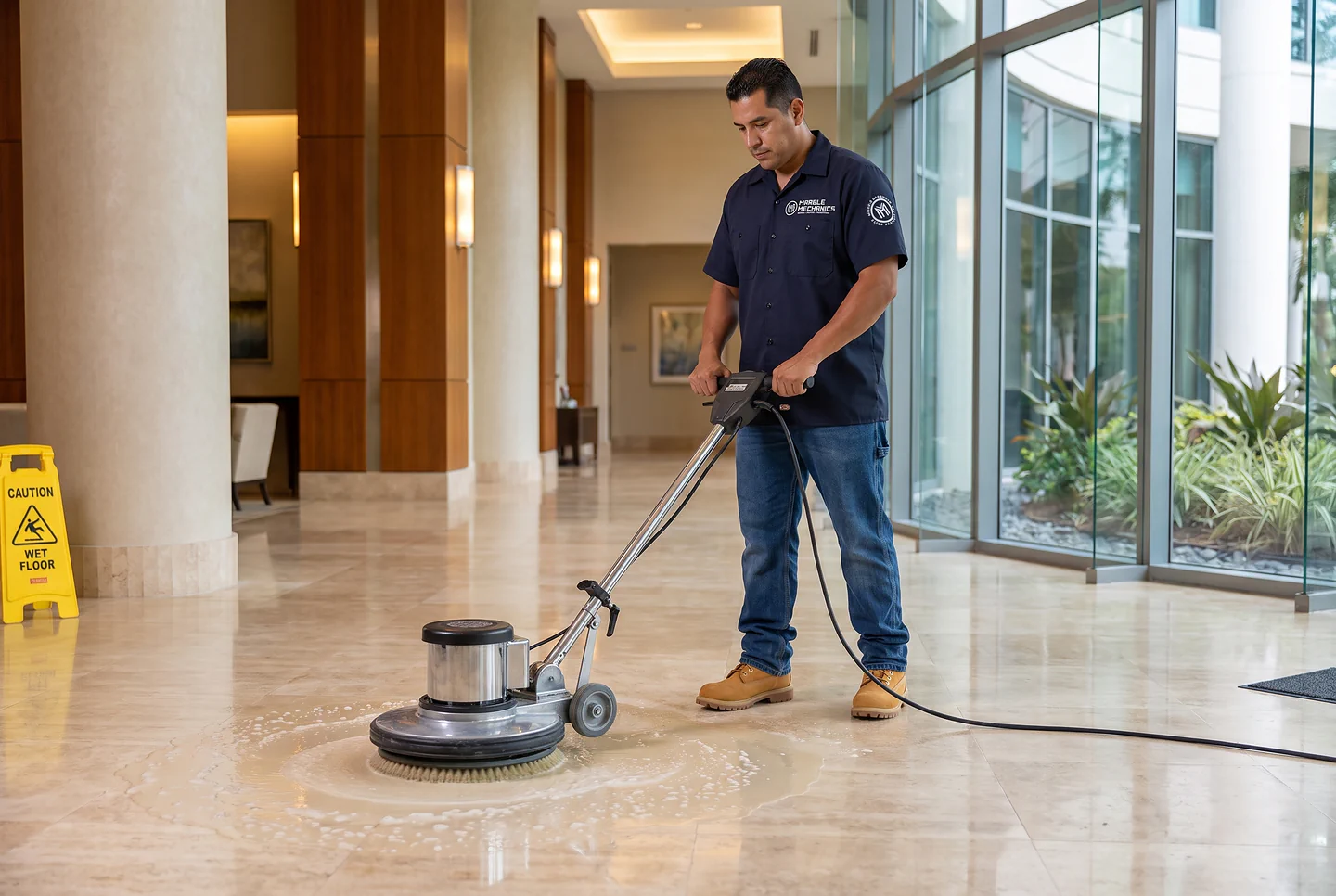
Honing stops at a mid grit and produces a smooth matte finish. Polishing continues through finer abrasives to a reflective one. Both are equally durable and both are sealed the same way. Honed hides subsequent marks better, which is why it suits floors and is the only sensible choice outdoors; polished shows the stone off and suits feature surfaces.
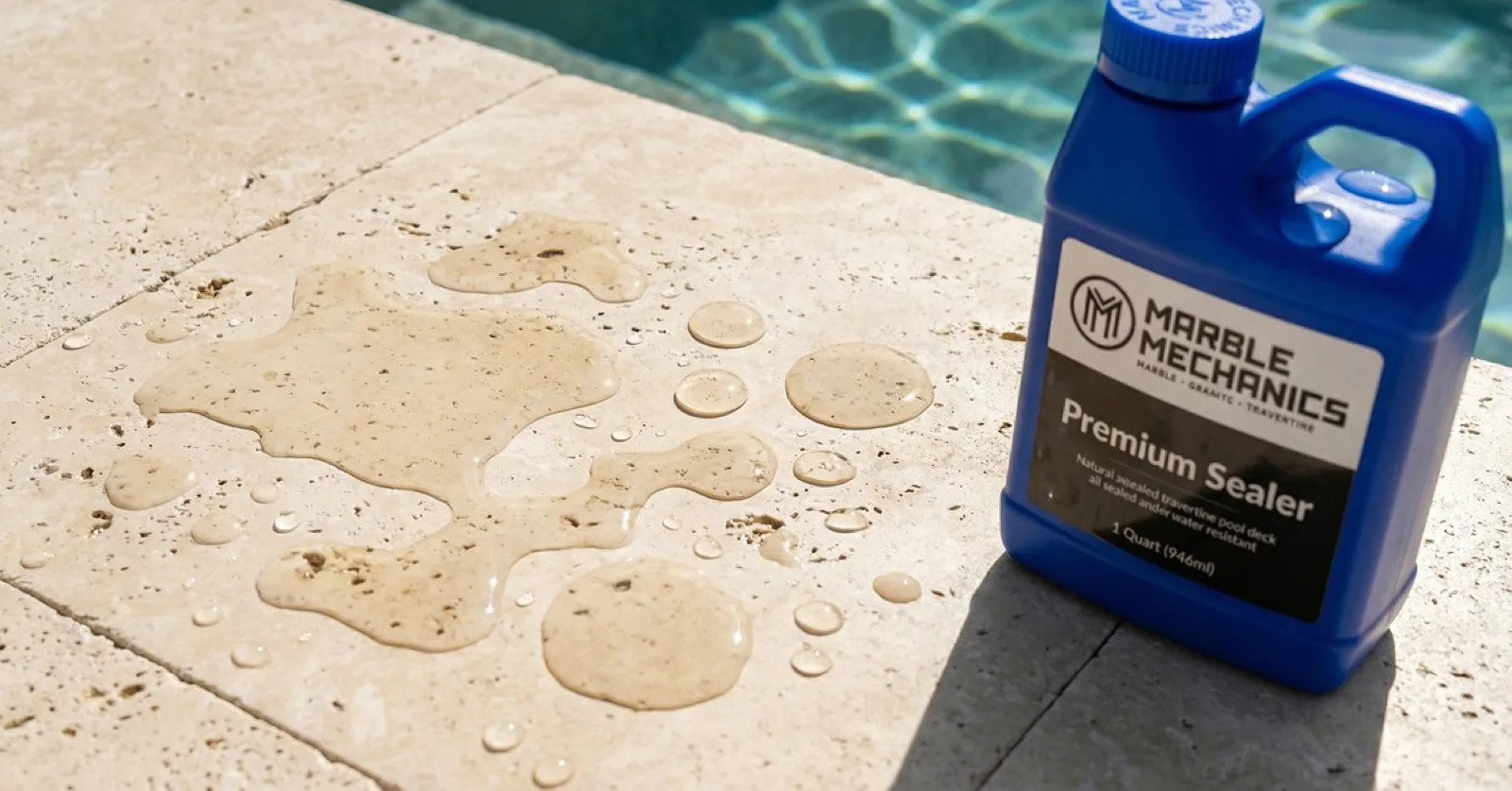
Travertine takes a penetrating sealer, an impregnator that soaks into the stone rather than sitting on top of it. It does not change how the stone looks or feels, it slows absorption. It also wears out invisibly: you will not see the sealer go, you will see water start to darken the stone and spills absorb faster than they used to.
That is the test worth knowing. Put a few drops of water on the surface and watch. If it beads, leave it alone. If the stone darkens within a few minutes, the sealer has worn through. In Florida that point arrives sooner than the interval printed on the product, and sooner again on anything exterior. The travertine maintenance guide covers the care routine between visits.
Every job is priced after we see the stone. That is not a dodge, it is the only honest way to quote this work: two floors that look identical from across the room can need very different work once you get close to them.
What determines the cost:
Every project starts with a free on-site assessment and a written, line-by-line quote before any work begins. No hidden fees, no surprises.
Travertine is not marble and does not respond to a marble process. Oscar Tineo has spent 27+ years on the stone types common in Tampa Bay homes, and travertine's pits, fill and acid sensitivity are their own discipline.
We restore the stone itself with progressive diamond abrasives, so the finish is the travertine. We never apply wax, acrylic or shine products, which build up, wear unevenly and have to be stripped before anyone can do the job properly.
Humidity around 74%, salt air on coastal properties, hard water and pool chemistry all shorten a sealer's life here. Sealing intervals get set by what your stone is doing, not by a number on a bottle.
Every job starts with a free on-site assessment and a written, line-by-line quote before any work begins. You approve the number before we touch the stone.
The questions homeowners ask us most, answered before you book.
The questions Tampa Bay travertine owners ask most. Something else in mind? We are happy to talk it through.
Book an estimateOnly if the floor is meant to be polished. Travertine takes a polished finish or a honed matte one and both are correct, so the first question is which one the floor had and which one you want. Where the finish has worn unevenly, polishing is what makes it one surface again. Where the stone is sound and simply dirty or unsealed, cleaning and sealing is the cheaper answer and polishing adds nothing. The free on-site assessment is where that gets decided rather than guessed.
Travertine is porous and it is formed with natural voids, so it asks more of you than a man made tile does. Unfilled travertine has open pits that catch grit, water and spills. Filled travertine behaves like a flat tile until the fill starts coming out, and then the holes reappear one at a time. It is also calcium based, so acid etches it: vinegar, citrus, wine and most bathroom cleaners leave dull marks that cleaning will not take out. None of that is a reason to avoid travertine. It is the reason travertine needs a working sealer and a honing and polishing pass every few years instead of a mop and a shine product.
It is treated that way in Tampa Bay, and it shows up where the budget was there to spend: entry floors, pool decks, bathrooms and whole ground floors in waterfront and estate homes. It is a natural stone cut from a single block, not a printed surface, so every tile is different and the look does not repeat the way a manufactured floor does. That is also why it is worth restoring. The stone is solid through its thickness, so the surface can be taken back and recut rather than replaced.
If the floor is dull because the finish has worn, the shine has to be cut back into the stone with progressive diamond abrasives, honing first to take the surface flat and then polishing it up. That is permanent until something new damages it. If the floor is dull because it is dirty or the sealer has failed, a strip, clean and reseal is the answer and it costs less. What does not work is a shine product or a wax, because that sits on top of the stone, holds dirt and wears off in weeks.
Yes. Most surface scratches can be removed completely through diamond honing and polishing. Deep gouges may require filling first, but the repaired area blends seamlessly with the surrounding stone once polished.
In most cases no, and where they are it is a texture difference rather than a color one. The fill is matched to the stone and ground flush with the surrounding surface, then the whole floor is honed as one piece, so the repair sits at the same level and takes the same finish. Travertine that has been left long enough for the edges of the voids to spall is the harder case, because there is less sound stone around the hole to blend into. That is worth establishing at the assessment rather than after the work.
Sealing is the final step of a full travertine restoration, so it is included whenever we hone or polish a floor. It is also available on its own for travertine that is structurally fine but has lost its protection and does not need refinishing. Which one you need depends on the condition of the surface, and that is what the free on-site assessment establishes. For how often travertine needs resealing in Florida conditions, our travertine maintenance guide covers it in detail.
Anything acidic, anything abrasive and anything that leaves a film. Vinegar, lemon, wine, bathroom and tile cleaners and most general purpose sprays etch travertine on contact, and an etch is not dirt: it is the surface eaten away, and it needs honing rather than cleaning. Scouring powders scratch it. Wax and shine products build up, trap dirt and make the next restoration harder than it needed to be. A pH neutral cleaner made for stone, a damp microfiber mop and drying afterwards is the whole routine.
Travertine usually costs less to buy and install than marble, which is part of why Tampa Bay has so much of it around pools and entries. Restoration is a different question. What drives the price there is condition rather than the name of the stone: how far the finish has worn, how much fill has been lost, how deep the etching goes and whether old coatings have to come off first. A travertine floor in poor condition can cost more to bring back than a marble floor in good condition.
Yes, and it changes what the job actually is. Filled travertine has resin or grout in its natural voids, so it behaves much like a flat tile and the work is mostly honing and polishing the surface. Unfilled travertine has open pits that catch grit, water and spills, so restoring it usually means filling before any finishing happens. Most Tampa Bay residential installations are filled and honed, but it is one of the first things we check on site.
We serve the entire Tampa Bay area within a 50 mile radius of our Tampa base. Call to check availability in your neighborhood.
Tampa, South Tampa, Davis Islands, Hyde Park, Bayshore Beautiful, Palma Ceia, Beach Park, Culbreath Isles, Avila, Swann Estates, Harbour Island, Westshore, Channelside, Brandon, Riverview, Valrico, Seffner, Mango, Lithia, Fish Hawk, Plant City, Ruskin, Sun City Center, Apollo Beach, Gibsonton, Carrollwood, Lutz, Temple Terrace, Westchase, New Tampa, Town N Country, Ybor City, Seminole Heights
St. Petersburg, Clearwater, Largo, Dunedin, Palm Harbor, Safety Harbor, Tarpon Springs, Tierra Verde, St. Pete Beach, Treasure Island, Madeira Beach, Indian Rocks Beach, Redington Beach, Indian Shores, Seminole, Pinellas Park, Gulfport, Belleair, Pass-a-Grille
Wesley Chapel, Land O Lakes, New Port Richey, Port Richey, Hudson, Odessa, Trinity, Zephyrhills, Dade City
Bradenton, Palmetto, Lakewood Ranch, Anna Maria Island, Holmes Beach, Longboat Key, Parrish, Ellenton
Sarasota, Osprey, Venice, Nokomis, Siesta Key
Lakeland, Winter Haven, Auburndale, Bartow, Davenport